About Virupa
Lived 850 – 999. Virupa was a poet, yogi and mahasiddha.
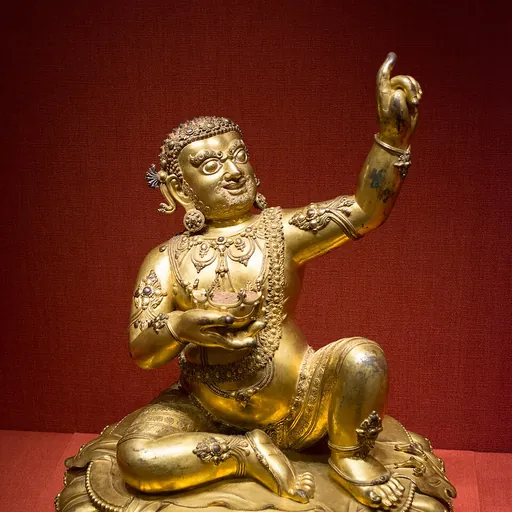
Virūpa, 16th century. It depicts a famous episode in his hagiography when he stopped the sun in the sky. Virupa (; Tib. bi ru pa or bir wa pa, ), also known as Virupaksa and Tutop Wangchuk, was an 8th–9th century Indian mahasiddha and yogi, and the source of important cycles of teachings in Vajrayana Buddhism.
Origin of Virupa/Birubapa
Virupa is especially known as the source of the Lamdré (Path–Fruit, Skt. mārga–phala) system held by the Sakya school, and is thus seen as the Indian founder of their lineage.
Tibetan sources mention that Virupa was born in Tripura in east India and studied at the Somapura Mahavihara as a monk, practicing tantra, particularly the Cakrasamvara. Alternatively, Indian sources such as the Navanathacaritramu claim that he was born in Maharashtra around the Konkan region to a pious Brahmin couple. The Tibetan historian Taranatha also says that Virupa lived in Maharashtra. He eventually left the monastery and traveled throughout India teaching tantra, performing various magical feats (siddhis) as well as "converting non-Buddhists (tirthikas), destroying their images and stopping their sanguinary rituals."
According to Indologist James Mallinson, a text called the Amṛtasiddhi, which is the earliest text known to teach Hatha yoga techniques, is attributed to Virupa. He also appears as a mahasiddha in various non-Buddhist texts, especially Nath works
Virupa/Birupa as a preaching guru The Buddhist monk Virubapa contributed the third poem in the list found in the Charyapada manuscript. It is claimed that he flourished during the reign of Devapala, from 810 to 850 A.D. Virubapa was supposed to have been born in the period when Devapala, the third king of the Pala dynasty, thrived. Devapala had succeeded in exerting influence in Bangla, the area adjacent to his kingdom, Tripura; this brought the monk Virubapa into close contact with the Sompura Mohavira at Paharpur, Bogura in Bangladesh—thus, his contact with the lower caste—like ‘Surini’, a lady who earned her living making and selling wines (p.13) —has been documented. The poem relates:
There is one female wine-seller. She enters into two houses. She ferments wine with fine barks (of trees) (ll. 1–2, p. 35). or the guide to be followed by the disciples. Perhaps this approach enabled composers of songs to have a connection with generations of followings and leading.
Dr. Muhammad Sahidullah also reports that Virubapa had for some time visited Paharpur Mohavira and stayed there to preach the theory of ‘Sahajayana’ and Paharpur Mohavira had a reputation as the abode and teaching place for Buddhist monks at the time of the Pala dynasty. This monastery was situated in the northwestern region of Bangladesh that kept close contact with the Tibetan Buddhist monks. Virubapa had a disciple, Dombipa, who is also the writer of the fourteenth song and thus the Buddhist cult of Sahajayana community extends through guru–disciple co-relational practices.
Don’t just read it —
keep it.
Full-length biographies made to live with: read them, listen on the way to work, watch them tonight.
- E-book
- Audio
- Video
Instant download · yours to keep · every purchase keeps this site free
Important facts
Related people
Same field, nearest in time





Contemporaries
People whose lives overlapped Virupa's


Frequently asked questions
Who was Virupa?
Indian religious teacher of the 9th century
When was Virupa born?
Virupa was born in 850.
When did Virupa die?
Virupa died in 999.
What was Virupa's occupation?
Virupa was a poet, yogi and mahasiddha.
Sources & further reading
Cite this page
APA: Biography.guide. (2026). Virupa. https://biography.guide/virupa/
MLA: "Virupa." Biography.guide, https://biography.guide/virupa/.
Chicago: "Virupa." Biography.guide. https://biography.guide/virupa/.
Data last updated: 2026-09-23 · Spot an error? Report a correction.
Portrait: Wikimedia Commons · author & licence
Page generated 2026-09-27 05:04 UTC