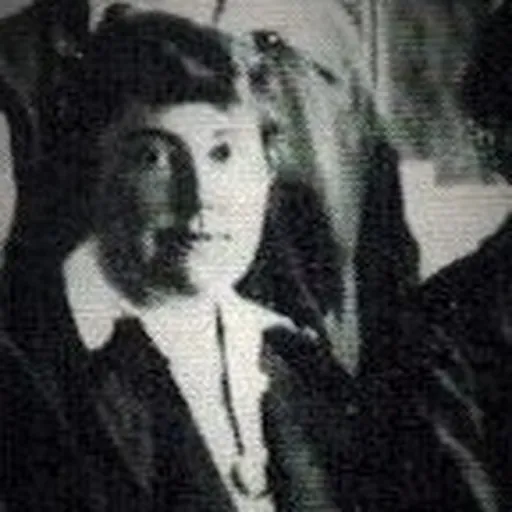
About Vera Ermolaeva
Lived 1893 – 1937 (aged 43). Vera Ermolaeva was a Russian painter, illustrator, draftsperson and graphic artist.
Vera Ermolaeva (November 2, 1893 – September 26, 1937) was a Russian painter, graphic artist and illustrator who participated in the Russian avant-garde movement. right Professors at the People's Art School in Vitebsk, July 26, 1919. From left to right: Lazar Lissitzky, Vera Ermolaeva, Marc Chagall, David Iakerson, Iouri Pen, Nina Kogan, Alexandre Romm.
Biography
Childhood and early life
Vera Mikhailovna Ermolaeva was born on November 2, 1893, in the village of Kliuchi in the Petrovsk uyezd of the Saratov Oblast (now – the Maloserdobinsky District of the Penza Oblast). Her father, Mikahil Sergeevich Ermolaev (1847-1911), was a landowner and served as chairman of the zemstvo county government. He also established a cooperative society called “The Labor Society,” and published a liberal journal called “Zhizn’” (Life) (1899 - 1901), in which writings by Lenin, Gorky, and others appeared. Her mother, Anna Vladimirovna, was born the Baroness of Ungern-Unkovskaia (1854 - ?).
As a child, Ermolaeva fell from a horse, an accident which crippled her legs and left her unable to walk without the aid of crutches. In 1902-3, her family traveled to Europe, where her parents consulted doctors about their daughter's condition. Ermolaeva studied in various schools in Paris, London, and Lausanne. This article has been translated into English and published in A. Povelikhina and Ye. Kovtun, Russian Painted Shop Signs and Avant-garde Artists (Leningrad, 1991), pp. 191–2.
She lived in an apartment on Basseinaia St., where artists and poets gathered. Maksim Gorky and Vladimir Mayakovsky both visited the apartment. Ermolaeva's illustrations for Segodnya publications include three works by Natan Vengrov (Myshata, Petukh, and Segodnia), all published in 1918. She also illustrated Pionery (1918), a Russian translation of a poem by Walt Whitman. The studio produced 13 publications.
Beginning in 1925, Ermolaeva created illustrations for children's books while working at DETGIZ, the Children's Division of the State Publishing House. She illustrated such books as “Top-top-top” (1925) by Nikolai Aseev, “Mnogo zverei” and “Rybaki” by Alexander Vvedensky, "Poezd" by Evgeny Schwartz (1929), “10 fokusov Chudodeeva“ (1929) by M. Il’in, "Ivan Ivanych Samovar” by Daniil Kharms (1930) and many others.
From 1929 to 1931, she illustrated a series of 12 books based on Ivan Krylov’s fables. These books include "Dve sobaki (Two Dogs)" and "Lzhets (The Liar)".
Ermolaeva also created children's books for which she both wrote the text and created the illustrations. These include: “Vnizu po Nilu” and “Sobachki (Doggies).”
With Iudin, she created a new type of picture book for children. These include: “Kto kogo?” and “Bumaga i nozhnitsy.”
Vitebsk Art School
In April 1919, the Visual Arts Department (IZO) of Nakompros sent Ermolaeva to Vitebsk to teach in the People's Art School. In November 1919, she invited Kazimir Malevich to come teach, as well. In 1921, after Mark Chagall departed, she became the school's director. Together with Malevich and his students, Ermolaeva developed the organization UNOVIS (Creators of the new art) – a society that positioned itself as a research laboratory focused on the development of art and artistic form. In 1920 and 1921, Ermolaeva's work was shown at UNOVIS exhibits in Moscow and in 1922 in Berlin.
State Institute of Artistic Culture
Following her return to Petrograd, Ermolaeva led the “color laboratory” in the State Institute of Artistic Culture (GINKHUK), which existed from 1923 – 1926. Malevich, Tatlin, Matiushin, Mansurov, and Punin were heads of departments there. Her relationship with Malevich weakened after GINKHUK ceased to operate in 1926.
Late 1920s – early 1930s
Illustraltion by Ermolayeva to De rerum natura by Lucretius, 1934She became associated with the “Association of Real Art” (Oberiu), which included A. Vvedensky, N. Zabolotsky, Oleinikov, and Daniil Kharms.
In the summer of 1928, she traveled along the shores of the Barents Sea with the artist P. V. Velikanova. She brought back a series of gouaches (see "gouache"). These gouaches impressed both Kharms and Vvedensky and inspired them to create literary works based on Ermolaeva's works.
Ermolaeva's gouaches of 1928 include: “Seated woman,” “Three Figures,” “Accordionist,” and “Ballerina.” According to Ev. Kovtun, these show the influence of cubism, particularly Braque.
In the early 1930s, Ermolaeva shifted her focus from children's books to books for adults, particularly works with a philosophical, epic bent. She illustrated Goethe’s Reynard the Fox and Cervantes’s Don Quixote. Her last book illustrations consisted of a series of gouaches inspired by Lucretius’ On the Nature of Things.
Exhibitions Source:
"Revolution and Art" (1920, Vitebsk)
Exhibitions of UNOVIS (1920, 1921, Moscow)
"The First Russian Art Exhibition" (1922, Berlin)
"The Exhibition of Paintings by Petrograd Artists [representing] All Movements from 1918-1923" (1923. Petrograd)
Exhibition of GINKHUK (1924, Petrograd)
Exhibition of the Research Departments of GINKHUK (1926, Leningrad)
"Graphic and Book Art of the USSR" (1929, Amsterdam)
"Artists of the RSFSR of the last 15 years" (1932, 1933; Leningrad, Moscow)
"The Woman in Socialist Realist Construction" (1934, Leningrad)
"Leningrad in the Works of Contemporary Artists" (1934, Leningrad)
Posthumous exhibitions Artworks of Vera Ermolaeva at the State Russian Museum in St. Petersburg, Russia (August 7, 2008 – September 30, 2008)
Vera Ermolaeva Foundation of Contemporary Feminist Art Initiatives
In Moscow, in 2013, the Vera Ermolaeva Foundation was established in her name; it is dedicated solely to the support of feminist initiatives in contemporary art.
Don’t just read it —
keep it.
Full-length biographies made to live with: read them, listen on the way to work, watch them tonight.
- E-book
- Audio
- Video
Instant download · yours to keep · every purchase keeps this site free
Important facts
People in Vera Ermolaeva's life
Named in this biography and alive at the same time




Related people
Same field, nearest in time

Contemporaries
People whose lives overlapped Vera Ermolaeva's




Frequently asked questions
Who was Vera Ermolaeva?
Russian painter (1893–1937)
When was Vera Ermolaeva born?
Vera Ermolaeva was born on 2 November 1893 in Klyuchi.
When did Vera Ermolaeva die?
Vera Ermolaeva died on 26 September 1937 in Karlag.
What was Vera Ermolaeva's occupation?
Vera Ermolaeva was a painter, illustrator, draftsperson and graphic artist.
What nationality was Vera Ermolaeva?
Vera Ermolaeva was Russian.
Sources & further reading
Cite this page
APA: Biography.guide. (2026). Vera Ermolaeva. https://biography.guide/vera-ermolaeva/
MLA: "Vera Ermolaeva." Biography.guide, https://biography.guide/vera-ermolaeva/.
Chicago: "Vera Ermolaeva." Biography.guide. https://biography.guide/vera-ermolaeva/.
Data last updated: 2026-09-23 · Spot an error? Report a correction.
Portrait: Wikimedia Commons · author & licence
Page generated 2026-09-27 05:05 UTC