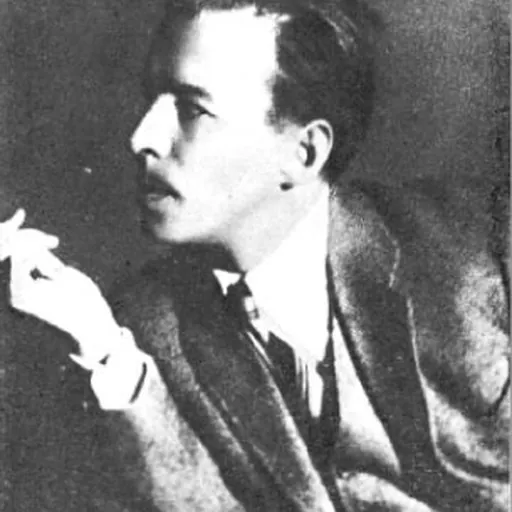
About Nikolai Aseev
Lived 1889 – 1963 (aged 74). Nikolai Aseev was a Russian poet, translator, science fiction writer, writer, architect and furniture designer.
Nikolai Nikolayevich Aseyev (; July 10, 1889 - July 16, 1963) was a Russian and Soviet Futurist poet and writer.
Biography Aseyev was born in the city of Lgov in the region of Kursk. He studied a technical school in the city and had also attended the Moscow Institute of Commerce.
His mother died before he was eight, and he was raised in part by his maternal grandfather. After graduating from the Kursk Real School in 1907, Aseyev studied at the Moscow Commercial Institute and later at the history and philology faculties of Moscow and Kharkov universities. In 1914, he co-founded the poetry circle Lirika with Sergei Bobrov and Boris Pasternak, and became a member of the Futurist group Centrifuga. Drafted in 1915, he was discharged due to tuberculosis. During the Russian Civil War, he lived in the Far East, where he worked alongside Sergei Tretyakov and David Burliuk in the literary group Tvorchestvo ("Creativity"). In 1922, he was called to Moscow by Anatoly Lunacharsky and became a core member of the LEF (Left Front of the Arts) group, which he helped lead from 1923 to 1928.
Works In 1914, his first poetic collections, "Night Flute" (Nochnaia fleita) and "Zor", which were written in the Russian Futurist style, were published. The former also reflected traces of Russian Symbolism. He was also one of those who contributed to the Soviet and American reconciliation narrative. He once wrote the Americans, "You have Abraham, we have a Joseph... let's make a new Bible."
Aseyev's long poem Mayakovsky Begins (Маяковский начинается, 1940) was a biographical work about his friend and fellow Futurist Vladimir Mayakovsky. It received the Stalin Prize, first class, in 1941. His popular verse "Budyonny March" (1922), set to music, became a widely known Soviet song. Aseyev died in Moscow on 16 July 1963 and was buried at Novodevichy Cemetery.
Don’t just read it —
keep it.
Full-length biographies made to live with: read them, listen on the way to work, watch them tonight.
- E-book
- Audio
- Video
Instant download · yours to keep · every purchase keeps this site free
Important facts
People in Nikolai Aseev's life
Named in this biography and alive at the same time


Related people
Same field, nearest in time

Contemporaries
People whose lives overlapped Nikolai Aseev's



Frequently asked questions
Who was Nikolai Aseev?
Russian poet (1889–1963)
When was Nikolai Aseev born?
Nikolai Aseev was born on 28 June 1889 in Lgov.
When did Nikolai Aseev die?
Nikolai Aseev died on 16 July 1963 in Moscow.
What was Nikolai Aseev's occupation?
Nikolai Aseev was a poet, translator, science fiction writer, writer, architect and furniture designer.
What nationality was Nikolai Aseev?
Nikolai Aseev was Russian.
Sources & further reading
Cite this page
APA: Biography.guide. (2026). Nikolai Aseev. https://biography.guide/nikolai-aseev/
MLA: "Nikolai Aseev." Biography.guide, https://biography.guide/nikolai-aseev/.
Chicago: "Nikolai Aseev." Biography.guide. https://biography.guide/nikolai-aseev/.
Data last updated: 2026-09-22 · Spot an error? Report a correction.
Portrait: Wikimedia Commons · author & licence
Page generated 2026-09-27 05:04 UTC