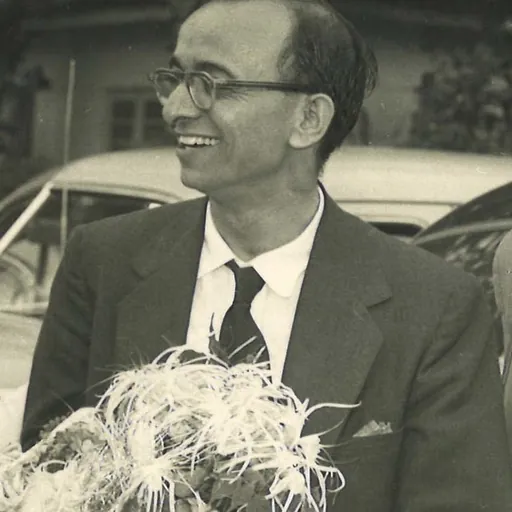
About Umashankar Joshi
Lived 1911 – 1988 (aged 77). Umashankar Joshi was an Indian politician, poet, writer, journalist and literary critic.
Umashankar Jethalal Joshi (21 July 1911 – 19 December 1988) was an Indian poet, scholar and writer known for his contributions to Gujarati literature. He wrote most of his works in Gujarati.
Biography
Early years Umashankar Joshi was born to Jethalal Kamalji and Navalbai in a small village named Bamna (now in Bhiloda Taluka of Aravalli district, Gujarat). He had eight siblings including six brothers and two sisters.
Umashankar Joshi's father, Jethalal who worked as a Karbhari of several Jagirs, wanted his sons to get an English education. In 1916, Joshi started his education at Primary school in Bamna and spent two years in 4th standard due to the absence of the teacher for a long time. Upon learning this Jethalal joined Joshi in Sir Pratap High School of Idar. As a boy who was raised in an orthodox environment, Joshi always heard "highly sensitive and expressive language" which shaped his future style, especially in writing plays. As a child, he had excursions to hilly areas of Aravalli and visits to colorful monsoon fairs in and around Bamna. This village life left a profound impact on his language and developed "lyrical vein" in him. The earliest of his published poems was written when Joshi was 17 when he had just completed matriculation and joined Gujarat college. Joshi along with two other friends climbed Mount Abu, the highest peak in the Aravalli mountain range to watch the moon rise over Nakki Lake on the mountain. After a joyous journey to the hilltop, the autumnal fall moon and the lake inspired Joshi to write his first-ever published poem. In 1934, Umashankar referred to Sundaram that "We are twin brothers. In the fulfilment of our creative urge, the Gujarati language has perhaps conspired to tie us together at its very root without our knowledge of it". This collaboration has a lasting impact on their philosophy and style.
Joshi's father died in 1934. Civil disobedience movement was called off by Mahatma Gandhi. Joshi joined Elphinstone College to continue his studies. By the time he joined Elphinstone College to pursue Graduation in arts, his works were in the school curriculum and he became established writer in Gujarati literature. In 1934, Gangotri, the anthology of Joshi's poems written during 1932-34 was published. In 1936, Joshi started writing one-act plays and published them in a collection called Sapna Bharathi. These works were popular on stage. In 1936, he took active part in establishing "Progressive writers' association".
Academic career and marriage On 25 May 1937, he married Jyotsna N. Joshi in Ahmedabad. He got a job as a teacher at Goklibai High school, Mumbai in 1937. He passed Master of Arts with Gujarati and Sanskrit subjects in First class at Mumbai University. He started working as a part-time lecturer at Sydenham College of Commerce, Mumbai. In 1939, he was appointed in Gujarat Vidyasabha as a professor in the postgraduate research studies department. Umashankar Joshi along with his wife Jyotsna Joshi started "Gangotri Trust" in 1955 which was intended to support the publication of "Sanskriti". The trust also undertook a project of translating texts from Indian and foreign languages into Gujarati with the support from ‘Nisheeth Purskar Granth Mala’. Bombay State government appointed him as member of Gujarati textbook committee in 1948. In 1953, he served as a visiting faculty at Lokbharti Shikshan Sanstha which was an educational institution in Sanosara, Bhavnagar district, Gujarat. In June, he was appointed professor of Gujarati literature at Gujarat University. He was also appointed the head of School of languages in that university. Joshi continued to work in the same university until his retirement in 1972. Indra Nath Choudhuri proposed this "manifestation of notes of despair emerging from sense of helplessness" is part of a wider phenomenon seen in Indian poets from the mid-1950s like Faiz Ahmad Faiz (Urdu), Jibanananda Das, Navakanta Barua, Agyeya, etc. Although his literature from the post-1950s started expressing disparity it also possesses the values of unity of humankind and peace that he expressed in the early 30s.
Old age, awards, and death
Umashankar Joshi received the Jnanpith Award for his work Nishanth along with Kannada poet K.V.Puttapa (for Ramayana Darsana) in 1967. In his acceptance speech, Umashankar Joshi reiterated his belief about Unity of national identity and world-mindedness by saying "What goes into the making of an Indian poet in the present-day world? His sharing the global anxiety and agony too. Paradoxically enough, the more world minded he is, the more Indian he will be, as one could see in the case of Tagore."
In 1970, Joshi was nominated to Rajya Sabha. Joshi became president of the Jnanpith Award committee in 1976 and Sahitya Akademi in 1978. He continued in the position of president of Sahitya Akademi from 1978 to 1983.
In 1988, he was admitted with lung cancer to Tata Memorial Hospital, Mumbai. He died on 19 December 1988 at the age of 77.
List of works His works include: Nishith ( નિશિથ ) – The God of Midnight (collection of poems) Gangotri ( ગંગોત્રી ) Vishwashanti ( વિશ્વશાંતિ ) – World Peace Mahaprasthan ( મહાપ્રસ્થાન ) – Great Departure Abhigna ( અભિજ્ઞ ) – Recognition. Sanskruti – Editor of the magazine Visamo – collection of stories Haveli – collection of dramas Shravani Melo – collection of stories Akho : Ek Adhyayan "Shakuntal"- translation of Abhigyan Shakuntal of Kalidas "Uttar Ramcharit"- translation of Uttar Ramcharit of Bhavbhooti "Ishavaya Upanishad"- translation and commentary in Gujarati. "Gujarat Mori Mori Re" Mahaprasthan in Hindi translated by Mahavir Sinh Chauhan in 1997
Influence and legacy
In Urdu literary journal Naya Adab, Ibham Rasheed called Joshi one of great writers of India and added that his "prose and poem delve into a space that tempts humans for deception and barbarity". Bholabhai Patel, a notable Gujarati writer and academician, was one of the students of Joshi in Gujarat University. Interaction and association with Joshi acted as touchstone for literary taste in Bholabhai Patel.
Awards Jnanpith Award – 1968 for Nishith, a collection of his poems. Ranjitram Suvarna Chandrak – 1939
Don’t just read it —
keep it.
Full-length biographies made to live with: read them, listen on the way to work, watch them tonight.
- E-book
- Audio
- Video
Instant download · yours to keep · every purchase keeps this site free
Important facts
People in Umashankar Joshi's life
Named in this biography and alive at the same time

Related people
Same field, nearest in time






Contemporaries
People whose lives overlapped Umashankar Joshi's





Frequently asked questions
Who was Umashankar Joshi?
Gujarati poet, scholar and writer. (1911-1988)
When was Umashankar Joshi born?
Umashankar Joshi was born on 21 July 1911 in Bamna.
When did Umashankar Joshi die?
Umashankar Joshi died on 19 December 1988 in Mumbai.
What was Umashankar Joshi's occupation?
Umashankar Joshi was a politician, poet, writer, journalist and literary critic.
What nationality was Umashankar Joshi?
Umashankar Joshi was Indian.
Sources & further reading
Cite this page
APA: Biography.guide. (2026). Umashankar Joshi. https://biography.guide/umashankar-joshi/
MLA: "Umashankar Joshi." Biography.guide, https://biography.guide/umashankar-joshi/.
Chicago: "Umashankar Joshi." Biography.guide. https://biography.guide/umashankar-joshi/.
Data last updated: 2026-09-22 · Spot an error? Report a correction.
Portrait: Wikimedia Commons · author & licence
Page generated 2026-09-27 05:01 UTC