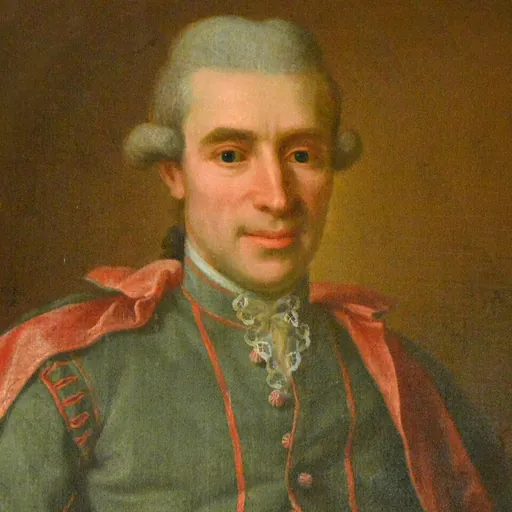
About Torbern Bergman
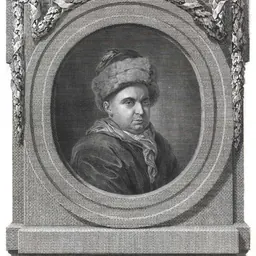
Lived 1735 – 1784 (aged 49). Torbern Bergman was a Swedish chemist, university teacher, entomologist and mineralogist, known for Chemical affinity.
Torbern Olof Bergman (KVO) (20 March 17358 July 1784) was a Swedish chemist and mineralogist noted for his 1775 Dissertation on Elective Attractions, containing the largest chemical affinity tables ever published. Bergman was the first chemist to use the A, B, C, etc., system of notation for chemical species.
Early life and education Torbern was born on 20 March 1735, the son of Barthold Bergman and Sara Hägg. He enrolled at the University of Uppsala at age 17. His father wished him to hear either law or divinity, while he himself was anxious to study mathematics and natural science; in the effort to please both himself and his father, he overworked himself and harmed his health. During a period of enforced abstinence from study, he amused himself with field botany and entomology. He was able to send Linnaeus specimens of several new kinds of insects, and in 1756 he succeeded in proving that, contrary to the opinion of that naturalist, the so-called Coccus aquaticus was really the ovum of a kind of leech. He returned to the university in 1758, and received his PhD in that year.
Career
Bergman lectured at the University of Uppsala on physics and mathematics, publishing papers on the rainbow, the aurora, the pyroelectric phenomena of tourmaline. Upon the resignation of the celebrated Johan Wallerius, Bergman was a candidate for the professorship of chemistry and mineralogy. His competitors charged him with ignorance of the subject, because he had never written on it. To refute them, he shut himself up for some time in a laboratory, and prepared a treatise on the manufacture of alum, which became a standard work. Thanks to the influence of Gustav III, then crown prince and chancellor of the university, he was appointed a professor of chemistry, and remained at this position for the rest of his life.
Bergman greatly contributed to the advancement of quantitative analysis, and he developed a mineral classification scheme based on chemical characteristics and appearance. He is noted for his research on the chemistry of metals, especially bismuth and nickel.
In 1764, Bergman was elected a member of the Royal Swedish Academy of Sciences. In April 1765 he was elected a Fellow of the Royal Society of London. In 1773 he was elected a member of the American Philosophical Society. In March 1782, he was elected Foreign Associate of the French Academy of Sciences.
In 1771, six years after he first discovered carbonated water and four years after Joseph Priestley first created artificially carbonated water, Bergman perfected a process to make carbonated water from chalk by the action of sulphuric acid. He is also noted for his sponsorship of Carl Wilhelm Scheele, whom some deem to be Bergman's "greatest discovery". The translation into English of his book Physical and Chemical Essays was read widely and regarded as the first systematic method of chemical analysis.
Personal life In 1771, Bergman married Margareta Catharina Trast.
Legacy In Bergman's honour, the uranium mineral torbernite and the lunar crater Bergman both bear his name.
Works
Tekniska Museet
Don’t just read it —
keep it.
Full-length biographies made to live with: read them, listen on the way to work, watch them tonight.
- E-book
- Audio
- Video
Instant download · yours to keep · every purchase keeps this site free
Important facts
People in Torbern Bergman's life
Named in this biography and alive at the same time

Related people
Same field, nearest in time



Contemporaries
People whose lives overlapped Torbern Bergman's





Frequently asked questions
Who was Torbern Bergman?
Swedish chemist (1735-1784)
When was Torbern Bergman born?
Torbern Bergman was born on 20 March 1735 in Låstads parish, Mariestad Municipality.
When did Torbern Bergman die?
Torbern Bergman died on 8 July 1784 in Västra Ny församling, Medevi.
What was Torbern Bergman's occupation?
Torbern Bergman was a chemist, university teacher, entomologist and mineralogist.
What was Torbern Bergman known for?
Torbern Bergman was known for Chemical affinity.
What nationality was Torbern Bergman?
Torbern Bergman was Swedish.
Sources & further reading
Cite this page
APA: Biography.guide. (2026). Torbern Bergman. https://biography.guide/torbern-bergman/
MLA: "Torbern Bergman." Biography.guide, https://biography.guide/torbern-bergman/.
Chicago: "Torbern Bergman." Biography.guide. https://biography.guide/torbern-bergman/.
Data last updated: 2026-09-22 · Spot an error? Report a correction.
Portrait: Wikimedia Commons · author & licence
Page generated 2026-09-27 05:02 UTC