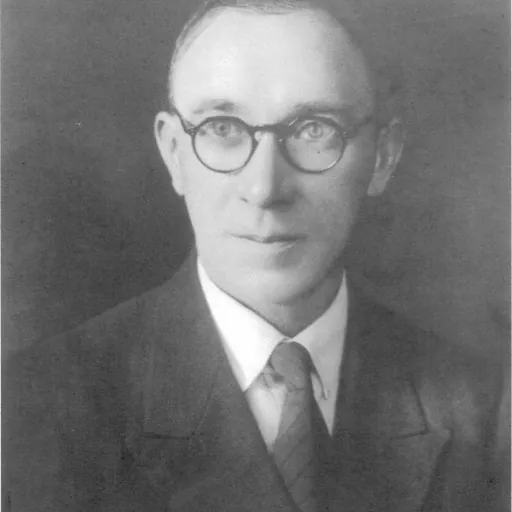
About Timothy J. Murphy
Lived 1893 – 1949 (aged 55). Timothy J. Murphy was an Irish politician.
Timothy Joseph Murphy (17 July 1893 – 29 April 1949) was an Irish Labour Party politician who served as Minister for Local Government from 1948 to 1949. He served as a Teachta Dála (TD) for the Cork West constituency from 1923 to 1949.
Early life Known as 'TJ', he was born in Clondrohid, County Cork, son of Timothy Murphy, carpenter, and Mary Murphy (née Shea). He moved to Dunmanway, County Cork around 1920, having been earlier educated at the Clondrohid and Macroom National Schools.
Politician Trade unionist By 1922, he became branch Secretary of the Dunmanway ITGWU. His was also involved in local politics and had a role in the election of fellow ITGWU activist in Dunmanway, Michael Bradley, to the Dáil in the 1922 general election.
He expanded the role of 'labour clubs' and was involved in the formation of virtually every Labour Club between 1926 and the early 1930s.
TD and councillor (1923–1949) Following Bradley's death in 1922, he contested the selection convention for the 1923 general election. At the Labour Party selection convention two Timothy Murphy's were nominated with the Dunmanway Murphy winning out by one vote over Timothy from Clonakilty.
He was first elected to Dáil Éireann at the 1923 general election as a Labour Party TD for Cork West. He was re-elected for this constituency as a Labour Party TD at the next nine general elections, until his death, but remained on the opposition benches of the Dáil until 1948 when the Labour Party joined the First Inter-Party Government. The Taoiseach John A. Costello then appointed him as Minister for Local Government in February of that year. from 1925, representing the Dunmanway local electoral area (1925–42) and the Skibereen local electoral area from 1942 until his resignation from the council in July 1948. He served on a number of county council committees and as vice-chairman and Chairman of the council, and was also a member of the West Cork board of public assistance and public health.
Michael O'Riordan controversy (1944) Murphy has been described as having been involved in the controversy surrounding the Liam Mellow branch of the Labour Party and Michael O'Riordan. A report in The Irish Press suggested that the Administrative Council had become aware that certain persons in Cork were engaging in activities which appear to be inconsistent with their membership of the Labour Party and they appointed a subcommittee to investigate the membership and administration of the Liam Mellows Branch. This was headed up by Murphy as vice-chair. They heard the complaint against O'Riordan and Nagle being present at the (NI) Communist Party conference. Following an investigation, the two Cork members were expelled on 5 February 1944 and the 4 Dublin members in April. O'Riordan would later accuse Murphy of "red-baiting".
Cabinet: Minister for Local Government (1948–1949) Local Authority Manager Philip Monahan told Cork Corporation in 1948 that an experiment to build houses by direct labour had been suggested by Murphy. To proceed with the direct labour experiment, the City Manager was in the process of appointing an assistant architect, a draughtsman, an assistant engineer and a foreman. Concurrently, Monahan had decided to build other houses by contract so that the corporation could then decide if one method was superior to the other. A deputation of the Cork Regional Branch of the Federation of Builders, Contractors and Allied Employers of Ireland appeared before the meeting to protest this direct labour policy, but the Corporation agreed to proceed with the project as outlined by the City Manager.
Death Murphy died suddenly in 1949, while speaking at an Inter-Party public meeting at Pearse Square, Fermoy, He was buried in Dunmanway Cemetery.
Legacy An area of Murphy's home town of Dunmanway today bears the name "T.J. Murphy Place".
Don’t just read it —
keep it.
Full-length biographies made to live with: read them, listen on the way to work, watch them tonight.
- E-book
- Audio
- Video
Instant download · yours to keep · every purchase keeps this site free
Important facts
People in Timothy J. Murphy's life
Named in this biography and alive at the same time




Related people
Same field, nearest in time





Contemporaries
People whose lives overlapped Timothy J. Murphy's


Frequently asked questions
Who was Timothy J. Murphy?
Irish politician (1893-1949)
When was Timothy J. Murphy born?
Timothy J. Murphy was born on 17 July 1893 in Clondrohid.
When did Timothy J. Murphy die?
Timothy J. Murphy died on 29 April 1949 in Fermoy.
What was Timothy J. Murphy's occupation?
Timothy J. Murphy was a politician.
What nationality was Timothy J. Murphy?
Timothy J. Murphy was Irish.
Sources & further reading
· Wikipedia: Timothy J. Murphy
Cite this page
APA: Biography.guide. (2026). Timothy J. Murphy. https://biography.guide/timothy-j-murphy/
MLA: "Timothy J. Murphy." Biography.guide, https://biography.guide/timothy-j-murphy/.
Chicago: "Timothy J. Murphy." Biography.guide. https://biography.guide/timothy-j-murphy/.
Data last updated: 2026-09-22 · Spot an error? Report a correction.
Portrait: Wikimedia Commons · author & licence
Page generated 2026-09-27 05:02 UTC