
About Tikashi Fukushima
Lived 1920 – 2001 (aged 81). Tikashi Fukushima was a Japanese painter.
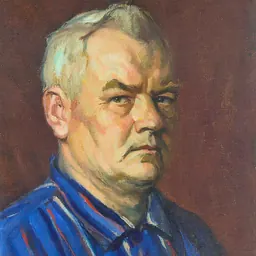
Tikashi Fukushima (Sōma, January 19, 1920 - São Paulo, October 14, 2001 ) was a Japanese-Brazilian painter and printmaker. Considered one of the most important abstractionists in Brazil, Fukushima also produced several works in the field of figurativism throughout his career. The artist has received various positive reviews from numerous important art critics for both his abstractionist and figurative productions. Fukushima belongs to the pre-war immigrant generation, composed of common immigrants who, after several changes in their lives, awakened to the arts. His master was Tadashi Kaminagai, whom Fukushima saw as a mentor, but who had a different style of painting than the one he later developed. Tikashi's works have been presented in national and international exhibitions.
Fukushima participated in artistic groups, such as Seibi-kai and Grupo Guanabara, having contact with numerous painters, including many of Japanese origin. The artist was honored with multiple titles and awards, and many of his works were acquired by important collectors in Brazil and other countries. In addition, he was a member of the Arts Commission of the Brazil-Japan Fine Arts Foundation, president of the Arts Commission of the Brazilian Society of Japanese Culture, and president of the Japanese-Brazilian Art Museum. He also received the decoration called the Order of the Sacred Treasure, in 1997.
Biography
Early years In his youth, Fukushima worked on a farm and in a warehouse. He finished high school and moved to Yokohama, near Tokyo, where he was a draftsman in an airplane factory for two years. Thus, he disembarked in the port of Santos and went to the countryside of the state of São Paulo, first to Pompeia and then to Lins, where he met Manabu Mabe. and both were determined to be painters; Mabe worked in the fields and painted when it rained.
Tikashi began working in a warehouse and in his free time devoted himself to drawing, making copies from photographs, In 1945, living in São Paulo and working in a workshop, he was introduced by his boss to a well-known painter, Tadashi Kaminagai, who at that time needed an assistant in a frame workshop in Rio de Janeiro. Thus, Fukushima agreed to work for Kaminagai and in 1946 he moved to Santa Teresa, Rio de Janeiro. Before the first painting made by the artist in 1946, Tikashi made drawings using graphite on paper. According to his son, Takashi, "When he arrived in Brazil, he had not yet carried out any artistic activities."
At this time, he had contact with several artists, such as Milton Dacosta, Inimá de Paula, Quirino Campofiorito, Van Rogger, and Di Cavalcanti, and began to attend the National School of Fine Arts in 1942, where he audited courses. Tikashi began to improve his techniques of "dessin", which consists of drawing the lines and outlines of objects and human figures, making several nude studies. In 1947, he participated in the 52nd National Fine Arts Salon, where he stated: "Excellent artists are the Japanese without a doubt. If they do not amaze with their genius, they never disappoint. This 'Paisagem ' by Fukushima is a document of good taste, of the right composition, of good color, worked with appreciable artistic refinement." Fukushima continued participating in the National Salon of Fine Arts until 1964. The Seibi-kai as were schools and associations where immigrants gathered.
The sale of Fukushima's works, like those of many other artists, helped to raise funds to ensure the continuity of the salons of the Seibi-kai, which were held annually. Fukushima's wife, Ai, was depicted in numerous drawings and paintings and accompanied the artist to meetings and trips. Since Tikashi did not speak Portuguese well and Ai did, she played an important role by being a channel of communication for her husband with Brazilians. According to his daughter, Elly, when Fukushima was not known as a painter, Ai was the one who supported the household by making clothes.
1950's Tikashi Fukushima's painting in the 1950s was "deeply marked by gesture, rhythm, and spirituality." Takashi's first contact with the arts was passed on by Tikashi in his home.
In the same year, Tikashi held a solo exhibition at Club Linense in São Paulo. He also participated in the Paulista Fine Arts Salon, together with other artists of Seibi-kai, helping organize the 1st Seibi Salon, where he won the silver medal. The artist knew the importance of holding this exhibition, as he realized that the complete restructuring of the movement and the appearance of new values would only be leveraged by holding an exhibition with awards for works by Japanese and Japanese-Brazilian artists. Seibi-kai's objective was to encourage the growth of the fine arts among the Japanese through monthly sessions of discussion, commentary and criticism, exchange with artists from Brazil and Japan, as well as holding exhibitions. Still in 1950, Fukishima also cooperated in organizing the first exhibition of the Guanabara group, at Galeria Domus. Ibiapaba Martins wrote in the Correio Paulistano that the "exhibition that cannot be missed by those who appreciate painting is the one at Galeria Domus."
In the days of the Guanabara Group, Tikashi and the other members would go out to make records of the churches, houses, factories, and streets of various neighborhoods in São Paulo. According to Arcangelo Ianelli:
However, Tikashi did not portray the city exactly as it was, he made modifications and even said, "I did not see much fun in portraying reality like in a photograph, I liked to deconstruct, simplify and dismantle the forms." According to his son, this way of painting without worrying about portraying the landscapes as they were, "were the steps towards saying goodbye to figurativism."
In 1951, Tikashi participated in the 1st São Paulo Art Biennial with work No. 81 "Paisagem". From that moment on, he felt his works became influential, In the same year, the second exhibition of the Guanabara group was held at the Institute of Architects of Brazil, in São Paulo Still in 1953, he participated in two National Salons, the Paulista and the Rio, and the third exhibition of the Guanabara Group was held at the Fukushima Gallery. Excluded, Fukushima realized that he should be more attentive to the changes of the concrete art movement and the new trends of the abstract.
In 1954, Tikashi was awarded a prize at the 19th Paulista Fine Arts Salon and exhibited in the Preto e Branco Salon. The following year, his work was shown at the 3rd São Paulo Art Biennial and the 4th Paulista Modern Art Salon. In 1956, he participated in the 5th National Salon of Modern Art, in Rio de Janeiro, at the 6th Baiano Salon of Fine Arts, in Salvador, and at the 20th Paulista Salon of Fine Arts, where he received the silver medal. The following year, 1957, he participated in the 6th National Hall of Modern Art, in the Santista Hall of Fine Arts, where he received the silver medal, and in the 21st Paulista Hall of Fine Arts, where he received the 1st Mayor of São Paulo Award. This exhibition was the artist's detachment from the figurative movement. In fact, this itinerant show was named by the artist "The Exhibition of Farewell to Figurativism,"
Ivo Zanini describes Fukushima's transition from figurativism to abstractionism as follows: "For several years (from 1946 to 1960) he moved through figurativism, when he founded in São Paulo, in the neighborhood of Paraíso, the Guanabara Group, which brought together artists already in full coexistence with the oscillations of modern art" and continues, exemplifying the themes of the paintings:
In the book Life and Art of the Japanese in Brazil ("Vida e Arte dos Japoneses no Brasil"), Cecília França Lourenço describes the use of geometry and abstractionism by Japanese-Brazilian artists as a response to a "vital and even cultural impulse, more easily identified with a gesture, stain, and formal research, and therefore an inexhaustible source revitalized through experience". Artists such as Mabe and Tikashi Fukushima were able to contribute decisively to the development of this abstract trend, In fact, abstractionism is where the most important and most productive phase of their work can be found. in the Diário da Noite: "the critics could learn from the group exhibition of the Grupo Guanabara something about painting." The works were also in the 4th Group Seibi of Artists Salon, where he won the great gold medal, and in the 7th Paulista Salon of Modern Art, in the gallery Prestes Maia, where Tikashi won the small silver medal. Regarding the latter, the journalist and critic Aracy Amaral, who later became professor of Art History at the University of São Paulo, observes: "Oriental by excellence, Fukushima expresses himself with all the refinement of the art of his people. Matter is his main characteristic, of exceptional richness, with wonderful chromatic variations, using new or little used materials and techniques in our medium, achieving results of great beauty and poetry."
In 1959, Tikashi's work was shown at the Dallas Museum of Art, in Dallas, Texas, in the Grupo Guanabara's 5th exhibition, in the 8th São Paulo Modern Art Salon, where he won the great silver medal.
1960's Throughout the 1960s, one of the characteristics of Fukushima's painting is Japan; placing his memories and impressions of that country into his art. In 1960, he organized a solo exhibition in Campinas,
In 1961, Tikashi had two individual exhibitions, one at the Ambiente Gallery and the other at the Museum of Modern Art in São Paulo. The newspaper O Estado de S. Paulo, of February 25, 1961, published the opinion of the director of this museum: "His extreme virtuosity as a painter sometimes appears in all its strength, because one feels in this the pleasure of the virtuoso in overcoming difficulties". He also stated that "Fukushima has from his people and culture, the figure of detail, extreme virtuosity in finishes, and a refinement of sensibility" and ended by saying that "everything is overcome by the optimistic impetus, the perennial song of life that is the very essence of his painting." Also in February, Jornal do Brasil published a text by art critic Mário Pedrosa, in which he commented on the way Fukushima painted: "He works by first taking notes, which he ends up fixing on a point, from where sudden suggestions come to him. These then guide him in the course of the work. The idea, if it can be called an idea, comes to him on the spot. The forming and inspiring nucleus is always a finding of matter, which gives him the key to the work. Often this nucleus is no more than an impression of beautiful effect, like a blank stroke of light."
In March, the Museum of Modern Art held an exhibition with works by Fukushima and Samson Flexor, where the great difference in style between the two painters was highlighted. About the works, the following comment was made: "Twenty large canvases are offered to the visitor's examination, and in them, the varied scale of motifs, which, after all, are not motifs, as the painter denies... For the latter, each of the paintings has a name and a destiny, but in truth, they are only painting, and, as paintings, matter. Nothing more. Hence the astonishing serenity." In comparing Fukushima's painting with Flexor's, it was commented that the results were opposite, for while Flexor's painting showed restlessness, Fukushima's revealed "a great serenity."
In the same year, in group exhibitions, Tikashi participated in the 16th Fine Arts Salon of the City of Belo Horizonte, at the Pampulha Museum of Art, where he was awarded a prize. He also exhibited at the 10th Modern Art Salon of São Paulo, the 6th São Paulo Art Biennial, and the 6th Tokyo Biennial.
In 1962, the artist had a solo show at Galeria Astréia, São Paulo, of the Folha de S.Paulo was that: "Of course, a painter like Tikashi Fukushima guides himself by various guides. He attaches himself to pictorial conglomerates, surprises them in the fashion in vogue, and goes about making art according to how he observes and feels."
In 1963, Fukushima organized three individual exhibitions, two at Galeria La Rouche and another one at the Institute of Architects of Brazil, all of them in São Paulo. Group exhibitions were held at the Carlos Gomes Museum, at the 7th São Paulo Art Biennial, and at the 12th National Modern Art Salon, Rio de Janeiro, where he was awarded a trip across Brazil.
During the military dictatorship in Brazil, many artists showed restlessness, with surrealist tendencies, which demanded constant updating, but Tikashi preferred to delve into the abstractionist option. In 1964, he had his work presented in a solo exhibition in São Paulo, Cecília França Lourenço, in commenting on Tomie Ohtake's work, when she reached a level of maturity, compared the artist's work to that of Fukushima and Mabe, in the context that all three had "a certain restraint, without allowing the emotion of the work to be totally extravasated."
In the same year, in group exhibitions, Tikashi's work was presented in the exhibitions "The Emergent Decade: Latin American Painters and Paintings in the 1960's", at the Solomon R. Guggenheim Museum in New York; in the 1st Art Biennial in Salvador, Bahia; in the 10th Salon of the Seibi Group of Artists, in the Brazilian Society of Japanese Culture; at the Museum of Contemporary Art of the University of São Paulo, in the exhibition "Three Premisses", at the Museum of Brazilian Art of the Armando Álvares Penteado Foundation.
In 1969, Fukushima organized a solo exhibition in Rio de Janeiro, another one in Santos, When back in Brazil, he began to paint the Quatro Estações ("Four Seasons") series of abstracts, where he illustrated the mountains, the movement of the winds, and the waves of the sea of the island of Honshu, Japan.
In the same year, Tikashi held a solo exhibition in São Paulo. In the same year, Walter Zanini, who at the time was director of the Museum of Contemporary Art of the University of São Paulo, brother of the also critic Ivo Zanini, wrote about Fukushima's work stating: "using impressionistic means at first, he moved on to more conceptual painting, influenced by Cubism assimilated to the fanciful contemplativeness of his mind. He paved the way for a more intuitive and informal space where goldens, blacks, and especially greens and reds find the most delicate diapasons, associated and placed in complementary oppositions..."
1972 was the year that Seiki-kai ended its activities. In the same year a new artistic movement of the Japanese-Brazilian community was established and the artists continued their activities in the I Bunkyo Hall, coordinated by the Brazilian Society of Japanese Culture. In Tikashi's words "it was a way for us to perpetuate the movement." Fukushima lived for a period of time in Maryland, USA, where he made paintings in a rented studio. Still in 1972, Fukushima organized a solo exhibition at the Galeria Guignard, Belo Horizonte, and another at the Art Museum of the Americas, Washington D. C.
For the Folha de S.Paulo of November 19, 1972, in the article entitled "A good understanding of the Brazilian oriental system", Ivo Zanini described Fukushima as one who arrived in Brazil in a modest way and over the years "imposed his art and today is one of the most authentic and recognized of the group of Japanese who contribute to the development of art in our country". He described the relationship between father and son Takashi, who did not have the influence of his father in his paintings; Takashi, who was 22 years old at the time, had already been painting for three years without any pressure from Tikashi, the father being an abstractionist and the son a figurative artist. About Tikashi's works, Zanini comments on the time the artist spent in the United States, that Tikashi believed that his art had undergone changes and consequently had a good return on the sales of his paintings.
The following year, Fukushima organized a show in Rio de Janeiro
In the following year, Tikashi organized another solo exhibition in São Paulo,
In 1977, Fukushima was appointed president of the Fine Arts Commission of the Brazilian Society of Japanese Culture and remained in that position until 1990
In 1979, he became a member of the Arts Commission of the Brazil-Japan Foundation of Arts, In 1980, Tikashi's work was presented in the exhibition "Masters of Lyrical Abstractionism in Brazil." and although Tikashi acknowledged Kaminagai as his master, he denied that Kaminagai had influenced the way he painted. About this he said that "Kaminagai represents an intermediate phase between the figurative and the abstract, and happy and light colors were his favorite, while I always try to give sobriety and depth to my works with dark and dense colors." Collectively, in the same year, his work was present in the "6th Brazil-Japan Fine Arts Exhibition," which took place in the cities of Atami, Kyoto, Rio de Janeiro, São Paulo, and Tokyo. Fukushima's works have also been presented at the Paço Imperial, the São Paulo Museum of Art, and the Museum of Contemporary Art of the University of São Paulo. In the same year, his work was shown at the São Paulo Museum of Art, and the exhibitions "Times of War: International Hotel" and "Times of War: Mauá Pension." In the same year, he organized an exhibition at the André Art Gallery, in São Paulo, The magazine Veja of July 22, 1988, described Tikashi as "a master of intense colors", in which the "touch of the brush leaves its mark in the form of volume". The same issue emphasized that the "importance given to the work of Mabe, Fukushima, and Shiró attracted a new wave of Japanese artists to Brazil, who arrived in the country mature and with established aesthetic positions.
1990's The 1990s were the last decade that Fukushima produced new works. According to the opinion of Hélio Alves Neves, "today, in full maturity, Tikashi Fukushima feels fulfilled as an artist. First, for turning the evolution of his work into a school admired and respected in Brazil and abroad, and then, as a human being, for being able to express all his feelings through his brushes, charged with the emotions of the colors of his palette". About Fukushimas's painting, Neves also explained that: stated: "it was possible to gather works by the members of Grupo Guanabara and record their impressions offering a serious starting point for further studies."
In 1993, as a continuation of the exhibition "Figurativism/Abstraction: red in Brazilian painting", another exhibition was held in Campinas. In the same year, the artist's work was selected to be shown at the Pinacoteca do Estado de São Paulo. His works were also exhibited in the "Portuguese-Japanese-Brazilian Exhibition", at the Brazilian Art Museum at the Armando Álvares Penteado Foundation. In 1994, the painter's works were in group exhibitions, all held in the capital of the state of São Paulo. Outside the capital, his work was exhibited at the 1st Paulista Biennial of Contemporary Art, in Valinhos.
Still in 1995, Fukushima's work was present in two exhibitions in São Paulo, and a group exhibition at the Metropolitan Museum of Art in Curitiba. In the Portuguese capital, Lisbon, his work was shown at the Jerónimos Monastery. In the same year, his work was exhibited at the Museum of Contemporary Art at the University of São Paulo.
In 1998, Fukushima's work was shown at the Itinerant International Japan-Brazil Exhibition, which took place at the Clóvis Salgado Foundation - Palace of Arts, in Belo Horizonte, and at the Usiminas Cultural Center, in Ipatinga. He had his work presented in three group exhibitions in São Paulo. The following year, the "International Japan-Brazil Itinerant Exhibition" was held in Brasília at the Ministry of Foreign Affairs and also at the São Paulo Museum of Art. The exhibition "Daily Life/Art. Consumption - Metamorphosis of Consumption" was presented at the Itaú Cultural Center. According to him, the demand for works of art in Brazil was great, but the socio-economic inequality was huge, and buyers were limited to people of the wealthier class, companies, and public agencies. Still according to Hariu, artists such as Ohtake, Fukushima, Mabe, and others are recognized abstractionists, representatives of Brazil, who have many supporters, and live in Hariu's words, in "palaces." Tikashi once said, "I don't know why, but these paintings sell like water. It even looks like I'm manufacturing counterfeit bills!"
Later years In his later years, Tikashi was already suffering from Alzheimer's disease. In 2001 he had his last solo exhibition before his death, which was called "Fukushima by Fukushima", at the Pinacoteca do Estado de São Paulo. Collectively, his work was presented in an exhibition called "Japanese-Brazilian Art: Moment", at the Euroart Castelli Gallery in São Paulo. because the artist had the habit of spreading several red lines on the canvas. In his own words "they are the veins, the soul of the painting,". These lines ended up hidden, under other layers of paint.
Personal life Takashi Fukushima met Ai Saito, who had arrived in Brazil in 1934, when she was 12 years old. She grew up teaching dressmaking and tailoring. Her relatives had arranged a fiancé for her, through the miai, a Japanese custom of arranged marriages. Ai's suitor was a medical student, but while visiting an uncle she was introduced to Tikashi and from then on they began a relationship hidden from Ai's parents, as they wanted her to marry the then-medical student.
Legacy After his death, several exhibitions of his works were organized; in the year of his death, the exhibition "4 Decades" was organized in São Paulo at the Nova André Gallery. The following year his works were shown twice again at the gallery, the first exhibition being called "Beyond the Canvas" and the other The "Seven Bastions of Brazilian Abstractionism". which became law number 13.507 of January 8, 2003, naming a previously unnamed space located on Avenida Politécnica, Butantã district, as Tikashi Fukushima Square. The bill was passed on December 13, 2003.
In 2003, Tikashi's works were exhibited twice at the Museum of Contemporary Art of the University of São Paulo. The first exhibition was called "MAC USP 40 Years: Contemporary Interfaces" and the second "Artknowledge: USP 70 Years". The following year, at Prestes Maia Gallery, the exhibition called "Guanabara Group at Masp" was held, and in the same year, the exhibition "Gesture and Expression: the Informal Abstractionism in the JP Morgan Chase and MAM Collection" was organized at the São Paulo Museum of Modern Art. in the program "O mundo da arte"("The world of art"), which exhibited Tikashi's journey, making a retrospective of the artist, at the Pinacoteca de São Paulo, and showing all the phases of his production.
In 2008, Fukushima's work was exhibited along with works by other Japanese-Brazilian artists at the Bandeirantes Palace, in the exhibition called "Japanese presence in Brazilian art: from figuration to abstraction." From April 28 to December 30, 2012, the exhibition was held at the Pinacoteca do Estado de São Paulo, called "São Paulo, an immigrant look," with about 30 works by Tikashi and other artists from the period of 1893 to 1980.
Collections Fukushima's work is part of important collections in Brazil and abroad, including:
Rockefeller Collection Roberto Marinho Collection V+R Sapoznik collection Japanese Embassy, Brasília MOA Museum of Art, Japan Museum of Contemporary Art, USP Museum of Art, Belo Horizonte Modern Art Museum of Brasília Modern Art Museum of Curitiba Porto Alegre Museum of Modern Art Rio de Janeiro Museum of Modern Art Museum of Modern Art of Latin America, Washington Imperial Palace, Tokyo Pinacoteca do Estado de São Paulo
Don’t just read it —
keep it.
Full-length biographies made to live with: read them, listen on the way to work, watch them tonight.
- E-book
- Audio
- Video
Instant download · yours to keep · every purchase keeps this site free
Important facts
People in Tikashi Fukushima's life
Named in this biography and alive at the same time


Related people
Same field, nearest in time

Contemporaries
People whose lives overlapped Tikashi Fukushima's





Frequently asked questions
Who was Tikashi Fukushima?
Japanese painter (1920-2001)
When was Tikashi Fukushima born?
Tikashi Fukushima was born on 19 January 1920 in Sōma-shi.
When did Tikashi Fukushima die?
Tikashi Fukushima died on 14 October 2001 in São Paulo.
What was Tikashi Fukushima's occupation?
Tikashi Fukushima was a painter.
What nationality was Tikashi Fukushima?
Tikashi Fukushima was Japanese.
Sources & further reading
· Wikipedia: Tikashi Fukushima
Cite this page
APA: Biography.guide. (2026). Tikashi Fukushima. https://biography.guide/tikashi-fukushima/
MLA: "Tikashi Fukushima." Biography.guide, https://biography.guide/tikashi-fukushima/.
Chicago: "Tikashi Fukushima." Biography.guide. https://biography.guide/tikashi-fukushima/.
Data last updated: 2026-09-20 · Spot an error? Report a correction.
Page generated 2026-09-27 05:02 UTC