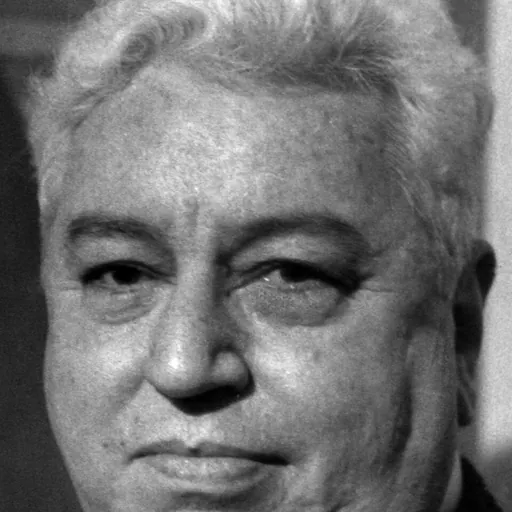
About Di Cavalcanti
Lived 1897 – 1976 (aged 79). Di Cavalcanti was a Brazilian painter, illustrator, caricaturist, visual artist, journalist and art critic.
Cover of exhibition program for the Week of Modern Art, by Di Cavalcanti. Emiliano Augusto Cavalcanti de Albuquerque Melo (September 6, 1897 – October 26, 1976), known as Di Cavalcanti, was a Brazilian painter who sought to produce a form of Brazilian art free of any noticeable European influences. His wife was the painter Noêmia Mourão, who would be an inspiration in his works in the later 1930s.
Style and subjects
Di Cavalcanti was obviously obsessed with the female body, since very many representations are to be found within the works he produced. The street scenes depicted by Cavalcanti are cheerful, characterized by a palette of bright colors and the depictions of everyday life in a normal, non-romanticized way. They evoke no strong political undercurrent, as do the works of such Mexican muralists of the 1930s and 1940s as Diego Rivera and David Siqueiros. The works produced by these artists were part of the revolutionary movement in opposition of the new revolutionary government who came to power in Mexico. Di Cavalcanti on the other hand refrained from overt political representations, although he himself was in a pursuit of perfecting a pure Brazilian art which had a clear break with European influences.
He tried through the creation of the Semana de Arte in 1922 and the Bienals in 1951 and 1953 to push for a true Brazilian art which was to be seen as separated from European stylistic influences. This was a dream and philosophy which can be seen as an ideal for Di Cavalcanti which was never found as one can see stylistic influences from the Italian Renaissance, Muralism, and the European Modernists.
List of artworks
The artworks below are all on display in the Museu de Arte Contempemporânea (MAC) in São Paulo, Brazil
As cinco moças de Guaratinguetá, 1926
The logo in front of the fabric focuses around the found m-two girls. On the left is a girl in blue dress with flowers, and blue hat the same color as the dress. While on the right, this is in profile, this one is skirt and blouse with details of the color of the skirt, the shirt on the back with a flower not shoulder and its orange hat. She carries a dated parasol.
It is not a matter of fabric, but others are found in the highest possible position, with a high level of direction: a direct person is in front, with her blue dress and her green head, she has a profile in profile with her pink dress and pink dress, carrying umbrellas to a letter in pink. The two girls are in white stockings.
In the background, the sing is not at the top direct of the screen, with the head resting on the arm that is signed on the window, is the fifth girl. With her orange dress and white hat. She looks out of the screen with her distant gaze.
All girls have the same skin tone, exceeding a blue dress, who feared lighter skin and the finest features. All five girls wear hats.
A shelled wall shows that either place is very simple, but nonetheless, it is full of charm.
Which can be viewed on
Modern Art Week, São Paulo, 1922 Modern Art Week was held at São Paulo’s Municipal Theater in 1922. The three-day event included artists from different disciplines and presented various European art movements to the public, such as Expressionism and Surrealism. Prior to this event, these movements had appeared in Brazil separately.
The Modern Art Week incorporated dance, music, theater, literature, visual arts, and architecture, and featured artists and writers who would become some of the most influential in the boom of Brazilian modernism that was to follow, among them Mário de Andrade, Oswald de Andrade, Manuel Bandeira, Anita Malfatti, and Tarsila do Amaral. Influenced by Brazil’s rapid industrialization and modernization, the event featured a heterogeneous group that, together, displayed the ambivalent modernization process that characterizes Brazilian modernism more broadly. Unlike many of their avant-garde contemporaries in Latin America and abroad, women artists played key roles in the Modern Art Week and in Brazilian modernist art more generally, especially in visual culture and dance.
As seen above on the right.
Portrait of Graca Aranha, 1922 José Pereira da Graça Aranha was born on June 21, 1868 in the city of São Luís, capital of Maranhão.
He was the son of Themistocles of Silva Maciel Aranha and of Maria da Gloria da Graça. His family was wealthy and, therefore, Graça Aranha had a good education from an early age.
He entered the Faculty of Recife to study law, graduating in 1886. With a bachelor's degree in law, he moved to Rio de Janeiro, where he held the position of Judge. Later, he was also a judge in the state of Espírito Santo.It was there that he wrote his most important work "Canaan."
Themes such as racism, prejudice and immigration were explored by him in the novel. He traveled to various countries around the Western Hemisphere (England, Italy, Switzerland, Norway, Denmark, France and the Netherlands) as a diplomat. These trips were essential for him to join the modernist movement that was emerging in Brazil. This is because it had contact with the European avant-garde and modern art. He was the organizer of the Modern Art Week that took place at the Municipal Theater of São Paulo in 1922.
In general he was a Brazilian writer and diplomat belonging to the pre-modernist movement in Brazil, as well as one of the founders of the Brazilian Academy of Letters (GLA) in 1897, being the holder of chair number 38, whose patron was Tobias Barreto. In addition, he played a leading role in the Modern Art Week of 1922.
Le Corbusier, 1923 Oswald and Mario, 1933 Maeterlinck, 1934 Barbusse, 1935 Duhamel, 1935 Ungaretti, 1942 Portrait of Augusto Schmidt, 1950
Exhibitions (above mentioned)
1917 Editoro do Livre, São Paulo, Brazil 1922 Semana de Arte, São Paulo, Brazil 1930 International Art Center, Roerich Center, New York 1932 Exposição de Arte Moderna, São Paulo, Brazil 1937 Art Technique Exhibition, Paris, France 1951 Bienal do Arte Moderna de São Paulo, São Paulo, Brazil (1st) 1953 Bienal do Arte Moderna de São Paulo, São Paulo, Brazil (2nd)
Don’t just read it —
keep it.
Full-length biographies made to live with: read them, listen on the way to work, watch them tonight.
- E-book
- Audio
- Video
Instant download · yours to keep · every purchase keeps this site free
Important facts
more
Emiliano Augusto di Cavalcanti Albuquerque Melo, Emiliano de Cavalcanti, Emiliano Augusto Cavalcanti de Albuquerque MeloPeople in Di Cavalcanti's life
Named in this biography and alive at the same time





Related people
Same field, nearest in time



Contemporaries
People whose lives overlapped Di Cavalcanti's

Frequently asked questions
Who was Di Cavalcanti?
Brazilian artist (1897-1976)
When was Di Cavalcanti born?
Di Cavalcanti was born on 6 September 1897 in Rio de Janeiro.
When did Di Cavalcanti die?
Di Cavalcanti died on 26 October 1976 in Rio de Janeiro.
What was Di Cavalcanti's occupation?
Di Cavalcanti was a painter, illustrator, caricaturist, visual artist, journalist and art critic.
What nationality was Di Cavalcanti?
Di Cavalcanti was Brazilian.
Sources & further reading
· DBpedia: Emiliano Di Cavalcanti
Cite this page
APA: Biography.guide. (2026). Di Cavalcanti. https://biography.guide/di-cavalcanti/
MLA: "Di Cavalcanti." Biography.guide, https://biography.guide/di-cavalcanti/.
Chicago: "Di Cavalcanti." Biography.guide. https://biography.guide/di-cavalcanti/.
Data last updated: 2026-09-22 · Spot an error? Report a correction.
Portrait: Wikimedia Commons · author & licence
Page generated 2026-09-27 05:01 UTC