
About Thomas Dundas
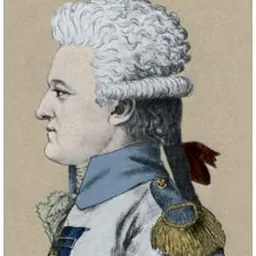
Lived 1765 – 1841 (aged 75–76). Thomas Dundas was a British naval officer.
Vice-Admiral Sir Thomas Dundas KCB ( – 29 March 1841) was a Royal Navy officer who served in the American War of Independence and the French Revolutionary and Napoleonic Wars. An effective frigate captain he made a number of small captures, but did not see action in any major fleet clashes, until he was present at the Battle of Trafalgar in 1805. He played an important role in relaying signals before the battle, and in towing dismasted British ships to safety afterwards. He had a largely uneventful career thereafter, rising through the ranks and eventually dying a vice-admiral.
Early life Little is known about Dundas's early life, but he appears to have been born in or around 1765, and to have joined the navy in 1778, during the American War of Independence. He was promoted to lieutenant on 15 July 1793, shortly after the outbreak of the French Revolutionary War, with one of his earliest commands being the sloop . His next promotion was to commander on 2 September 1795, and he was then raised to post-captain on 9 July 1798.
Frigate captain With the end of the Peace of Amiens in 1803 Dundas returned to sea in 1804 in command of the 36-gun fifth rate . He was initially assigned to patrol off the west coast of Spain and in the English Channel, where he captured several prizes. In mid-August 1805 Dundas had a narrow escape when he came across a large fleet off northern Spain, which challenged the Naiad using British codes. This was in fact the combined fleet under Pierre-Charles Villeneuve, heading for Ferrol. They then all went below and witnessed Nelson's will. Better weather on the morning of 23 October allowed Dundas to make more sail, but the return of the gale in the afternoon placed both ships in difficulties. At 1940 that evening the two ships collided, damaging Naiads jolly boat and smashing away most of the starboard quarter gallery. He steered straight for Gibraltar, and came within sight of the rock by midday, despite having been fired on by the Spanish battery at Tarifa. Dundas took Naiad in and anchored at 1330 that afternoon, while the Belleisle was warped into the mole. Dundas went on to command the 64-gun , another Trafalgar veteran, and the 74-gun . During his career Dundas is said to have invented a type of inflammable ball... applicable for besieging a town, and peculiar for its small weight, by which means may be thrown to a great distance; and it takes fire on a very curious plan: it spreads a flame on three distinct openings, which is so strong, that the fire extends a full yard in length from the ball itself, and is so powerful, that anything under, over, or near, cannot escape its effects. He died in Reading, Berkshire on 29 March 1841.
Don’t just read it —
keep it.
Full-length biographies made to live with: read them, listen on the way to work, watch them tonight.
- E-book
- Audio
- Video
Instant download · yours to keep · every purchase keeps this site free
Important facts
People in Thomas Dundas's life
Named in this biography and alive at the same time
Related people
Same field, nearest in time





Contemporaries
People whose lives overlapped Thomas Dundas's





Frequently asked questions
Who was Thomas Dundas?
Scottish Royal Navy officer (c. 1765-1841)
When was Thomas Dundas born?
Thomas Dundas was born in 1765.
When did Thomas Dundas die?
Thomas Dundas died on 29 March 1841 in Reading.
What was Thomas Dundas's occupation?
Thomas Dundas was a naval officer.
What nationality was Thomas Dundas?
Thomas Dundas was British.
Sources & further reading
· DBpedia: Thomas Dundas (Royal Navy officer)
Cite this page
APA: Biography.guide. (2026). Thomas Dundas. https://biography.guide/thomas-dundas/
MLA: "Thomas Dundas." Biography.guide, https://biography.guide/thomas-dundas/.
Chicago: "Thomas Dundas." Biography.guide. https://biography.guide/thomas-dundas/.
Data last updated: 2026-09-20 · Spot an error? Report a correction.
Page generated 2026-09-27 05:34 UTC