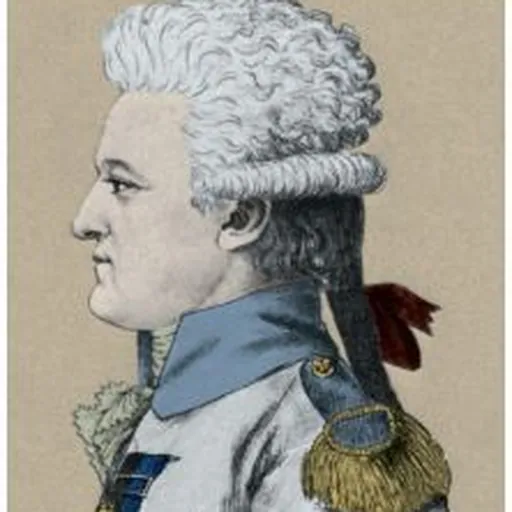
Pierre-Charles Villeneuve
French naval officer during the Napoleonic Wars
About Pierre-Charles Villeneuve
Lived 1763 – 1806 (aged 42). Pierre-Charles Villeneuve was a French naval officer and vizeadmiral.
Vice-Admiral Pierre-Charles-Jean-Baptiste-Silvestre de Villeneuve (31 December 1763 – 22 April 1806) was a French Navy officer who served in the French Revolutionary and Napoleonic Wars. He was in command of a Franco-Spanish fleet which was defeated by the British Royal Navy at the Battle of Trafalgar in 1805.
Early career
Pierre-Charles Villeneuve was born on 31 December 1763 at Valensole, Provence. Despite his aristocratic ancestry, Villeneuve sympathised with the French Revolution; dropping the nobiliary particle from his name, he was able to continue serving in the French navy when other aristocratic naval officers were purged. Villeneuve fought in several naval battles of the War of the First Coalition, and was promoted to counter admiral in 1796.
Villeneuve participated in the French invasion of Egypt and Syria in 1798; at the Battle of the Nile, he was in command of the French rear division. His ship, , was one of only two French ships of the line to escape the defeat. On 11 June Villeneuve set out for Europe with Nelson again in pursuit.
On 22 July Villeneuve, now with twenty ships of the line and seven frigates, passed Cape Finisterre on the northwest coast of Spain and entered the Bay of Biscay. Here he met a British fleet of fifteen ships of the line commanded by Vice Admiral Sir Robert Calder. In the ensuing Battle of Cape Finisterre, a confused action in bad visibility, the British, though outnumbered, were able to cut off and capture two Spanish ships.
For two days Villeneuve shadowed the retreating British, but did not seek a battle. Instead he sailed to A Coruña, arriving on 1 August. Here he received orders from Napoleon to sail to Brest and Boulogne as planned. Instead, perhaps believing a false report of a superior British fleet in the Bay of Biscay, and against the Spanish commanders' objections, he sailed away back to Cádiz, rendering Napoleon's planned invasion of Britain wholly impossible.
The battle
At Cádiz the combined French and Spanish fleets were kept under blockade by Nelson. Nelson arriving off Cadiz on the 28th September. In September, Villeneuve was ordered to sail for Naples and attack British shipping in the Mediterranean, but he was initially unwilling to move and continued in blatant disregard of superior orders.
In mid-October he learned that Napoleon was about to replace him as commanding officer with François Étienne de Rosily-Mesros and order him to Paris to account for his actions. (Napoleon had written to the Minister of Marine, "Villeneuve does not possess the strength of character to command a frigate. He lacks determination and has no moral courage.") Before his replacement could arrive, Villeneuve gave the order to sail on 18 October.
Inexperienced crews and the difficulties of getting out of Cádiz meant that it took two days to get all 34 ships out of port and into some kind of order. On 21 October 1805 Villeneuve learned of the size of the British fleet, and turned back to Cádiz, but the combined fleets were intercepted by Nelson off Cape Trafalgar. Nelson, though outnumbered, won the Battle of Trafalgar, and Villeneuve's flagship was captured along with many other French and Spanish ships.
Aftermath and death
The British sent Villeneuve to England in HMS Euryalus but released him on parole; during this time he lived in Bishop's Waltham in Hampshire. He stayed at the Crown Inn public house and his men, who numbered 200, stayed in local houses. He was allowed to attend the funeral of Lord Nelson whilst at Bishop's Waltham. Freed in late 1805, he returned to France, where he attempted to go back into military service, but his requests were not answered.
On 22 April 1806, he was found dead at the Hôtel de la Patrie in Rennes with five stab wounds in the left lung and one in the heart. He had left a farewell letter to his wife. A verdict of suicide was recorded. The question of whether Villeneuve committed suicide has been a source of contention among historians ever since.
Don’t just read it —
keep it.
Full-length biographies made to live with: read them, listen on the way to work, watch them tonight.
- E-book
- Audio
- Video
Instant download · yours to keep · every purchase keeps this site free
Important facts
People in Pierre-Charles Villeneuve's life
Named in this biography and alive at the same time

Related people
Same field, nearest in time




Contemporaries
People whose lives overlapped Pierre-Charles Villeneuve's





Frequently asked questions
Who was Pierre-Charles Villeneuve?
French naval officer during the Napoleonic Wars
When was Pierre-Charles Villeneuve born?
Pierre-Charles Villeneuve was born on 31 December 1763 in Valensole.
When did Pierre-Charles Villeneuve die?
Pierre-Charles Villeneuve died on 22 April 1806 in Rennes.
What was Pierre-Charles Villeneuve's occupation?
Pierre-Charles Villeneuve was a naval officer and vizeadmiral.
What nationality was Pierre-Charles Villeneuve?
Pierre-Charles Villeneuve was French.
Sources & further reading
· Wikipedia: Pierre-Charles Villeneuve
· DBpedia: Pierre-Charles Villeneuve
Cite this page
APA: Biography.guide. (2026). Pierre-Charles Villeneuve. https://biography.guide/pierre-charles-villeneuve/
MLA: "Pierre-Charles Villeneuve." Biography.guide, https://biography.guide/pierre-charles-villeneuve/.
Chicago: "Pierre-Charles Villeneuve." Biography.guide. https://biography.guide/pierre-charles-villeneuve/.
Data last updated: 2026-09-23 · Spot an error? Report a correction.
Portrait: Wikimedia Commons · author & licence
Page generated 2026-09-27 05:07 UTC