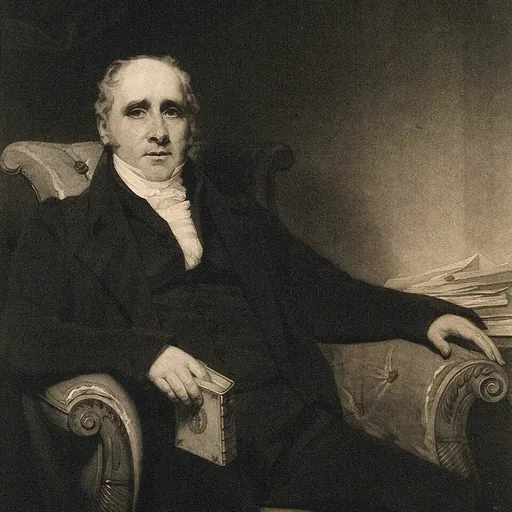
About Thomas Charles Hope
Lived 1766 – 1844 (aged 77). Thomas Charles Hope was a British chemist, physicist and university teacher, known for Strontium.
Thomas Charles Hope (21 July 1766 – 13 June 1844) was a Scottish physician, chemist and lecturer. He proved the existence of the element strontium, and gave his name to "Hope's Experiment", which shows that water reaches its maximum density at .
Early life Born in Edinburgh, the third son of Juliana Stevenson and surgeon and botanist John Hope, he lived at High School Yards on the south side of the old town.
He was educated next door to his house at the High School, the University of Edinburgh (MD 1787) and the University of Paris. The element was later renamed to strontium.
Edinburgh and the university Hope was elected a fellow of the Royal Society of Edinburgh in 1788, and served as its vice president from 1822 to 1833. In 1791 following the death of his uncle, Alexander Stevenson, Hope succeeded him in his uncle's role as professor of Medicine at Glasgow University.
In 1795 Hope was selected by Joseph Black as his assistant (1795–1799) and eventual successor to the professorship of medicine and chemistry (1799–1843) at the University of Edinburgh. Hope’s goal was to more fully combine the practice of medicine with his chemical instruction.
In 1796 Hope was elected a member of the Harveian Society of Edinburgh and served as president in 1800 and 1816.
In 1800 Hope won the annual Edinburgh Arrow archery competition.
In 1804 he became a member of the Highland Society.
In May 1810 he was elected a Fellow of the Royal Society of London.
From 1815 to 1819 he served as President of the Royal College of Physicians of Edinburgh.
Between 1824–40 Hope worked with scientists based in Poissy, France. With the town's major, Jean-François Senincourt, he tried to establish a university in the town. Within a few years their aims began to be realised as medical students crowded his lectures.
In 1828 he gave £800 to found a chemistry prize at the University of Edinburgh.
In the 1830s he is listed as living at 31 Moray Place, a large townhouse in the Moray Estate on the western edge of Edinburgh's New Town.
In 1843 he resigned the professorship.
He died at his home, 31 Moray Place in Edinburgh's West End in 1844. He is buried in Greyfriars Kirkyard in central Edinburgh. The grave lies against the western wall of the original churchyard, towards the north-west corner.
Works
Hope's apparatus
Source:
Hope's apparatus consists of a vertical vessel full of water surrounded round the middle by a trough of cooling ice. Two thermometers, one above and one below the trough, measure the temperature of the water. It is designed to demonstrate that water reaches its maximum density at .
As the water in the central part of the vessel cools towards (and thus becomes denser) it sinks to the bottom of the vessel, displacing the warmer water. The lower thermometer will then read a constant . Further cooling towards will cause the now less dense water to rise to the top of the vessel, where the upper thermometer will then read a constant .
Don’t just read it —
keep it.
Full-length biographies made to live with: read them, listen on the way to work, watch them tonight.
- E-book
- Audio
- Video
Instant download · yours to keep · every purchase keeps this site free
Important facts
People in Thomas Charles Hope's life
Named in this biography and alive at the same time



Related people
Same field, nearest in time



Contemporaries
People whose lives overlapped Thomas Charles Hope's




Frequently asked questions
Who was Thomas Charles Hope?
British physician and chemist
When was Thomas Charles Hope born?
Thomas Charles Hope was born on 21 July 1766 in Edinburgh.
When did Thomas Charles Hope die?
Thomas Charles Hope died on 13 June 1844 in Edinburgh.
What was Thomas Charles Hope's occupation?
Thomas Charles Hope was a chemist, physicist and university teacher.
What was Thomas Charles Hope known for?
Thomas Charles Hope was known for Strontium.
What nationality was Thomas Charles Hope?
Thomas Charles Hope was British.
Sources & further reading
· Wikipedia: Thomas Charles Hope
· DBpedia: Thomas Charles Hope
Cite this page
APA: Biography.guide. (2026). Thomas Charles Hope. https://biography.guide/thomas-charles-hope/
MLA: "Thomas Charles Hope." Biography.guide, https://biography.guide/thomas-charles-hope/.
Chicago: "Thomas Charles Hope." Biography.guide. https://biography.guide/thomas-charles-hope/.
Data last updated: 2026-09-20 · Spot an error? Report a correction.
Portrait: Wikimedia Commons · author & licence
Page generated 2026-09-27 04:57 UTC