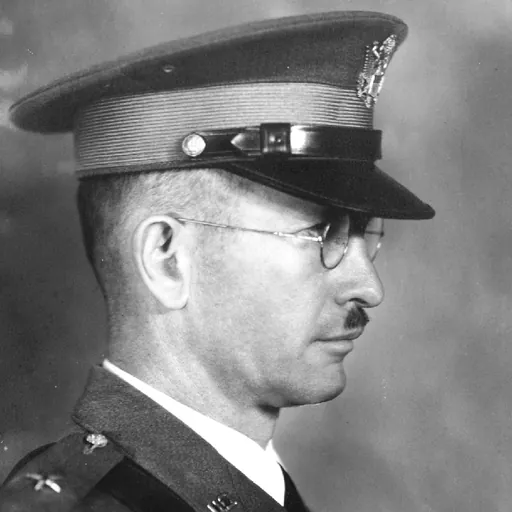
About Sumter deLeon Lowry
Lived 1893 – 1985 (aged 91). Sumter deLeon Lowry was an American military personnel.
Sumter de Leon Lowry Jr. (August 27, 1893 – February 3, 1985) was an American insurance executive, National Guard officer, and political candidate from Florida. A veteran of the Pancho Villa Expedition, World War I, and World War II, he is best known for his service as commander of several units in the Florida National Guard. Lowry served in the military for 38 years and attained the rank of major general. Apart from his military service, he is remembered for his opposition to racial integration, on which he based his unsuccessful 1956 campaign for governor of Florida.
A native of St. Augustine, Florida, Lowry was raised in Tampa, where his father served as a member of the city commission. He was educated in Tampa, and was a 1914 graduate of Virginia Military Institute. After graduation, Lowry began his long association with the United States Army by joining the Florida National Guard and organizing a new unit, Company H, 2nd Infantry Regiment, which he commanded as a captain. Lowry served with his unit on the Texas–Mexico border during the Pancho Villa Expedition in 1916–1917. The 2nd Florida Infantry was federalized for wartime service as the 124th Infantry, and sent to France as replacement soldiers. Lowry served with the unit in the U.S. then went to France as commander of Company I, 331st Infantry. The Armistice occurred before his company saw combat, and he performed post–war occupation duty until returning home in early 1919. After the war, he participated in the Florida National Guard's reorganization by helping organize the 116th Field Artillery Regiment, which he eventually commanded as a colonel. Lowry also began a career in the insurance industry in the early 1920s, and was the longtime chairman of the board of the Gulf Life Insurance Company. In 1934, he was promoted to brigadier general as commander of the 56th Artillery Brigade, a unit of the 31st Infantry Division.
Lowry was among the Florida National Guard members activated for World War II; he commanded the 31st Infantry Division Artillery, and participated in the Dutch East Indies and New Guinea campaigns, for which he received the Bronze Star Medal and other awards. After returning to Florida after the war, Lowry aided in the state's post–war National Guard reorganization, and was assigned to command the 51st Infantry Division as a major general. He retired from the military in 1952; in addition to receiving the Army Distinguished Service Medal, he received a state promotion to lieutenant general on Florida's retired list in recognition of his many years of service.
An ardent anti–communist and a believer in racial segregation, Lowry regarded the civil rights movement of the 1950s and 1960s as an extension of a plot to spread communism throughout the world. In 1956, he was a candidate for the Democratic nomination for governor of Florida. Running on the single issue of maintaining school segregation, Lowry failed to gain much traction, and was defeated by incumbent LeRoy Collins, who went on to win the general election. In 1962, he made a run for the United States House of Representatives in a newly created Tampa–based district. Running on a segregationist platform, he lost the Democratic nomination to Sam Gibbons, who went on to win the general election.
In retirement, Lowry continued to reside in Tampa. He died there on February 3, 1985, and was buried in Woodlawn Cemetery in Tampa.
Childhood
Lowry was born in St. Augustine, Florida; his parents were Sumter de Leon Lowry Sr. (1861–1936), and Willie Miller Lowry (1862–1946). The family moved to Tampa when he was an infant, and the senior Lowry became a successful businessman. Lowry Sr. and his wife became active in a host of Tampa area civic causes and historical projects, including leadership roles in the Sons of Confederate Veterans and Daughters of the Confederacy.
The younger Lowry was educated in Tampa, and was a 1911 graduate of Hillsborough High School. He then attended the Virginia Military Institute (VMI), from which he graduated in 1914. Lowry was a standout student at VMI, serving as a cadet captain, starting on the football team, and serving as captain of the basketball team. He was a district agent for the National Life Insurance Company of Chicago and represented the Aetna Casualty and Security Company and other insurers. Lowry served as president of the Victory National Insurance Company from 1921 until 1928, when it merged with the Gulf Life Insurance Company. He moved from Tampa to Jacksonville in 1929, and came back to Tampa after returning to Florida following his World War II military service. Lowry remained with Gulf Life until 1959, and after selling a large portion of the company's assets to Clint Murchison Jr. and John D. Murchison, he remained on the board of directors. Lowry was "exceedingly successful as a businessman" and his other ventures included real estate development in Florida and nearby states, and serving as chairman of the board for both Jacksonville's Bushnell Steel Company and Havana's Cuban American Metal Distributors.
Lowry wrote two pieces for Review of Reviews in the early 1930s, in which he argued in favor of a proposed cross–Florida ship canal, "A Florida Ship Canal" and "A Canal Across Florida".
Military career Early years Lowry began his military career after his VMI graduation in 1914 by assisting in the creation of Company H, 2nd Florida Infantry, which he was elected to command with the rank of captain.
World War I When the 2nd Florida Infantry was federalized for service in World War I, Lowry served with the newly designated 124th Infantry as commander of Company H during pre–mobilization training at Camp Wheeler, Georgia. 124th Infantry soldiers were sent from Camp Wheeler to Camp Mills, New York for embarkation to France as replacement troops for units already in combat, In October, he deployed to France as commander of Company I, 331st Infantry Regiment, a unit of the 83rd Division. He was mustered out of federal service at Fort Oglethorpe, Georgia in February and returned to Tampa. and when each state was requested to nominate individuals to serve as the national organization's official incorporators, Herbert J. Drane nominated Lowry to represent Florida, who then attended the Legion's first organizational meeting. The national organization recruited him to oversee creation of its Florida department, He was then elected commander of the Florida department, which he headed from 1921 to 1923.
Post–World War I After the war Lowry was one of the organizers of the Florida National Guard's 116th Field Artillery Regiment. After commanding the regiment's 1st Battalion as a major, then commanded the regiment from 1923 to 1934 with the rank of colonel. In 1934 he was promoted to brigadier general as commander of 56th Artillery Brigade, 31st Division.
In the 1930s and 1940s, Lowry authored several articles on military topics for professional journals. Among these were "The 116th Field Artillery Makes History" (The Field Artillery Journal, Jan.–Feb. 1936, pp. 88–89) and "Is This Perfection?" (The Field Artillery Journal, Sep.–Oct. 1937, pp. 333–336).
World War II During World War II, Lowry commanded the 31st Division Artillery. Lowry's wartime service was recognized with award of the Army Distinguished Service Medal and Bronze Star Medal. The newly organized division was made up of units from Florida and South Carolina, and Lowry commanded during its initial organization, equipping, and training.
Awards and decorations In addition to the Distinguished Service Medal and Bronze Star Medal, Lowry's other decorations included the Mexican Border Service Medal, World War I Victory Medal, American Defense Service Medal, Asiatic–Pacific Campaign Medal, and World War II Victory Medal.
Opposition to school integration and campaign for governor (1956) Lowry was described in a 1956 news article as a "popeyed patriot" who displayed a "rabid brand of racism".
He ran for governor in 1956 on the single issue of maintaining school segregation, which had become an issue due to the 1954 Brown v. Board of Education decision. He was supported by the Ku Klux Klan, but his "principal supporter" was Florida businessman Ed Ball. In an election that was watched nationally for signs of moderation on race and civil rights as a viable approach, Running on a segregationist platform, Lowry finished second of five candidates in the Democratic primary, which advanced him to a runoff against first–place finisher Sam Gibbons. This organization created and distributed materials warning about the dangers it perceived in communism and the United Nations, which it argued were attempting to eliminate U.S. sovereignty and establish a single worldwide government.
Retirement and death In retirement, Lowry continued to reside in Tampa. He was also active in efforts to improve Tampa and preserve his family's legacy, including purchasing an elephant in 1960, which he donated to the Lowry Park Zoo. Lowry and other family members also established several charities that work to better Tampa, including the Sumter & Ivilyn Lowry Charitable Foundation, the Sumter L. Lowry Foundation, and the Lowry Murphey Family Foundation. Among other endeavors, the Sumter L. Lowry Foundation maintains Mount Lyn Lowry, a mountain and mountaintop memorial to Lowry's daughter in Haywood County, North Carolina. Lowry died in Tampa on February 3, 1985, and was buried at Woodlawn Cemetery in Tampa.
In 1974, Tampa's Civitan International Club named Lowry the city's "Man of the Year". In announcing the award, the club's spokesman said Civitan selected Lowry in recognition of his many years of service to the community, including his military experience, civic and charitable efforts, and work to promote patriotism and anticommunism. VMI presents an annual award, The Society of the Cincinnati Medal, to a top performing cadet, and Lowry was the 1914 recipient. Lowry also endowed the Lowry Freedom Award at the University of Tampa for presentation to each year's top performing Reserve Officers' Training Corps cadet.
In 1986, the Florida National Guard constructed an armory in Plant City, Florida. The armory was named after Lowry in 1991 and underwent renovation in 2013 and 2014. and their children included: Helen (1917–1918); Elizabeth (Betty) (1920–1925); Sumter (1924–2000); and Ann (1934–2005), the wife of David R. Murphey III. In 1945, Lowry married Ivilyn Ingram (1903–1988), whom he met while he was stationed at Camp Livingston. They were the parents of a daughter, Ivilyn (Lyn) (1947–1962).
Don’t just read it —
keep it.
Full-length biographies made to live with: read them, listen on the way to work, watch them tonight.
- E-book
- Audio
- Video
Instant download · yours to keep · every purchase keeps this site free
Important facts
People in Sumter deLeon Lowry's life
Named in this biography and alive at the same time



Related people
Same field, nearest in time





Contemporaries
People whose lives overlapped Sumter deLeon Lowry's


Frequently asked questions
Who was Sumter deLeon Lowry?
American National Guard officer (1893–1985)
When was Sumter deLeon Lowry born?
Sumter deLeon Lowry was born on 27 August 1893 in St. Augustine.
When did Sumter deLeon Lowry die?
Sumter deLeon Lowry died on 3 February 1985.
What was Sumter deLeon Lowry's occupation?
Sumter deLeon Lowry was a military personnel.
What nationality was Sumter deLeon Lowry?
Sumter deLeon Lowry was American.
Sources & further reading
· Wikipedia: Sumter deLeon Lowry
· DBpedia: Sumter de Leon Lowry Jr.
Cite this page
APA: Biography.guide. (2026). Sumter deLeon Lowry. https://biography.guide/sumter-deleon-lowry/
MLA: "Sumter deLeon Lowry." Biography.guide, https://biography.guide/sumter-deleon-lowry/.
Chicago: "Sumter deLeon Lowry." Biography.guide. https://biography.guide/sumter-deleon-lowry/.
Data last updated: 2026-09-22 · Spot an error? Report a correction.
Portrait: Wikimedia Commons · author & licence
Page generated 2026-09-27 05:02 UTC