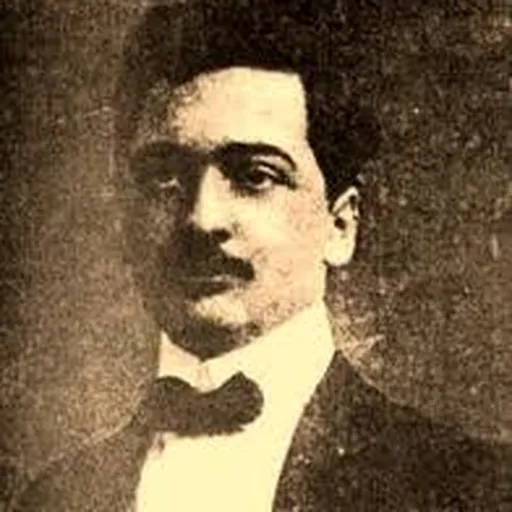
About Ștefan Zeletin
Lived 1882 – 1934 (aged 51–52). Ștefan Zeletin was a Romanian philosopher, sociologist, economist and political scientist.
Ștefan Zeletin (born Ștefan Motăș; June 19, 1882 – July 20, 1934) was a Romanian philosopher, sociologist, liberal economist and political theorist.
Biography
Born in Burdusaci, Bacău County, his mother Catinca Motăș (née Chiriac) was the daughter of Ștefanache Chiriac, a local official of Greek origin from the nearby village of Ursa. Her husband, the postelnic Dumitrache Motăș, died sixteen years before Zeletin's birth. The latter's father is unknown (one possibility is the local mayor and well-off landowner Neculache Brăescu), and he remained sensitive to the fact of his illegitimate birth, adopting a pseudonym (after the Zeletin River that passes through Burdusaci) to distance himself from his mother's husband. He grew up in a peasant family of the bourgeoisie, which he would later analyze in his work.
He attended Codreanu High School in Bârlad and the theological seminary in Roman. His tertiary studies took place at the University of Iași (1906), of Berlin (1907–1908), Paris (1909–1910), Leipzig (1910), Berlin (1910–1911) and Erlangen (1911). he returned to Romania and taught German at Codreanu. He started publishing soon after, with Evanghelia naturii ("The Gospel of Nature") coming out at Iași in 1915, and Din țara măgarilor ("From the Country of the Donkeys") appearing in 1916. One scope of the work was to ridicule Romanian pretensions over Southern Dobruja, which the country had gained as a result of the Second Balkan War. He moved to the national capital Bucharest in 1920, continuing to work as a German teacher, A sympathizer of the National Liberal Party, with leading member Vintilă Brătianu a backer of his theories, Zeletin nevertheless joined the People's Party. A popular theorist of neoliberalism in the 1930s and 1940s, his ideas were shunned after the onset of the Communist regime in 1947. His works again began to see publication as part of anthologies in the 1970s, when his work on social development theory was re-evaluated. Following the 1989 fall of communism, his work reappeared in proper form and his ideas reentered debates about political ideology and national identity.
Work Intellectual debates in interwar Romania were dominated by "traditionalists", who argued that the country should look to its past for its road to development; and "Europeanists", who said the industrialized and urbanized West pointed the economic and social way forward. Among the latter camp, while Eugen Lovinescu wrote about the transformative power of ideas, Zeletin focused on the importance of economics in Burghezia română. There, he argued that the 1829 Treaty of Adrianople had loosened the Danubian Principalities from the constricting influence of long Ottoman domination, producing the fundamental economic changes that gave rise to modern Romania. He pointed out how, following the 1859 Union of the Principalities, massive Western investment had led to the emergence of a bourgeois middle class composed of boyars who had turned to trade, and of a capitalist economy. Moreover, he argued that continued industrialization and adoption of European technology, guided by this class, were necessary for Romania to avoid retrenchment. Zeletin placed early-1920s Romania at this second stage, thus explaining the "nationalism of reaction" that was "xenophobic, in particular anti-Semitic", directed against the country's Jewish community. Prophetically, he suggested that Romanians would "attempt to emancipate themselves from foreign patronage, in order to live on their own strength"; he died before the worst of the country's xenophobic and antisemitic reaction had displayed itself.
He saw the liberal forms the country had adopted as being not artificial, but well-adapted to his society's current stage of development. Adopting a semi-Marxist discourse, Zeletin held that modern capitalism was a "historical necessity" both unavoidable and not subject to criticism. By contrast, he viewed traditional Romanian culture as reactionary. Among Burghezia română'''s admirers were Ibrăileanu, Tudor Vianu, Alexandru Claudian and Constantin Noica.
In Neoliberalismul (1927), he proposed a scientific definition of neoliberalism, enumerated its effects and identified the impediments to its gaining political currency in Romania—popular prejudice on the one hand, and on the other, doctrines such as Junimism, nationalism, Poporanism and socialism. Constantin Rădulescu-Motru, Nae Ionescu, Virgil Madgearu and Nicolae Roșu accused him of holding materialist, Marxist or socialist views.
BibliographyEvanghelia naturii (1915)Din țara măgarilor. Însemnări (1916)Burghezia română (1925)Neoliberalismul (1927)Nirvana. Gânduri despre lume și viață (1928)
Don’t just read it —
keep it.
Full-length biographies made to live with: read them, listen on the way to work, watch them tonight.
- E-book
- Audio
- Video
Instant download · yours to keep · every purchase keeps this site free
Important facts
People in Ștefan Zeletin's life
Named in this biography and alive at the same time



Related people
Same field, nearest in time



Contemporaries
People whose lives overlapped Ștefan Zeletin's



Frequently asked questions
Who was Ștefan Zeletin?
Romanian academic
When was Ștefan Zeletin born?
Ștefan Zeletin was born in 1882 in Burdusaci.
When did Ștefan Zeletin die?
Ștefan Zeletin died in 1934 in Bucharest.
What was Ștefan Zeletin's occupation?
Ștefan Zeletin was a philosopher, sociologist, economist and political scientist.
What nationality was Ștefan Zeletin?
Ștefan Zeletin was Romanian.
Sources & further reading
Cite this page
APA: Biography.guide. (2026). Ștefan Zeletin. https://biography.guide/stefan-zeletin/
MLA: "Ștefan Zeletin." Biography.guide, https://biography.guide/stefan-zeletin/.
Chicago: "Ștefan Zeletin." Biography.guide. https://biography.guide/stefan-zeletin/.
Data last updated: 2026-09-20 · Spot an error? Report a correction.
Page generated 2026-09-27 05:10 UTC