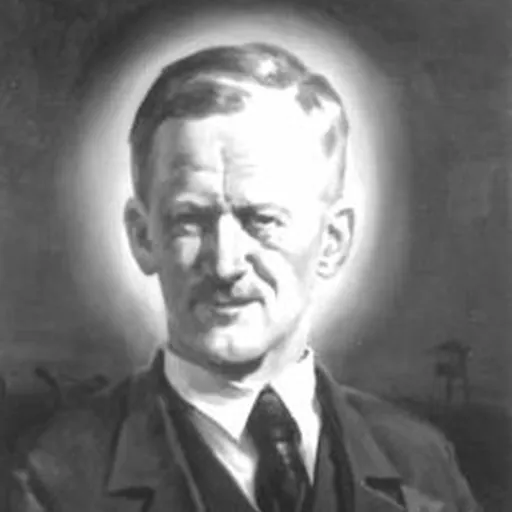
Stanisław Starowieyski
Polish officer, social activist, blessed
About Stanisław Starowieyski
Lived 1895 – 1941 (aged 45). Stanisław Starowieyski was a Polish military personnel, papal chamberlain and activist.
Stanisław Kostka Starowieyski (1895-1941) is Polish Blessed of the Catholic Church, who was a church, social, and charitable activist, as well as and a papal chamberlain. He served in the Austro-Hungarian Army during World War I and then served in the Polish Armed Forces during the Polish–Ukrainian and Polish–Soviet Wars from 1918 to 1920. He died in Dachau concentration camp, and was beatified in 1999.
Biography Youth Stanisław Kostka Maria Gerard Franciszek de Hieronymo Biberstein Starowieyski was born on May 11, 1895, in Ustrobna, as the third child of Stanisław Jan and Amelia née Łubieńska. His father was a member of the Diet of Galicia and Lodomeria, the Imperial Council, and the Legislative Sejm (1919–1922), and owned estates in Bratkówka and Korabniki. The family was of noble origin, related to the Bibersteins.
Stanisław spent his early childhood at the domestic estate of Bratkówka. following reforms launched at the time by Pope Pius X. Like his siblings, Stanisław was tutored at home in Krosno. Later, residing in Bratkówka, Stanisław studied in Sanok at the C.K. Gimnazjum (Imperial and Royal Gymnasium), today known as Primary School No. 8 Sophia of Halshany, where he completed Grades 1-3 from 1905 to 1908.
In 1910, Stanisław moved to the Jesuit College in Khyriv. In 1914 he finished 8th grade and passed his final exam. At this institution, he joined the Roman Catholic society Sodality of Our Lady. In 1923 and 1924, he served during reserve duty periods as an officer of the 9th Field Artillery Regiment in Biała Podlaska. The family manor had been completely devastated by wartime, and the pair had to live in a modest outbuilding. As the family grew, their outbuilding was gradually transformed into a residential building. On his way back to Łaszczów, he stopped at Niepokalanów, where he met Father Maksymilian Kolbe.
His ashes were returned in an urn to his family by the camp authorities. They were buried at the Szeptycki family cemetery in the manor of Łabunie, today owned by the Franciscan Missionaries of Mary. The patronage of his name was granted to the following educational institutions: the Primary School in Bratkówka ; A commemorative plaque recalling his memory was unveiled in Bratkówka, at the Starowieyski's manor house, on October 17, 2002.
Since June 18, 2017, the Church of the Holy Apostles Peter and Paul in Łaszczów has been housing Blessed Stanisław's indirect relic: his holy rosary, which was kept by his wife after he was arrested and deported. The rosary moved eventually into the hands of his grandson, Wojciech Starowieyski, who donated it to the church in Łaszczów with the consent of Marian Rojek, the bishop of the Diocese of Zamość-Lubaczów.
Family Ancestors
Stanisław's grandfather was Stanisław Michał Starowieyski (1815–1895), a landowner, member of the Imperial Council and of the Diet of Galicia and Lodomeria. Stanisław's father was Stanisław Jan Starowieyski (1866–1926). Stanisław's father-in-law was Aleksander Maria Szeptycki (1866–1940), who was tortured to death by the Gestapo on June 19, 1940 in the Rotunda Zamość. He was a landowner and had the following siblings: Blessed Klymentiy Sheptytsky (1869–1951); general Stanisław Szeptycki (1867–1950); Metropolitan bishop Andrey Sheptytsky (1865–1944); Leon, a landowner.
Siblings Zofia Starowieyska-Morstinowa (1891–1966), a Polish essayist and literature critic. Five days after she died (July 8, 1966), a mass was said in her intention, celebrated by then-Archbishop Karol Wojtyła (Pope John Paul II). Ludwik (1896–1958), a year older than Stanisław. They went to the same school in 1905–1908. Maria (1896–1951), who worked in a school for nurses. Marian (1899–1939), doctor of law, allegedly killed by Russians soldiers. Ignacy (1922–1994); Aleksander (1923–1944), who died during the Warsaw Uprising (nom-de-guerre Oleś); Maria (1925–1970), who participated in the Warsaw Uprising (nom-de-guerre Mysłowska); Stanisław (1927–1959) who participated in the Warsaw Uprising (nom-de-guerre Rak); Elżbieta (1929–still alive); Andrzej (1931–2013) who participated in the Warsaw Uprising.
Other family members Nephews Marek Starowieyski (born 1937), a Polish Catholic priest, prelate. A professor in theology, he published research papers on ancient Christianity and patrology. Franciszek Starowieyski (1930–2009), a Polish graphic designer.
Palace in Łabunie – Count Aleksander Szeptycki
The palace was erected as a summer residence for Jan Jakub Zamoyski, the voivode of Podolia who married Ludwika Maria Poniatowska, the sister of the King of Poland, Stanisław August Poniatowski.
In the late 19th century, after several changes of ownership, Jan Stanisław Tarnowski sold this property near Zamość to Count Aleksander Maria Szeptycki, Stanisław Starowieyski's future father-in-law. The Szeptycki family did not live there, preferring the estate of Łaszczów. inhabiting a small mansion located from the palace itself. and outbuildings, to the Franciscan Missionaries of Mary (FMM), who had been running an orphanage there with his approval. The Count's decision was a gift to the congregation in gratitude for taking care of his sick daughter Zofia, who suffered from tuberculosis and died in 1917, in Łabunie. On June 26, 1922, three FMM sisters fled Odessa, escaping the Russian Civil War.
The palace suffered heavily during the Second World War: 85% of the buildings were destroyed. After a partial reconstruction, FMM sisters moved back to Łabunie in 1963. A modest necropolis of the Szeptycki family (including Stanisław Starowieyski's ashes) has been established in a circle around a wooden cross, on the outskirts of the park. Surrounding the palace are graves of the FMM sisters.
Don’t just read it —
keep it.
Full-length biographies made to live with: read them, listen on the way to work, watch them tonight.
- E-book
- Audio
- Video
Instant download · yours to keep · every purchase keeps this site free
Important facts
People in Stanisław Starowieyski's life
Named in this biography and alive at the same time





Related people
Same field, nearest in time



Contemporaries
People whose lives overlapped Stanisław Starowieyski's

Frequently asked questions
Who was Stanisław Starowieyski?
Polish officer, social activist, blessed (1895–1941)
When was Stanisław Starowieyski born?
Stanisław Starowieyski was born on 11 May 1895 in Ustrobna.
When did Stanisław Starowieyski die?
Stanisław Starowieyski died on 13 April 1941 in Dachau concentration camp.
What was Stanisław Starowieyski's occupation?
Stanisław Starowieyski was a military personnel, papal chamberlain and activist.
What nationality was Stanisław Starowieyski?
Stanisław Starowieyski was Polish.
Sources & further reading
· Wikipedia: Stanisław Starowieyski
· DBpedia: Stanisław Kostka Starowieyski
Cite this page
APA: Biography.guide. (2026). Stanisław Starowieyski. https://biography.guide/stanislaw-starowieyski/
MLA: "Stanisław Starowieyski." Biography.guide, https://biography.guide/stanislaw-starowieyski/.
Chicago: "Stanisław Starowieyski." Biography.guide. https://biography.guide/stanislaw-starowieyski/.
Data last updated: 2026-09-21 · Spot an error? Report a correction.
Portrait: Wikimedia Commons · author & licence
Page generated 2026-09-27 04:59 UTC