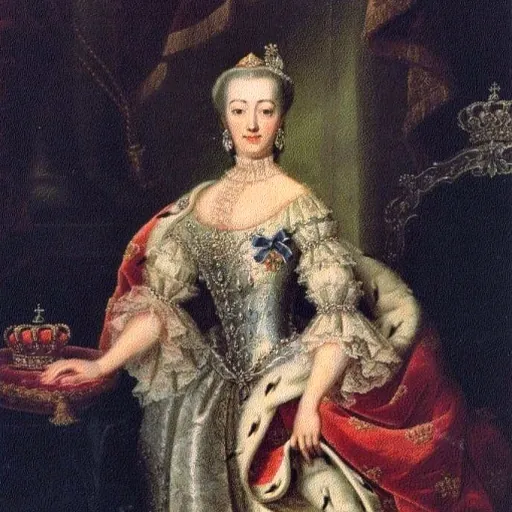
About Sophia Magdalene of Brandenburg-Kulmbach
Lived 1700 – 1770 (aged 69). Sophia Magdalene of Brandenburg-Kulmbach was a Norwegian, Danish and German consort.
Sophie Magdalene of Brandenburg-Kulmbach (28 November 1700 – 27 May 1770) was Queen of Denmark and Norway by marriage to King Christian VI of Denmark and Norway.
Life Early life
She was born in Castle Schonberg, Bavaria, on 28 November 1700 to Christian Heinrich, Margrave of Brandenburg-Bayreuth-Kulmbach and Countess Sophie Christiane of Wolfstein. She was raised at the court of the Queen of Poland, Christiane Eberhardine of Brandenburg-Bayreuth, in Saxony.
Crown Princess King Frederick IV of Denmark allowed his son, Crown Prince Christian, to find a suitable bride. During a trip through Europe accompanied by Chancellor Ulrik Adolf Holstein the Crown Prince met Sophie Magdalene while she was serving as lady-in-waiting of the Queen of Poland at Pretzsch Castle. She came from a small (the Margraviate of Kulmbach was not greater than Lolland-Falster), insignificant, relatively poor and large German princely family (she had 13 siblings); however, the King gave his permission. In the Crown Prince's letters he wrote that he fell for Sophie Magdalene's intense religiosity, which matched with his own beliefs. It would affect his later reign. The wedding took place on 7 August 1721 at Pretzsch Castle in Saxony.
A French envoy to the Danish court sent a description home of the 20-year-old Crown Princess: She's a proud, impressive woman, although she is not high growth or of beautiful forms. She's not exactly pretty, but her majestic attitude was notorious. Her skin is very white, her face-range is fine, vibrant and soulful with light blue eyes; they still shaped lips crimped sometimes of a sneer. She dressed with the greatest splendor and used a lot of diamonds and other precious stones.
Queen Consort
At the death of Frederick IV on 12 October 1730, the couple became King and Queen of Denmark and Norway. They were crowned on 6 June 1731 in the Chapel of Frederiksborg Palace. She was behind the making of a new Danish queen's crown when she refused to wear the same one that the hated Queen Anna Sophie – whom she called "that whore!" (die Hure!) Queen Sophie Magdelene established the collection of crown jewels when she bequeathed a large part of her jewelry for that purpose. This includes the emeralds given to Sophie by King Christian VI upon the birth of the future Frederik V.
Coin by Johann Karl von Hedlinger with portrait of Sophie Magdalene. The marriage between the king and queen was harmonious and her husband loved and trusted her, but the royal couple was not popular. Queen Sophie Magdalene was described as haughty, arrogant and proud, and she was accused of isolating the royal family within the court, which was dominated by the royal couple's strong religious feelings and the German favorites and relatives of the queen.
A number of laws and prohibitions inspired by the strong religious feelings of the royal couple were issued, including a ban against theater performances and rides on Sundays, and in 1735, it introduced public holiday regulation with obligatory church attendance, where breaches of duty resulted in fines or time in jail. Sophie Magdalene's religiosity and strong influence of Pietism was expressed when, in 1737, she founded at Vallø Castle the Noble Vallø Foundation for Unmarried Daughters (Danish: Det Adelige Stift Vallø for ugifte døtre), a home for aging and aristocratic unmarried women.
Despite their Pietism, however, the royal couple loved the splendor and luxury; King Louis XIV of France was their great princely role model. Sophie Magdalene made the most of her position as queen in matters of rank, precedence and ceremony, and the court life was a mixture of subdued religious puritanism and ceremonious pomp. The queen was also accused of creating a certain isolation around the royal family. The king and the queen rarely let themselves be seen in public, and were so humanly hostile that they let themselves be transported through the city in a carriage with covered windows.
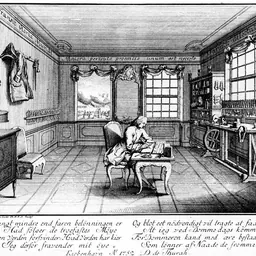
Sophie Magdalene led an extravagant lifestyle - despite Denmark's faltering economy. Following the fashion of queens of her day, she owned a lathe built by Diderich de Thurah, 1735–36, which she used for turning items of ivory or precious woods. It has been speculated that the love of Sophie Magdalene for the jewels and luxury came from her father-in-law, after watching him cover his consort, Anna Sophie von Reventlow, with jewels and other gifts. She also enjoyed fashion.
Queen Sophie Magdalene was accused of never having discarded her German, even though German culture and language had been dominant at the Court before her time: the first member of the Danish royal family who spoke Danish rather than German was in fact Sophie Magdalene's great grandson, Frederik VI. The Queen learned Danish, but German was the language spoken at court and in high society.
As a queen, she received several of her relatives in Denmark. Her younger sister, Sophie Caroline, Dowager Princess of Ostfriesland, was appointed by her as abbess at Vallø stift, with an annual pension of 16,600 thalers, a large sum in those times. At the National Archives is a letter from Sophie Magdalene to her husband. She asked him to allow the return of her sister to Ostfriesland. The reason was that the queen was violently jealous of her, and was sure that Sophie Caroline and Christian VI had an affair. The king replied "that he with all his heart was willing to let her go, if with this he could win his wife's confidence and heart, but it would hurt the Princess". At end, Sophie Caroline was not expelled. The suspected affair became known enough to have been the subject of the later court case of Anna Sophie Magdalene Frederikke Ulrikke, who claimed to have been the result of the purported affair. Two of Sophie Magdalene's brothers were Danish admirals, and her mother, Dowager Margravine Sophie Christiane of Brandenburg-Kulmbach, arrived to Denmark after the announcement of Sophie Magdalene's first pregnancy in 1723, staying at Sorgenfri Palace in Kongens Lyngby, where she remained for the rest of her life until her death in 1737. While her influence over her spouse was great, she does not seem to have shown much interest for politics, and when he at one point suggested that she be made regent if their son should succeed him while still a child, she displayed great dislike for and disinterest in the idea. In addition, Sophie Magdalene also hosted almost all Christian's birthdays celebrations. Sophie Magdalene was distantly related with King Christian VII's mistress, Anne Cathrine Benthagen, the famous Støvlet-Cathrine, who reportedly was the illegitimate daughter of Prince Georg Ludwig of Brunswick-Bevern, whose sister was married with one of the queen's brothers. During Christian's reign, Moltke was disfavored and Danneskjöld was favored on her advice.
She spent her later years in bad health, or, as it was said, in hypochondria. She died in Christiansborg Palace on 27 May 1770 and was buried in Roskilde Cathedral.
Her sarcophagus with embroidered coats of arms, in Roskilde Cathedral, Denmark.
Issue Frederick V of Denmark (31 March 1723 – 14 January 1766) Princess Louise (19 June 1724 – 20 December 1724) Princess Louise (19 October 1726 – 8 August 1756), married Ernest Frederick III, Duke of Saxe-Hildburghausen.
Ancestry
Don’t just read it —
keep it.
Full-length biographies made to live with: read them, listen on the way to work, watch them tonight.
- E-book
- Audio
- Video
Instant download · yours to keep · every purchase keeps this site free
Important facts
Family & relationships
People in Sophia Magdalene of Brandenburg-Kulmbach's life
Named in this biography and alive at the same time

Related people
Same field, nearest in time
Contemporaries
People whose lives overlapped Sophia Magdalene of Brandenburg-Kulmbach's

Frequently asked questions
Who was Sophia Magdalene of Brandenburg-Kulmbach?
Queen consort of Denmark and Norway
When was Sophia Magdalene of Brandenburg-Kulmbach born?
Sophia Magdalene of Brandenburg-Kulmbach was born on 28 November 1700 in Schönberg.
When did Sophia Magdalene of Brandenburg-Kulmbach die?
Sophia Magdalene of Brandenburg-Kulmbach died on 27 May 1770 in Christiansborg Palace.
What was Sophia Magdalene of Brandenburg-Kulmbach's occupation?
Sophia Magdalene of Brandenburg-Kulmbach was a consort.
What nationality was Sophia Magdalene of Brandenburg-Kulmbach?
Sophia Magdalene of Brandenburg-Kulmbach was Norwegian, Danish and German.
Sources & further reading
· Wikipedia: Sophia Magdalene of Brandenburg-Kulmbach
· DBpedia: Sophie Magdalene of Brandenburg-Kulmbach
Cite this page
APA: Biography.guide. (2026). Sophia Magdalene of Brandenburg-Kulmbach. https://biography.guide/sophia-magdalene-of-brandenburg-kulmbach/
MLA: "Sophia Magdalene of Brandenburg-Kulmbach." Biography.guide, https://biography.guide/sophia-magdalene-of-brandenburg-kulmbach/.
Chicago: "Sophia Magdalene of Brandenburg-Kulmbach." Biography.guide. https://biography.guide/sophia-magdalene-of-brandenburg-kulmbach/.
Data last updated: 2026-10-02 · Spot an error? Report a correction.
Portrait: Wikimedia Commons · author & licence
Page generated 2026-10-05 04:09 UTC