
About Maria Amalia of Austria
Lived 1701 – 1756 (aged 55). Maria Amalia of Austria was a German consort.
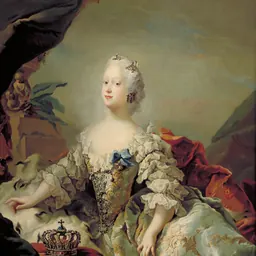
Maria Amalia of Austria (; 22 October 1701 – 11 December 1756) was Holy Roman empress, queen of Bohemia, and electress of Bavaria among many other titles as the spouse of Emperor Charles VII. By birth, she was an archduchess of Austria as the daughter of Emperor Joseph I. One of her children was Maximilian III Joseph, Elector of Bavaria.
Biography
Early life Maria Amalia was born on 22 October 1701 in the Hofburg in Vienna eleven weeks after the death of her infant brother Leopold Joseph, her parents' only son. Her mother, Wilhelmine Amalia of Brunswick-Lüneburg, was unable to conceive more children after her, supposedly because her father had contracted syphilis and passed it onto his wife, rendering her infertile.
Maria Amalia and her elder sister, Maria Josepha were both given a very strict Catholic upbringing by their mother, but Maria Amalia was described as having a more vivid and extroverted personality than her sister.
When Maria Amalia was nine years old, her father died of smallpox and was succeeded by his brother Charles VI. During the reign of Maria Amalia's grandfather Leopold I, his two sons, the future Joseph I and Charles VI signed the Mutual Pact of Succession, which gave Joseph's daughters precedence in the order of succession over Charles' daughters (if neither had sons). Charles replaced this with the Pragmatic Sanction of 1713. This put Maria Amalia and her elder sister Maria Josepha behind his own future daughters, the first of whom, Maria Theresa, would be born in 1717. The displaced archduchesses were not allowed to marry until they renounced their rights to the throne.
Marriage
Maria Amalia was proposed as a bride for Victor Amadeus, Prince of Piedmont, heir to the Kingdom of Sicily and the Duchy of Savoy in the hope that the union would create better relations between Savoy and Austria. However, the prince's father, King Victor Amadeus II did not agree to the plan, and the suggested groom died of smallpox in 1715.
In 1717, Maria Amalia met her future spouse, Charles Albert, Hereditary Prince of Bavaria, when he visited Vienna on his way to participate in the Siege of Belgrade. Charles Albert used his time in the city become acquainted with the imperial family, wishing to marry into the House of Habsburg for dynastic and economic reasons. They met for a second time in 1718. Charles Albert initially asked to marry her elder sister, Maria Josepha, but she was already engaged.
After she had recognised the Pragmatic Sanction and effectively renounced her right to the throne, Maria Amalia married Charles Albert on 5 October 1722 in Vienna. She received a great dowry, including jewelry worth 986 500 guilders. The opera by Tomaso Albinoni was performed at the wedding, but the wedding was not celebrated as much in Vienna as it would be in Munich, where festivities lasted from 17 October to 4 November.
The couple lived in the Nymphenburg Palace in Munich and had seven children. In May 1727, after the birth of the heir, Maximilian Joseph, Maria Amalia was gifted the Fürstenried Palace as her own residence. In 1734, Charles Albert named the Amalienburg in the Nymphenburg Palace Park after her. Their relationship was described as a moderately happy one despite Charles Albert's infidelity and illegitimate children, as they had similar personalities and interests. They both enjoyed court life, pomp, and festivals, made the Bavarian court a cultural center together. Maria Amalia liked operas and her apartments are regarded as a notable example of Rococo interior design. She was interested in politics, had a passion for hunting, and liked to travel, arguing that pilgrimages would help her have sons. She supported churches and convents and had a close relationship with her sister-in-law Maria Anna Karolina, a Poor Clare.
Despite the fact that Maria Amalia had renounced her claims to the Habsburg monarchy upon her marriage, Charles Albert claimed them in her name during the War of the Austrian Succession after her uncle, Charles VI died. After an agreement with King Augustus III of Poland, the husband of her elder sister Maria Josepha (who would otherwise have a stronger claim), her husband invaded Bohemia. Maria Amalia was crowned queen of Bohemia in Prague on 7 December 1741. On 12 February 1742, she became Holy Roman empress following her husband's coronation as emperor in Frankfurt. On 14 February 1742, Bavaria was occupied by Austria.
Death
Maria Amalia's husband died on 20 January 1745 and was buried at the Theatine Church in Munich. She persuaded her son, the new elector, Maximilian, to make peace with her cousin Maria Theresa. As a widow, she mainly resided at Fürstenried Palace. In 1754, she started the first modern hospital in the city, managed by nuns of the Order of Saint Elisabeth who she had invited to found a convent.
Maria Amalia died in Munich in the Nymphenburg Palace on 11 December 1756, 5= 5. Eleonore-Magdalena of Neuburg 6= 6. John Frederick, Duke of Brunswick-Lüneburg 7= 7. Benedicta Henrietta of the Palatinate 8= 8. Ferdinand III, Holy Roman Emperor 9= 9. Maria Anna of Spain 10= 10. Philipp Wilhelm, Elector Palatine 11= 11. Elisabeth Amalie of Hesse-Darmstadt 12= 12. George, Duke of Brunswick-Lüneburg 13= 13. Anne Eleonore of Hesse-Darmstadt 14= 14. Edward, Count Palatine of Simmern 15= 15. Anna Gonzaga
Don’t just read it —
keep it.
Full-length biographies made to live with: read them, listen on the way to work, watch them tonight.
- E-book
- Audio
- Video
Instant download · yours to keep · every purchase keeps this site free
Important facts
Family & relationships
People in Maria Amalia of Austria's life
Named in this biography and alive at the same time



Related people
Same field, nearest in time

Contemporaries
People whose lives overlapped Maria Amalia of Austria's



Frequently asked questions
Who was Maria Amalia of Austria?
queen of Bohemia
When was Maria Amalia of Austria born?
Maria Amalia of Austria was born on 22 October 1701 in Vienna.
When did Maria Amalia of Austria die?
Maria Amalia of Austria died on 11 December 1756 in Nymphenburg Palace.
What was Maria Amalia of Austria's occupation?
Maria Amalia of Austria was a consort.
What nationality was Maria Amalia of Austria?
Maria Amalia of Austria was German.
Sources & further reading
· Wikipedia: Maria Amalia of Austria
· DBpedia: Maria Amalia, Holy Roman Empress
Cite this page
APA: Biography.guide. (2026). Maria Amalia of Austria. https://biography.guide/maria-amalia-of-austria/
MLA: "Maria Amalia of Austria." Biography.guide, https://biography.guide/maria-amalia-of-austria/.
Chicago: "Maria Amalia of Austria." Biography.guide. https://biography.guide/maria-amalia-of-austria/.
Data last updated: 2026-09-20 · Spot an error? Report a correction.
Page generated 2026-09-27 05:25 UTC