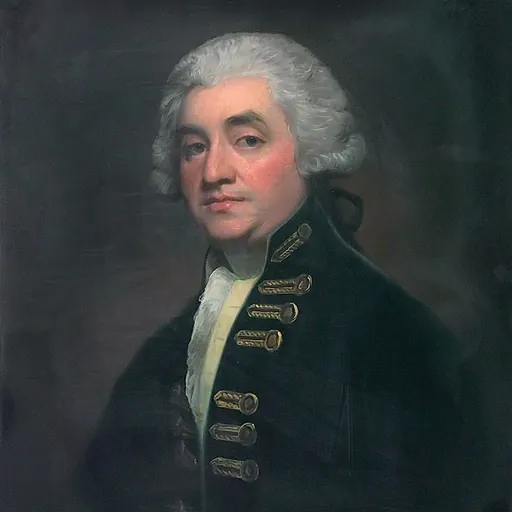
About Sir Joshua Rowley, 1st Baronet
Lived 1734 – 1790 (aged 55). Sir Joshua Rowley, 1st Baronet was a British naval officer.
Vice-Admiral of the White Sir Joshua Rowley, 1st Baronet (1 May 1734 – 26 February 1790) was a Royal Navy officer who served in the War of the Austrian Succession, Seven Years' War and American War of Independence. The fourth son of Admiral of the Fleet Sir William Rowley, he served with distinction in a number of battles throughout his career and was highly praised by his contemporaries. Unfortunately whilst his career was often active he did not have the opportunity to command any significant engagements and always followed rather than led. His achievements have therefore been eclipsed by his contemporaries such as Augustus Keppel, Edward Hawke, Richard Howe and George Rodney.
Early career and the Battle of Toulon
He entered the navy and served on his father's flagship and served at the battle of Toulon, a battle that was exceptionally controversial despite its inconclusive outcome and led Admiral Thomas Mathews and several of his Captains to be dismissed from the Royal Navy. Admiral William Rowley then became Commander-in-Chief of the Mediterranean until 1748. Joshua Rowley remained with his father and was promoted to the rank of lieutenant on 2 July 1747. In 1752 Rowley's name appears once more serving as lieutenant aboard the 44-gun fifth-rate frigate . On 4 December 1753 he was promoted to post-captain and given command of the sixth-rate of 24-guns. By March 1755 he had been appointed to , a fifth Rate 40-gun frigate that had been captured from the French during the War of the Austrian Succession in 1746. In Ambuscade he was attached to a squadron under Admiral Edward Hawke in the Bay of Biscay. During that short period Hawke's squadron captured over 300 enemy merchantmen. By the time Hawke had replaced the unfortunate Admiral John Byng at Minorca in 1756 Rowley had been moved to the 50-gun .
Seven Years' War
By October 1757 Rowley had been given the task of commissioning the 60-gun fourth-rate . Once launched she joined Admiral Henry Osborn's fleet of 14 ships of the line in the Mediterranean. Osborn was at the time blockading a French squadron under Admiral Jean-François de La Clue-Sabran in Cartagena, preventing them from joining the French fleet off Louisburg. Michel-Ange Duquesne de Menneville had been ordered to break through the British blockade and reinforce La Clue-Sabran and then with superiority of numbers break out of Cartagena and make their way to Louisbourg. Osborn intercepted Duquesne and his three ships of the line and one frigate on 28 February 1758 at the Battle of Cartagena. Osborn's squadron captured two French ships of the line, and under the guns of the Spanish castle the 60-gun Oriflamme was driven ashore by Montagu and .
Battle of Saint Cast
Rowley joined Admiral Anson's fleet in the channel in 1758 and took part in the fateful expeditions along the coast of France.
The expedition, which took place throughout early September 1758 was a massive undertaking. Britain's Naval forces were under the command of Admiral Lord Anson, seconded by Commodore Howe. Britain's Land forces were commanded by Lieutenant-General Thomas Bligh. These included twenty two ships of the line with nine frigates and Commodore Howe's one third-rate, four fourth-rates, ten frigates, five sloops, two fire-ships, two bomb ketches, one hundred transports, twenty tenders, ten store-ships and ten cutters . The land forces consisted of four infantry brigades and a few hundred Light Dragoon cavalry, totaling over 10,000 soldiers.
Initially the expedition met with considerable success capturing the port of Cherbourg. The British destroyed the port, the docks and the ships harbored there, carrying off or destroying considerable war material and goods. Captain Rowley was wounded and was left on the beach. Along with captains Maplesden, Paston, and Elphinstone he was taken prisoner on the beach.
With the huge loss of life and military equipment, the battle ended British hopes of an invasion of Brittany during the Seven Years' War. The battle was an embarrassment for both the British Army and Navy. The French had designs to invade Scotland and had been ordered to break through the blockading British ships and collect transports for the invasion. On 20 November, 23 ships of Hawke’s squadron that had been sheltering from the seasonal gales in Torbay caught up with and attacked 21 Ships of the Line under Admiral Conflans in Quiberon bay. The bay itself is infamous due to its clustered and hidden shoals and variable wind and weather. The battle was fought directly through the dangerous shoals and the British lost two ships wrecked on the shoals and the French lost six with another successfully captured. The battle has been described by several later historians as the "Trafalgar" of the Seven Years' War. The risks of taking such a large fleet into the dangerous shoals of the bay with the Atlantic gales beating down upon them separated Hawke from many of his contemporaries and showed not only his daring genius but the confidence that he inspired in his subordinates. The French were equally impressed at the daring and audacity of the British Naval commanders and it took a great many years for them to recover. He accompanied an East India Company convoy in that year and returned to England. In 1762, with two frigates, , under a young Captain John Jervis, and , in company, he took another convoy of East and West Indian trade to the westward, and successfully protected it from the squadron of Commodore de Ternay. "So highly, however, was his conduct approved, by the East India Company, and by the London West - India merchants, that they presented him with a handsome silver epergne and dish". It was during this period that Rowley took a particular interest in the career of midshipman Erasmus Gower, appointing him to acting lieutenant and recommending to the Admiralty that Gower serve on loan to the Portuguese Navy. Gower's subsequent distinguished career carried all the hallmarks of Rowley's influence. After several years on the beach, in October 1776 Rowley was appointed to the 74-gun , in which at the beginning of 1778 he convoyed some transports to Gibraltar.
Battle of Ushant
On his return to England he was attached to the fleet under Admiral Keppel whom he had last seen leading the van at the Battle of Quiberon Bay in HMS Torbay. It was with Keppel on 27 July 1778 that Rowley led the van (on the starboard tack) at the First Battle of Ushant. Monarch had two killed and nine wounded. Once more Rowley was involved in a battle that ended ambiguously and yet caused great upheaval and political and naval ramifications. As a consequence of the battle Keppel resigned his command after a court-martial acquitted him. Admiral Hugh Palliser was also court martialled and was heavily criticized leading to his resignation as a member of parliament.
Battles of Grenada & Gaudeloupe
At the end of 1778 Rowley moved into the 74-gun and was sent to the West Indies with a commodore's Broad pennant in command of a squadron of seven ships, as a reinforcement to Admiral John Byron, whom he joined at Saint Lucia in February 1779. On 19 March he was promoted to rear-admiral of the blue. The battle was a draw and did little to change the course of the war that was already moving into its closing stages.
Later that year Rowley captured two French frigates and a sloop-of-war. They were, la Fortunée (42 guns), la Blanche (36 guns), and l'Ellis (28 guns). Rowley also led his squadron to capture of a large French convoy, from Marseilles, off Martinique. in which ship he commanded the rear division in the action off Martinique on 17 April against the comte de Guichen and the van in the two further stalemate engagements of 15 and 19 May. The three battles were inconclusive and when the hurricane season arrived de Guichen returned to Europe and Rodney sent Rowley to Jamaica with ten ships of the line to reinforce Sir Peter Parker, as there was an imminent threat to the colony from the Spanish.
Commander-in-Chief Jamaica In 1782 Rowley succeeded to the command of the Jamaica Station a post which he held until the end of the American War of Independence. Rowley had proved throughout his career that he was both brave and a very capable officer and yet the successes of other commanders of the Jamaica station had set an extraordinary precedent that he could not match in his brief time there. Sarah Rowley Arabella Rowley Sir William Rowley, 2nd Baronet, Member of Parliament for Suffolk 1812–1830, High Sheriff of Suffolk in 1791 Philadelphia Rowley, married Admiral Sir Charles Cotton Admiral Bartholomew Samuel Rowley, who also served as Commander-in-Chief of the Jamaica Station Reverend Joshua Rowley Admiral Sir Charles Rowley.
Don’t just read it —
keep it.
Full-length biographies made to live with: read them, listen on the way to work, watch them tonight.
- E-book
- Audio
- Video
Instant download · yours to keep · every purchase keeps this site free
Important facts
People in Sir Joshua Rowley, 1st Baronet's life
Named in this biography and alive at the same time




Related people
Same field, nearest in time



Contemporaries
People whose lives overlapped Sir Joshua Rowley, 1st Baronet's





Frequently asked questions
Who was Sir Joshua Rowley, 1st Baronet?
Royal Navy vice-admiral
When was Sir Joshua Rowley, 1st Baronet born?
Sir Joshua Rowley, 1st Baronet was born on 1 May 1734 in Suffolk.
When did Sir Joshua Rowley, 1st Baronet die?
Sir Joshua Rowley, 1st Baronet died on 26 February 1790 in Suffolk.
What was Sir Joshua Rowley, 1st Baronet's occupation?
Sir Joshua Rowley, 1st Baronet was a naval officer.
What nationality was Sir Joshua Rowley, 1st Baronet?
Sir Joshua Rowley, 1st Baronet was British.
Sources & further reading
· Wikipedia: Sir Joshua Rowley, 1st Baronet
Cite this page
APA: Biography.guide. (2026). Sir Joshua Rowley, 1st Baronet. https://biography.guide/sir-joshua-rowley-1st-baronet/
MLA: "Sir Joshua Rowley, 1st Baronet." Biography.guide, https://biography.guide/sir-joshua-rowley-1st-baronet/.
Chicago: "Sir Joshua Rowley, 1st Baronet." Biography.guide. https://biography.guide/sir-joshua-rowley-1st-baronet/.
Data last updated: 2026-09-20 · Spot an error? Report a correction.
Portrait: Wikimedia Commons · author & licence
Page generated 2026-09-27 04:57 UTC