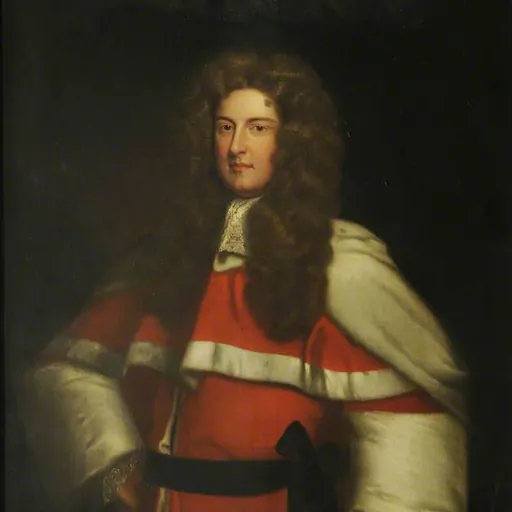
About Sir Gilbert Dolben, 1st Baronet
Lived 1658 – 1722 (aged 63–64). Sir Gilbert Dolben, 1st Baronet was a British and English judge and politician.
Sir Gilbert Dolben, 1st Baronet (1658–1722), of Finedon, Northamptonshire, was an English lawyer, landowner and Tory politician who sat in the English and British House of Commons between 1685 and 1715. He also served as a High Court judge in Ireland for many years. He was the grandfather of the leading anti-slavery campaigner Sir William Dolben.
Background
Dolben was the elder son of John Dolben, Archbishop of York, and his wife Catherine Sheldon, daughter of Ralph Sheldon of Stanton, Staffordshire. His background was strongly episcopal: he was a grand-nephew of Gilbert Sheldon, Archbishop of Canterbury and a more remote connection of John Williams, Archbishop of York. His uncle Sir William Dolben was a distinguished judge. He was the elder brother of John Dolben, who had a similar but much less successful career as a barrister and politician. He entered the Inner Temple in 1674, and was called to the Bar in 1680. For a short time, he pursued a career in diplomacy, but decided on a full-time legal practice. He was slow to build up his practice, something about which he grumbled a good deal, but did not suffer financially as he had married an heiress.
Dolben was returned unopposed as Tory MP for Peterborough at the 1690 in his own interest, and worked with the Court party. He conducted a considerable amount of routine parliamentary business, and was noted as one of the lawyers particularly interested in introducing legislative change. He was returned again at the 1695 general election. He refused to take the Oath of Association, introduced by the House of Commons after the failure of the Jacobite assassination plot 1696, apparently, because he objected to the reference to the life of King William III having been saved by divine providence, which in his view raised the question of whether he was King by Divine Right. As a result, he lost his place on the Commission of the Peace for the second time. In late March 1696, he voted against fixing the price of guineas at 22 shillings. He opposed the attainder of Sir John Fenwick for treason and made a long speech on 25 November 1696, arguing that the case should be dealt with by an ordinary process of criminal law, and voted against the attainder. He spoke and voted on many issues, but was a particularly strong supporter of the Blasphemy Act 1697. He did not stand at the 1698 English general election.
Dolben was returned again for Peterborough at the first general election of 1701. After Parliament was dissolved he was blacklisted for opposing the preparations for war against France. On 13 May 1701, he was appointed a judge of the common pleas in Ireland and about this time he was restored to the commission of the peace. He was returned at the second general election of 1701 and remained active in Parliament. He was involved in preparing a bill to prevent bribery at elections on 17 January 1702) and as a Tory, he supported the motion of 26 February 1702 which vindicated the Commons’ proceedings in the impeachments of William III's ministers. He was returned again for Peterborough in 1702, 1705 and 1708. At the 1710 British general election he transferred to Yarmouth, Isle of Wight, where he was returned as a Tory MP in the interest of John Richmond Webb, the Tory governor of the island. He was returned again at the 1713 British general election. He retained the post on the accession of Queen Anne in 1702. He remained a member of the English House of Commons, and divided his time between England and Ireland, somewhat to the neglect of his judicial duties. Though he was said to be on bad terms with Thomas Wharton, 1st Marquess of Wharton, the Lord Lieutenant of Ireland from 1708, his career in Ireland seems to have been uneventful. He was one of the few High Court judges who refused to become involved in the bitter feud between the Crown and Dublin Corporation in 1713–4. Perhaps for this reason, or perhaps because of his wealth and social standing (he had married an heiress and was made a baronet in 1704) he was the only senior Irish judge who was not removed from office in the general purge of the Irish judiciary which followed the death of Queen Anne. He solicited for a seat on the English Bench but did not receive it and remained on the Irish Bench until he retired in 1720. He was a bencher of his Temple and acted as its treasurer in 1721. He is said to have been one of the few investors who enriched themselves, rather than suffering losses, in the South Sea Bubble.
Family and personality
By 1683, Dolben married Anne Mulso, eldest daughter and co-heiress with her sister Elizabeth (who married his brother John) of Tanfield Mulso of Finedon Hall, Northamptonshire and his wife Mary Luther, a marriage which greatly increased his wealth. They had one surviving son, Sir John Dolben, 2nd Baronet, who was father of Sir William Dolben, 3rd Baronet, a leader in the movement for the abolition of slavery. He died at Finedon in October 1722.
For many years he was greatly troubled by the profligacy of his brother John, an inveterate gambler who ran through all his own money and then his wife's. In 1691 Gilbert wrote that John's wife and children were living on the charity of friends, something he described as shameful for the family, and a reproach to his father's memory, as critics accused the Archbishop of having been a neglectful parent.
He was a man of scholarly tastes: John Dryden acknowledged the help Dolben had given him in preparing his translations of Virgil.
Don’t just read it —
keep it.
Full-length biographies made to live with: read them, listen on the way to work, watch them tonight.
- E-book
- Audio
- Video
Instant download · yours to keep · every purchase keeps this site free
Important facts
People in Sir Gilbert Dolben, 1st Baronet's life
Named in this biography and alive at the same time



Related people
Same field, nearest in time

Contemporaries
People whose lives overlapped Sir Gilbert Dolben, 1st Baronet's





Frequently asked questions
Who was Sir Gilbert Dolben, 1st Baronet?
English lawyer and politician; (1658-1722)
When was Sir Gilbert Dolben, 1st Baronet born?
Sir Gilbert Dolben, 1st Baronet was born in 1658.
When did Sir Gilbert Dolben, 1st Baronet die?
Sir Gilbert Dolben, 1st Baronet died in 1722.
What was Sir Gilbert Dolben, 1st Baronet's occupation?
Sir Gilbert Dolben, 1st Baronet was a judge and politician.
What nationality was Sir Gilbert Dolben, 1st Baronet?
Sir Gilbert Dolben, 1st Baronet was British and English.
Sources & further reading
· Wikipedia: Sir Gilbert Dolben, 1st Baronet
· DBpedia: Sir Gilbert Dolben, 1st Baronet
Cite this page
APA: Biography.guide. (2026). Sir Gilbert Dolben, 1st Baronet. https://biography.guide/sir-gilbert-dolben-1st-baronet/
MLA: "Sir Gilbert Dolben, 1st Baronet." Biography.guide, https://biography.guide/sir-gilbert-dolben-1st-baronet/.
Chicago: "Sir Gilbert Dolben, 1st Baronet." Biography.guide. https://biography.guide/sir-gilbert-dolben-1st-baronet/.
Data last updated: 2026-09-21 · Spot an error? Report a correction.
Portrait: Wikimedia Commons · author & licence
Page generated 2026-09-27 04:58 UTC