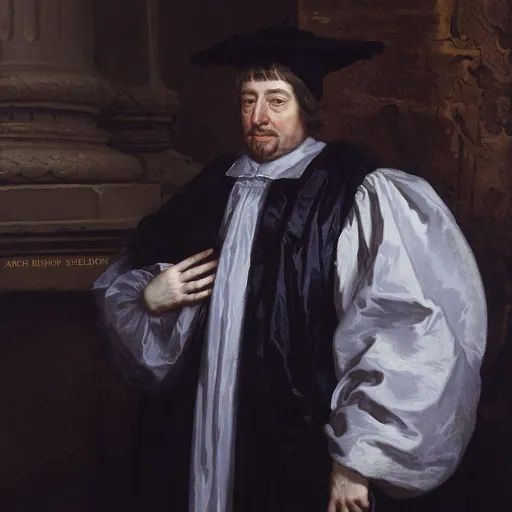
Gilbert Sheldon
Archbishop of Canterbury; Bishop of London
About Gilbert Sheldon
Lived 1598 – 1677 (aged 79). Gilbert Sheldon was a British anglican priest, theologian, bishop and archbishop.
Gilbert Sheldon (19 June 1598 – 9 November 1677) was an English religious leader who served as the Archbishop of Canterbury from 1663 until his death.
Early life Sheldon was born in Stanton, Staffordshire in the parish of Ellastone, on 19 June 1598, the youngest son of Roger Sheldon; his father worked for Gilbert Talbot, 7th Earl of Shrewsbury. He was educated at Trinity College, Oxford; he matriculated at Oxford on 1 July 1614, graduated BA from Trinity College on 27 November 1617, and MA(Oxon) on 28 June 1620. In 1619, he was incorporated at Cambridge. In 1622 he was elected fellow of All Souls' College, where he took the degrees of BD on 11 November 1628 and DD on 25 June 1634. In 1622, he was ordained, and shortly afterwards he became domestic chaplain to Thomas Coventry, 1st Baron Coventry.
In March 1636 he was elected warden of All Souls' on the death of Richard Astley. He had already made the acquaintance of William Laud, and corresponded with him on college business, university politics, and on the conversion of William Chillingworth from Roman Catholicism. Sheldon was not initially a Laudian, and he resisted (unsuccessfully) Laud's appointment of Jeremy Taylor to a fellowship at All Souls'. In 1634 and 1640 he was pro-vice-chancellor. In 1638 he was on the commission of visitation for Merton College; the visit produced a report requiring reforms.
Archbishop of Canterbury He was translated to become Archbishop of Canterbury in 1663: the congé d'élire was issued on 14 July, Sheldon was elected on 11 August, royal assent was given on 20 August and his election was confirmed (in a legal ceremony by which he officially took his new post) on 31 August at Lambeth Palace; he was enthroned by proxy and vested with the temporalities on 7 September. He was greatly interested in the welfare of the University of Oxford, of which he became Chancellor in 1667, succeeding Lord Clarendon, as Hyde now was. The Sheldonian Theatre at Oxford was built and endowed at his expense.
He accepted much purely secular work, acting as arbiter on petitions presented through him, and taking up investigations passed on by the king, especially in connection with the navy. Sheldon lost political influence after the fall of Clarendon in 1667, and by making Charles's philandering a matter of religious reproach. He was vocal against the Royal Declaration of Indulgence of 1672. notes = While serving as a bishop Sheldon's arms would be displayed impaled with the arms of the diocese and topped by a mitre.
Don’t just read it —
keep it.
Full-length biographies made to live with: read them, listen on the way to work, watch them tonight.
- E-book
- Audio
- Video
Instant download · yours to keep · every purchase keeps this site free
Important facts
People in Gilbert Sheldon's life
Named in this biography and alive at the same time


Related people
Same field, nearest in time


Contemporaries
People whose lives overlapped Gilbert Sheldon's





Frequently asked questions
Who was Gilbert Sheldon?
Archbishop of Canterbury; Bishop of London (1598-1677)
When was Gilbert Sheldon born?
Gilbert Sheldon was born on 19 June 1598 in Staffordshire.
When did Gilbert Sheldon die?
Gilbert Sheldon died on 9 November 1677 in Lambeth Palace.
What was Gilbert Sheldon's occupation?
Gilbert Sheldon was an anglican priest, theologian, bishop and archbishop.
What nationality was Gilbert Sheldon?
Gilbert Sheldon was British.
Sources & further reading
Cite this page
APA: Biography.guide. (2026). Gilbert Sheldon. https://biography.guide/gilbert-sheldon/
MLA: "Gilbert Sheldon." Biography.guide, https://biography.guide/gilbert-sheldon/.
Chicago: "Gilbert Sheldon." Biography.guide. https://biography.guide/gilbert-sheldon/.
Data last updated: 2026-09-22 · Spot an error? Report a correction.
Portrait: Wikimedia Commons · author & licence
Page generated 2026-09-27 05:03 UTC