
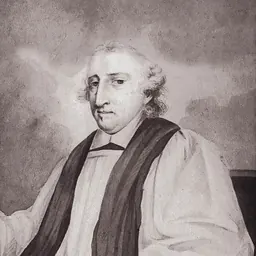
John Pearson
17th century English theologian and scholar
About John Pearson
Lived 1613 – 1686 (aged 73). John Pearson was an English anglican priest, theologian and bishop.
John Pearson (28 February 1613 – 16 July 1686) was an English theologian and scholar. He served with the Cavaliers in the English Civil War, acting as a chaplain to George Goring's forces.
Life He was born at Great Snoring, Norfolk.
From Eton College he passed to Queens' College, Cambridge, and was elected a scholar of King's College, Cambridge in April 1632, and a fellow in 1634. On taking orders in 1639 he was collated to the Salisbury prebend of Nether-Avon. In 1640 he was appointed chaplain to the lord-keeper Finch, by whom he was presented to the living of Thorington in Suffolk. In the Civil War he acted as chaplain to George Goring's Cavalier forces in the west. In 1654 he was made weekly preacher at St Clement's, Eastcheap, in London.
With Peter Gunning he disputed against two Roman Catholics, John Spenser and John Lenthall, on the subject of schism, a one-sided account of which was printed in Paris by one of the Roman Catholic disputants, under the title Scisme Unmask't (1658). Pearson also argued against the Puritan party, and was much interested in Brian Walton's polyglot Bible. In 1659 he published in London his celebrated Exposition of the Creed, dedicated to his parishioners of St Clement's, Eastcheap, to whom the substance of the work had been preached several years before. For example, in relation to the Christian cross, he wrote in his commentary on the Apostles' Creed that the Greek word stauros originally signified "a straight standing Stake, Pale, or Palisador", but that, "when other transverse or prominent parts were added in a perfect Cross, it retained still the Original Name", and he declared: "The Form then of the Cross on which our Saviour suffered was not a simple, but a compounded, Figure, according to the Custom of the Romans, by whose Procurator he was condemned to die. In which there was not only a straight and erected piece of Wood fixed in the Earth, but also a transverse Beam fastned unto that towards the top thereof".
Soon after the Restoration he was presented by Juxon, Bishop of London, to the rectory of St Christopher-le-Stocks; and in 1660 he was created doctor of divinity at Cambridge, appointed a royal chaplain, prebendary of Ely, archdeacon of Surrey, and Master of Jesus College, Cambridge. In 1661 he was appointed Lady Margaret's Professor of Divinity; and on the first day of the ensuing year he was nominated one of the commissioners for the review of the liturgy in the conference held at the Savoy. There he won the esteem of his opponents and high praise from Richard Baxter. On 14 April 1662 he was made Master of Trinity College, Cambridge. In 1667 he was admitted a fellow of the Royal Society.
Upon the death of John Wilkins in 1672, Pearson was appointed bishop of Chester. He died at Chester on 16 July 1686, and is buried in Chester Cathedral.
Theology According to Margaret Drabble, Pearson was one of the most erudite theologians of his age. Pearson's Exposition of the Creed, is considered one of the best products of English dogmatic theology.
Works In 1659 his Golden Remains of John Hales of Eton, with a memoir, was published. Also in 1659 was published his Exposition of the Creed in which the lectures which were given at the church of St Clement, Eastcheap, London, were included. (The notes are a rich mine of patristic learning.) In 1672 he published at Cambridge Vindiciae epistolarum S. Ignatii, in 4to, in answer to Jean Daillé. His defence of the authenticity of the letters of Ignatius has been confirmed by J. B. Lightfoot and other scholars. In 1682 his Annales cyprianici were published at Oxford, with John Fell's edition of Cyprian's works. His last work, the Two Dissertations on the Succession and Times of the First Bishops of Rome, formed with the Annales Paulini the principal part of his Opera posthuma, edited by Henry Dodwell in 1688.
See the memoir in Biographia Britannica, and another by Edward Churton, prefixed to the edition of Pearson's Minor Theological Works (2 vols., Oxford, 1844). Churton also edited almost the whole of the theological writings.
Notes and references
Don’t just read it —
keep it.
Full-length biographies made to live with: read them, listen on the way to work, watch them tonight.
- E-book
- Audio
- Video
Instant download · yours to keep · every purchase keeps this site free
Important facts
People in John Pearson's life
Named in this biography and alive at the same time



Related people
Same field, nearest in time



Contemporaries
People whose lives overlapped John Pearson's





Frequently asked questions
Who was John Pearson?
17th century English theologian and scholar
When was John Pearson born?
John Pearson was born on 28 February 1613 in Great Snoring.
When did John Pearson die?
John Pearson died on 16 July 1686 in Chester.
What was John Pearson's occupation?
John Pearson was an anglican priest, theologian and bishop.
What nationality was John Pearson?
John Pearson was English.
Sources & further reading
· DBpedia: John Pearson (bishop)
Cite this page
APA: Biography.guide. (2026). John Pearson. https://biography.guide/john-pearson-anglican-priest/
MLA: "John Pearson." Biography.guide, https://biography.guide/john-pearson-anglican-priest/.
Chicago: "John Pearson." Biography.guide. https://biography.guide/john-pearson-anglican-priest/.
Data last updated: 2026-09-26 · Spot an error? Report a correction.
Page generated 2026-09-27 05:15 UTC