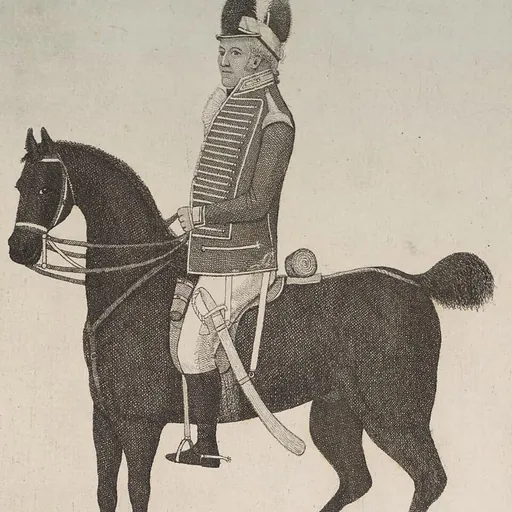
About Sir George Nugent, 1st Baronet
Lived 1757 – 1849 (aged 91). Sir George Nugent, 1st Baronet was a British politician and military officer.
Field Marshal Sir George Nugent, 1st Baronet, (10 June 1757 – 11 March 1849) was a British Army officer. After serving as a junior officer in the American Revolutionary War, he fought with the Coldstream Guards under the Duke of York during the Flanders Campaign. He then commanded the Buckinghamshire Volunteers in the actions of St. Andria and Thuyl on the river Waal and participated in the disastrous retreat from the Rhine. He went on to be commander of the northern district of Ireland, in which post he played an important part in preventing the outbreak of unrest in Belfast during the Irish Rebellion, and then became Adjutant-General in Ireland. He went on to be Governor of Jamaica, commander of the Western District in England, commander of the Kent District in England and finally Commander-in-Chief, India.
Early life Born the illegitimate son of Lieutenant Colonel the Hon. Edmund Nugent (who was the only son of Robert Nugent, 1st Earl Nugent) and a Ms. Fennings. His father had another illegitimate son, Admiral of the Fleet Sir Charles Edmund Nugent. His father's half sister, Mary Elizabeth Nugent, married George Nugent-Temple-Grenville, 1st Marquess of Buckingham. Through his Mary, he inherited the title of Earl Nugent. Lord Buckingham's aunt, Hester Grenville, had married William Pitt, who became Prime Minister of the United Kingdom.
Nugent was educated at Charterhouse School and the Royal Military Academy, Woolwich.
Military career
He was commissioned as an ensign in the 39th Regiment of Foot on 5 July 1773 and was posted to Gibraltar. He transferred the 7th Regiment of Foot at New York with promotion to lieutenant in September 1777 and saw action at the Battle of Forts Clinton and Montgomery in October 1777 and then took part in the Philadelphia campaign during the American Revolutionary War. and a major in the same regiment on 3 May 1782.
Flanders and Ireland Promoted to lieutenant colonel in September 1783, Nugent was appointed commanding officer of the 97th Regiment of Foot and returned to England, but in the post-war cost reductions the regiment was disbanded and he instead became commanding officer of the 13th Regiment of Foot in 1787. He became an aide-de-camp to his brother-in-law, the Marquess of Buckingham, who was serving as Lord Lieutenant of Ireland, in November 1787. He exchanged into the Coldstream Guards as a company commander in October 1790 and served at the Siege of Valenciennes in May 1793, the Battle of Lincelles in August 1793 and the Siege of Dunkirk also in August 1793 under the Duke of York during the Flanders Campaign. He commanded the regiment under Sir Ralph Abercromby in the action at Fort St. Andries, and with Major General David Dundas at Tuil on the river Waal and participated in the disastrous retreat from the Rhine. Promoted to major general on 1 May 1796, he became Captain of St Mawes Castle on 5 November 1796 and served in that role until his death. He went on to be commander of the northern district of Ireland in 1798, in which post he played an important part in preventing the outbreak of unrest in Belfast during the Irish Rebellion of 1798, and became Adjutant-General in Ireland in August 1799. He also represented Charleville, County Cork in the last Irish House of Commons before the Acts of Union 1800. with promotion to local lieutenant general on 29 May 1802. While serving there, he strengthened the fort that had been built in 1709 in Harbour View. Named Fort Nugent, the fort guarded the eastern entrance of the city of Kingston Harbour, although all that remains there now is a Martello tower that was added after Nugent's departure. Promoted to the substantive rank of lieutenant general on 25 September 1803, Nugent returned to England in February 1806 and became commander of the Western District in England in August 1806. and created a baronet of Waddesdon in the county of Buckinghamshire on 11 November 1806. He bought Westhorpe House in Buckinghamshire in October 1808 and became commander of the Kent District in England in July 1809.
Having been appointed a Knight of the Order of the Bath on 1 February 1813 and promoted to full general on 4 June 1813, Nugent was replaced as Commander-in-Chief by Lord Moira in October 1813. and, having been elected Member of Parliament for Buckingham again in July 1818, he was awarded an honorary DCL by the University of Oxford in 1819. and later as honorary colonel of the 6th Regiment of Foot. Promoted to field marshal on 9 November 1846.
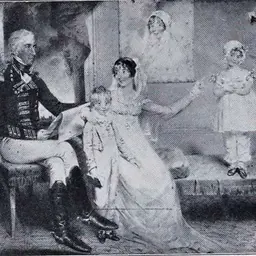
Personal life George Nugent, his wife Maria, and their children George and Louisa. Portrait by John Downman. On 16 November 1797, Nugent was married to Maria Skinner (1771–1834) in Belfast. Maria was a daughter of Cortlandt Skinner, the Attorney-General of New Jersey and a descendant of the Schuyler and Van Cortlandt families of British North America, Together, they had three sons and two daughters, including: Louisa Elizabeth Nugent (1803–1875), who married Thomas Fremantle, 1st Baron Cottesloe, the eldest son of Betsey and Adm. Sir Thomas Fremantle.
George and Maria Nugent lived at Stowe and enjoyed a close friendship with his aunt and uncle, Lord and Lady Buckingham.
Lady Nugent, who died in 1834, wrote a journal of her experiences in Jamaica first published in 1907. Sir George died at Westhorpe House on 11 March 1849 and was buried at St John the Baptist Church in Little Marlow.
Arms
Don’t just read it —
keep it.
Full-length biographies made to live with: read them, listen on the way to work, watch them tonight.
- E-book
- Audio
- Video
Instant download · yours to keep · every purchase keeps this site free
Important facts
People in Sir George Nugent, 1st Baronet's life
Named in this biography and alive at the same time



Related people
Same field, nearest in time



Contemporaries
People whose lives overlapped Sir George Nugent, 1st Baronet's




Frequently asked questions
Who was Sir George Nugent, 1st Baronet?
British Army officer (1757-1849)
When was Sir George Nugent, 1st Baronet born?
Sir George Nugent, 1st Baronet was born on 10 June 1757.
When did Sir George Nugent, 1st Baronet die?
Sir George Nugent, 1st Baronet died on 11 March 1849 in Westhorpe House.
What was Sir George Nugent, 1st Baronet's occupation?
Sir George Nugent, 1st Baronet was a politician and military officer.
What nationality was Sir George Nugent, 1st Baronet?
Sir George Nugent, 1st Baronet was British.
Sources & further reading
· Wikipedia: Sir George Nugent, 1st Baronet
· DBpedia: Sir George Nugent, 1st Baronet
Cite this page
APA: Biography.guide. (2026). Sir George Nugent, 1st Baronet. https://biography.guide/sir-george-nugent-1st-baronet/
MLA: "Sir George Nugent, 1st Baronet." Biography.guide, https://biography.guide/sir-george-nugent-1st-baronet/.
Chicago: "Sir George Nugent, 1st Baronet." Biography.guide. https://biography.guide/sir-george-nugent-1st-baronet/.
Data last updated: 2026-09-21 · Spot an error? Report a correction.
Portrait: Wikimedia Commons · author & licence
Page generated 2026-09-27 05:01 UTC