About Semerkhet
Lived 3000 BC – 2910 BC. Semerkhet was an Egyptian sovereign.
Name sources
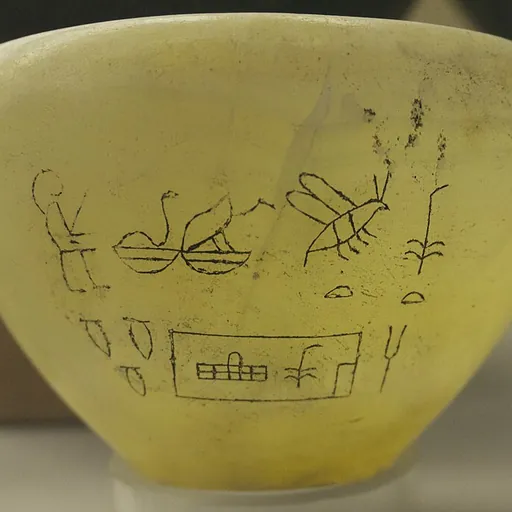
Semerkhet is well attested in archaeological records. His name appears in inscriptions on vessels made of schist, alabaster, breccia, and marble. His name is also preserved on ivory tags and earthen jar seals. Objects bearing Semerkhet's name and titles come from Abydos and Sakkara.
Semerkhet's serekh name is commonly translated as "companion of the divine community" or "thoughtful friend". The latter translation is questioned by many scholars, since the hieroglyph khet (Gardiner-sign F32) normally was the symbol for "body" or "divine community". M23:t-L2:t-G16-A21A
Scribes and priests of the Ramesside era were also confused, because the archaic ideogram that was used during Semerkhet's lifetime was very similar to the sign of an old man with a walking stick (Gardiner sign A19). This had been read as Semsu or Sem and means "the eldest". It was used as a title identifying someone as the head of the house. Due to this uncertainty, it seems that the compiler of the Abydos king list simply tried to imitate the original figure, whilst the author of the Royal Canon of Turin seems to have been convinced about reading it as the Gardiner-sign A19 and he wrote Semsem meaning, Horus the Elder, with uniliteral signs. The Saqqara King List omits Semerkhet's throne name. The reason for that is unknown, but all kings from Narmer up to king Den also are missing their throne names.
Identity
Virtually nothing is known about Semerkhet's family. His parents are unknown, but it is thought that one of his predecessors, king Den, might have been his father. Possibly, Semerkhet was born to queen Betrest. On the Cairo Stone she is described as his mother, but definite evidence for that view has not yet been found. It would be expected that Semerkhet had sons and daughters, but their names have not been preserved in the historical record. A candidate as a possible member of his family line is his immediate successor, king Qa'a.
Reign
Usurper debate An old theory, supported by Egyptologists and historians such as Jean-Philippe Lauer, Walter Bryan Emery, Wolfgang Helck, and Michael Rice once held that Semerkhet was a usurper and not the rightful heir to the throne. Their assumption was based on the observation that a number of stone vessels with Semerkhet's name on them, originally were inscribed with king Adjib's name. Semerkhet simply erased Adjib's name and replaced it with his own. Furthermore, they point out that no high official and priest associated with Semerkhet was found at Sakkara. All other kings, such as Den and Adjib, are attested in local mastabas.
Year by year records While the Cairo Stone reports the whole of Semerkhet's reign, unfortunately, the surface of the stone slab is badly worn and most of the events are now illegible. The following chart follows the reconstructions by Toby A. H. Wilkinson, John D. Degreef, and Hermann Alexander Schlögl:
Cairo Stone, main fragment: Year of coronation: Appearance of the king of Lower- and Upper Egypt; unifying the two realms; circumambulation of the White Wall of Memphis 1st year: Following of Horus; destruction of Egypt 2nd year: Appearance of the king; creation of a statue for Seshat and Sed 3rd year: Following of Horus... (rest is missing) 4th year: Appearance of the king of Upper Egypt; creation of the building ‘throne of Horus the harpooner’ 5th year: Following of Horus, creating an image of Min 6th year: Appearance of the king of Lower and Upper Egypt, festival of Sopdu 7th year: Following of Horus... (rest is missing) 8th year: Appearance of the king of Lower and Upper Egypt, creating an image of a cattle deity year of death: The ...th month and ...th day. (damaged)
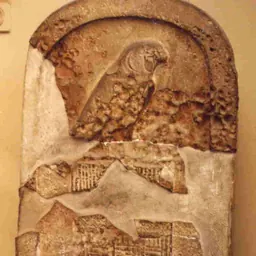
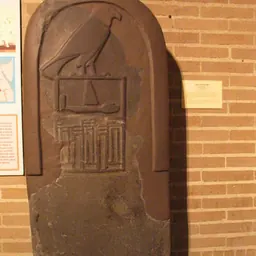
"Calamity" Egyptologists and historians pay special attention to the entry "Destruction of Egypt" in the second window of Semerkhet's year records. The inscription gives no further information about that event, but it has a resemblance to Manetho's report. The Eusebian version says: "His son, Semémpsês, who reigned for 18 years; in his reign a very great calamity befell Egypt." The Armenian version sounds similar: "Mempsis, 18 years. Under him many portents happened and a great pestilence occurred." None of the documents from after Semerkhet's reign provide any details about this "calamity". Semerkhet's burial site was excavated in 1899 by archaeologist and Egyptologist Sir William Matthew Flinders Petrie at Abydos and is known as "Tomb U". While excavating, Petrie found no stairways as he did at the necropolis of Den and Adjib. He found a ramp, four metres wide and leading straight into the main chamber. The ramp starts approximately ten metres east outside the tomb and has a base slope of 12°. Inside the tomb the ramp shows irregular graduations. Petrie was also confused by the small number of clay seals. Only 17 seals were found. For archaeologists and Egyptologists, the complete arrangement of the burial site suggests that the builders were pressed for time. When Petrie freed the ramp from sand, he found that the complete ramp was thickly covered in aromatic oil, which still gave off a scent. Beside the ramp several wooden and hand-made baskets and earthen jars were found. These were dated to the Ramesside era. Scholars now think that Semerkhet's tomb was re-opened and restored when Ramesside priests and kings saw the tomb of king Djer as the ritual burial of Osiris's head. The findings inside the main chamber included precious objects such as inlays and fragments of furniture (especially pedestals), copper-made armatures, and jewelry made of ebony, amethyst, and turquoise. Some vessels originating from the Levant were also found. They once contained Bescha oil, which was of great value to the Egyptians. Outside the tomb, close to the entrance, a damaged tomb stela made of black granite displaying Semerkhet's serekh name was excavated.
Don’t just read it —
keep it.
Full-length biographies made to live with: read them, listen on the way to work, watch them tonight.
- E-book
- Audio
- Video
Instant download · yours to keep · every purchase keeps this site free
Important facts
People in Semerkhet's life
Named in this biography and alive at the same time
Related people
Same field, nearest in time


Contemporaries
People whose lives overlapped Semerkhet's


Frequently asked questions
Who was Semerkhet?
Egyptian pharaoh
When was Semerkhet born?
Semerkhet was born in 3000 BC.
When did Semerkhet die?
Semerkhet died in 2910 BC.
What was Semerkhet's occupation?
Semerkhet was a sovereign.
What nationality was Semerkhet?
Semerkhet was Egyptian.
Sources & further reading
Cite this page
APA: Biography.guide. (2026). Semerkhet. https://biography.guide/semerkhet/
MLA: "Semerkhet." Biography.guide, https://biography.guide/semerkhet/.
Chicago: "Semerkhet." Biography.guide. https://biography.guide/semerkhet/.
Data last updated: 2026-09-20 · Spot an error? Report a correction.
Portrait: Wikimedia Commons · author & licence
Page generated 2026-09-27 04:57 UTC