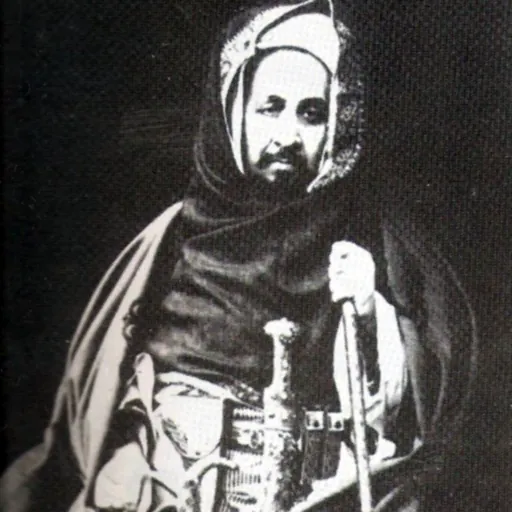
Sayyid Ahmed Sharif as-Senussi
Libyan supreme leader of the Senussi order
About Sayyid Ahmed Sharif as-Senussi
Lived 1873 – 1933 (aged 59). Sayyid Ahmed Sharif as-Senussi was a Libyan military personnel.
Ahmed Sharif as-Senussi (1873 – 10 March 1933) was the supreme leader of the Senussi order (1902–1933), although his leadership in the years 1917–1933 could be considered nominal. His daughter, Fatimah el-Sharif was the Queen consort of King Idris I of Libya.
Early life Ahmed Sharif was the grandson of Muhammad ibn Ali as-Senussi, who founded the Senussi religious order in Cyrenaica in the middle of nineteenth century. In 1895, as-Senussi accompanied his father, Mohammed ash Sharif, and his uncle Muhammed al-Mahdi, then leader of the Senussi order, on their trip from Jaghbub to Kufra, where they remained until 1899, and where Ahmed's father died in 1896.
In 1899 Mohammed el Mahdi and as-Senussi moved from Kufra to Zawiat Guru, in Chad, then to Bergo, aiming to check the French advance in Chad.
Struggle against the French In 1900, the French forces approached to Kanem, Mohammed el Mahdi assigned his nephew Ahmed to lead the struggle. Between those who fought with Mohammed el Barrani (Ruler of Zawiyat Ber Alali in Kanem), and Omar Al-Mukhtar, the future resistance leader in Libya.
On 1 June 1902, Mohammed el Mahdi died. Because his son Mohammed Idris was only 12 years old, he named, before his death, his nephew Ahmed Sharif to be his successor. Ahmed ash Sharif continued the struggle against the French in Chad which resulted at last into a failure as the French forces took Wadai in 1909 during the Wadai War.
Struggle against the Italians In October 1911 the Italians invaded Libya beginning the Italo-Turkish War, so as-Senussi suspended the struggle against the French in Chad and concentrated his efforts against the Italians. Sheikh as-Senussi quickly united the tribes of Cyrenaica to jihad against the Italians, forming three battalions of the Senussi. He worked with many Turkish officers against the Italians, such as Enver, Fethi, Mustafa Kemal, Cevat Abbas, Fuat Bulca, and Süleyman Askeri. The first major battle was attended by as-Senussi was Sidi Kraiyem near Derna. The battle itself was a setback to the Italian forces. As-Senussi was awarded the Order of Osmanieh, first class, for his service to the Ottoman Empire. After the Treaty of Ouchy the Senussis continued the struggle. In 1913, Mehmed V sent Sheikh as-Senussi cash, a sword decorated with precious stones, a watch, and a prayer rug.
In his book "The Road to Mecca", Muhammad Asad tells his personal acquittance with as-Senussi and his personal travel to Libya with as-Sanussi's request.
War with the British in Egypt
As-Senussi was one of the first to answer the call of jihad against the Allied Powers on November 14, 1914. With the outbreak of World War I, the Ottoman Empire came into conflict with the British Empire. Italy joined the Allies in May 1915.
In February 1915 the Turks attacked the Suez Canal. At first, Ahmed ash Sharif, already a deputy in North Africa for the Ottoman caliph, was not involved in the conflict against the British. But in November 1915, encouraged by the Turks, the Senussi horsemen under him invaded Egypt and took Sallum. British forces withdrew to Mersa Matruh. In 1915, after four years of hostilities, the Italian forces in Cyrenaica were almost confined to some separated points on the coast.
He was appointed Governor of Tripoli while he was fighting against the British. That title, and being made an honorary “ferik” increased his influence in the region. At one point he was given the title “Regent Sultan of Tripoli and the Benghazi Area." Senussi's uprising was not only a strategic asset for the Ottoman Empire, but also propaganda for the Islamic world, which was seen in the germination of pro-Senussi brochures. Since the Senussi had a great influence over the peoples of many Egyptian oases – Siwa, Kharga, and Dakhla, for example – the British had to take the Senussi threat seriously. Weakened by this defeat, as-Senussi conceded the leadership of the Senussi order to his 26-year-old cousin Mohammed Idris (later King Idris I of Libya), who conducted the negotiations with the British and Italians. Sheikh Ahmed and some tribes did not recognize this agreement and continued the raids. The struggle between the British and the Senussi forces continued intermittently until the end of the war.
On 10–11 August 1918 Enver Pasha ordered for Sheikh Senussi to be extracted from Tripoli. Embarking on a German submarine from the Gulf of Sirte, he was brought to the Austrian port of Pola, where he set off for Istanbul. He was welcomed at Sirkeci Station by the Enver Pasha, the Central Command, and a crowd of African immigrants. On the second day of his arrival in Istanbul on August 31, 1918, Sheikh Senussi girded Mehmed VI with a sword at a ceremony held in Eyüpsultan. During this time, he was given the rank of vizier and pasha and was hosted in Topkapı Palace as a guest of the Sultan.
Don’t just read it —
keep it.
Full-length biographies made to live with: read them, listen on the way to work, watch them tonight.
- E-book
- Audio
- Video
Instant download · yours to keep · every purchase keeps this site free
Important facts
People in Sayyid Ahmed Sharif as-Senussi's life
Named in this biography and alive at the same time

Related people
Same field, nearest in time





Contemporaries
People whose lives overlapped Sayyid Ahmed Sharif as-Senussi's



Frequently asked questions
Who was Sayyid Ahmed Sharif as-Senussi?
Libyan supreme leader of the Senussi order (1873–1933)
When was Sayyid Ahmed Sharif as-Senussi born?
Sayyid Ahmed Sharif as-Senussi was born on 18 December 1873 in Jaghbub.
When did Sayyid Ahmed Sharif as-Senussi die?
Sayyid Ahmed Sharif as-Senussi died on 10 March 1933 in Medina.
What was Sayyid Ahmed Sharif as-Senussi's occupation?
Sayyid Ahmed Sharif as-Senussi was a military personnel.
What nationality was Sayyid Ahmed Sharif as-Senussi?
Sayyid Ahmed Sharif as-Senussi was Libyan.
Sources & further reading
· Wikipedia: Sayyid Ahmed Sharif as-Senussi
· DBpedia: Ahmed Sharif as-Senussi
Cite this page
APA: Biography.guide. (2026). Sayyid Ahmed Sharif as-Senussi. https://biography.guide/sayyid-ahmed-sharif-as-senussi/
MLA: "Sayyid Ahmed Sharif as-Senussi." Biography.guide, https://biography.guide/sayyid-ahmed-sharif-as-senussi/.
Chicago: "Sayyid Ahmed Sharif as-Senussi." Biography.guide. https://biography.guide/sayyid-ahmed-sharif-as-senussi/.
Data last updated: 2026-09-22 · Spot an error? Report a correction.
Portrait: Wikimedia Commons · author & licence
Page generated 2026-09-27 05:02 UTC