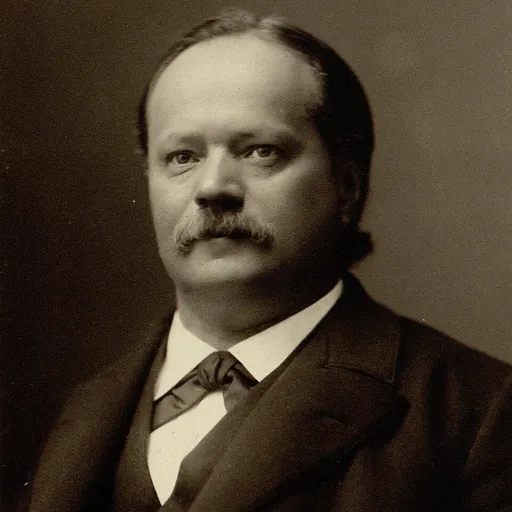
About Lazarus Fuchs
Lived 1833 – 1902 (aged 68). Lazarus Fuchs was a German mathematician and university teacher, known for Fuchs's theorem, Fuchsian group and Picard–Fuchs equation.
Lazarus Immanuel Fuchs (5 May 1833 – 26 April 1902) was a Jewish-German mathematician who made important contributions to the field of linear differential equations. He was born in Moschin in the Grand Duchy of Posen (modern-day Mosina, Poland) and died in Berlin, Germany. He was buried in Schöneberg in the St. Matthew's Cemetery. His grave in section H is preserved and listed as a grave of honour of the State of Berlin. Contribution He is the eponym of Fuchsian groups and functions, and the Picard–Fuchs equation. A singular point a of a linear differential equation
is called Fuchsian if p and q are meromorphic around the point a, and have poles of orders at most 1 and 2, respectively. According to a theorem of Fuchs, this condition is necessary and sufficient for the regularity of the singular point, that is, to ensure the existence of two linearly independent solutions of the form
where the exponents can be determined from the equation. In the case when is an integer this formula has to be modified.
Another well-known result of Fuchs is the Fuchs's conditions, the necessary and sufficient conditions for the non-linear differential equation of the form
to be free of movable singularities.
An interesting remark about him as a teacher during the period of his work at the Heidelberg University pertains to his manner of lecturing: his knowledge of the mathematics he was assigned to teach was so deep that he would not prepare before giving a lecture — he would simply improvise on the spot, while exposing the students to the train of thought taken by mathematicians of the finest degree.
Lazarus Fuchs was the father of , a German mathematician.
Selected works Über Funktionen zweier Variabeln, welche durch Umkehrung der Integrale zweier gegebener Funktionen entstehen, Göttingen 1881. Zur Theorie der linearen Differentialgleichungen, Berlin 1901. Gesammelte Werke, Hrsg. von Richard Fuchs und Ludwig Schlesinger. 3 Bde. Berlin 1904–1909.
Don’t just read it —
keep it.
Full-length biographies made to live with: read them, listen on the way to work, watch them tonight.
- E-book
- Audio
- Video
Instant download · yours to keep · every purchase keeps this site free
Important facts
People in Lazarus Fuchs's life
Named in this biography and alive at the same time


Related people
Same field, nearest in time


Contemporaries
People whose lives overlapped Lazarus Fuchs's


Frequently asked questions
Who was Lazarus Fuchs?
German mathematician (1833–1902)
When was Lazarus Fuchs born?
Lazarus Fuchs was born on 5 May 1833 in Mosina.
When did Lazarus Fuchs die?
Lazarus Fuchs died on 26 April 1902 in Berlin.
What was Lazarus Fuchs's occupation?
Lazarus Fuchs was a mathematician and university teacher.
What was Lazarus Fuchs known for?
Lazarus Fuchs was known for Fuchs's theorem, Fuchsian group and Picard–Fuchs equation.
What nationality was Lazarus Fuchs?
Lazarus Fuchs was German.
Sources & further reading
Cite this page
APA: Biography.guide. (2026). Lazarus Fuchs. https://biography.guide/lazarus-fuchs/
MLA: "Lazarus Fuchs." Biography.guide, https://biography.guide/lazarus-fuchs/.
Chicago: "Lazarus Fuchs." Biography.guide. https://biography.guide/lazarus-fuchs/.
Data last updated: 2026-09-20 · Spot an error? Report a correction.
Page generated 2026-09-27 05:09 UTC