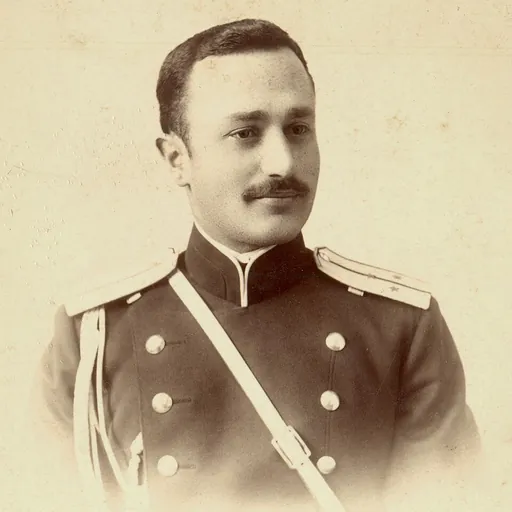
About Christophor Araratyan
Lived 1876 – 1937 (aged 61). Christophor Araratyan was a Russian military personnel.
Christophor Araratov (; Kristap'or Araratian, ) (June 18, 1876 – December 10, 1937), also known as Khachatur Araratian and Christapor Araratian, was an Armenian career officer of the Russian Imperial Army. He was promoted to the rank of Major General of the Armenian army during its fight for independence during and after World War I. Araratov participated in the 1918 battles of Sardarapat and Karakilisa against the Turkish invaders.
Armenian-American historian Richard G. Hovannisian describes Christophor Araratov: Minister of Military Affairs Kristapor Araratian was a relative latecomer to Armenian national affairs. As was not uncommon in the officer corps, he had been reared in a Russian milieu and had first served in the Caucasus during the world war. Distinguishing himself at the battle of Sardarabad as commander of the 2nd Artillery Brigade of the Armenian Corps, Colonel Araratian quickly advanced to the rank of major general. In March 1919 he was selected to replace Major General Hakhverdian as the nonpartisan military minister, a post he retained in the coalition, the interim, and [later] the regular cabinet of Alexandre Khatisian.For having fought to establish the independence of the First Republic of Armenia, in 1937 during the Great Purge of Joseph Stalin, Araratov was arrested and executed on charges of nationalism. Following Stalin's death in 1953, the Soviet government began a period of rehabilitation, which was extended posthumously to many of the tens of thousands of Stalin's victims. Araratov was rehabilitated and his awards were officially restored to him (via his survivors). His achievements were again acknowledged in history books. Araratov during the short-lived Republic of Armenia was described to be a "jolly and honest" soldier.
Early years Christophor Araratov was born in a noble family on June 18, 1876, in Tiflis (present day capital of Georgia). His father, Karapet Avetikovich Araratov, was a lieutenant colonel of the Russian Imperial Army.
General Tovmas Nazarbekian was selected as the Commanding Officer (Sparapet of Armenia). The Sparapet of Armenia Tovmas Nazarbekian appreciated the talent and skills of the colonel. Yerevan assigned 1st Division with 1st Erzurum/Erzincan regiment, 2nd Khnus Regiment, 3rd Yerevan Regiment, and 4th Erzinjan/Yerevan Regiments under General Christophor Araratov. In 1918 he was the head of artillery brigade of Armenian army.
Following the Russian Revolution, Araratov who had previously been serving in the Romanian front moved to Kars where the staff of the brigade was located. On March 3, 1918, the Grand Vizier Talaat Pasha signed the Treaty of Brest-Litovsk with the Russian SFSR. It stipulated that Bolshevik Russia cede Batum, Kars, and Ardahan. Between March 14 – April 1918, the Trabzon peace conference was held between the Ottoman Empire and the delegation of the Transcaucasian Sejm. The representatives in Tiflis acknowledged the existence of a state of war between themselves and the Ottoman Empire. With the fall of Kars, Araratov realized that the government of Transcaucasian Seym was not interested in struggle against the invader: Caucasian Turks supported Turkey to gain an alliance in founding their own independent state.
On May 11, 1918, a new peace conference opened at Batum. At this conference the Ottomans extended their demands to include Tiflis as well as Alexandropol and Echmiadzin; they intended to build a railroad to connect Kars and Julfa with Baku. The Armenian and Georgian members of the Republic's delegation began to stall. Beginning on May 21, the Ottoman army moved ahead again. The conflict led to the Battle of Sardarapat (May 21–29), the Battle of Kara Killisse (1918) (May 24–28), and the Battle of Bash Abaran (May 23–29).
Kemal Asad, commander of 9th Infantry Division of Turkish army, sent a message to Kemal Esad, commander of Attacking Group of Forces, about Armenian artillery during Sardarapat Battle, commanded by Kristapor Araratov:
During the Battle of Sardarapat, Araratov's artillery brigade fought bravely and took prisoners of a battery of Turkish soldiers. The victory at Sardarapat made Republic of Armenia independence possible.
After Sardarapat, Araratov was reassigned to the front against the Georgian Army, which occupied Lori in 1918. On October 30, the Armistice of Mudros was signed, and the Caucasus Campaign ended. The fights stopped before the New Year of 1919.
First Republic of Armenia Members of the Second Cabinet, October 1, 1919. Sitting (left to right): Avetik Sahakyan, Alexander Khatisian, Christophor Araratov, Standing (left to right): Nikol Aghbalian, Abraham Gyulkhandanyan, Sargis Araratyan.
In the start of 1919, all around Armenia Azerbaijanis excited rebellions. In that unstable situation on April 16, 1919, Prime Minister Hovhannes Kajaznuni left for Tiflis to conduct negotiations there and Alexander Khatisian became Acting Premier, with Araratov as Minister of War from March 27. The latter had replaced Hovhannes Hakhverdyan on this post and was promoted to the rank of Major General.
In April 1920 he was assigned to Kars as a military governor of the region. In October 1920, when the city yielded to Turks, he was taken prisoner by Turkey. Turkish General Kâzım Karabekir Pasha used to visit him in prison and offered him a chance to teach a course of Russian artillery at the Turkish military university. Araratov refused it several times.
In 24 years of military service from 1896 to 1920, Araratov only went on vacation for a total of about 3 months.
Soviet Armenia period At the end of 1921, Araratov was returned at the request of Aleksandr Myasnikyan to what was then Soviet Armenia. He took a position as head assistant of a rifle division. Later he was appointed as head of military chairs at Yerevan State University and then at National Economy Institute.
On September 2, 1937, during the Great Purge of Joseph Stalin, Araratov was arrested along with many other high-ranking military officers, who were accused of being "nationalists" and "anti-soviet activists" for their support of Armenian independence. After about three months, together with other heroes of Sardarapat: Movses Silikyan, Dmitry Mirimanov, Aghasi Varosyan, Stepan Ohanesyan, Hakob Mkrtchyan, and Harutyun Hakobyan, Araratov was taken on December 10 to Nork gorge and executed by a firing squad of the NKVD. Within Soviet territories, many more military and other suspected political enemies were executed.
The officers' awards were stripped from their names, their families were sometimes sent to labor camps in the gulag as enemies of the state, and the men's names were removed from history books.
Rehabilitation Following Stalin's death in 1953, the Soviet Union began rehabilitation of his victims of political repression. They first offered amnesty to prisoners held for non-political offenses, then began to release political prisoners as well. The government later rehabilitated numerous people posthumously, as they did for Araratov and Silikyan: restoring their medals and their places in history.
Personal life Araratov was married to a woman named Nina Ejubova and they had two children, Constantine and Elena. Elena was a very talented dancer whose career was greatly undermined on the basis that her father was executed as an enemy of the Soviet Union. Through her, he has a grandson, Yuriy Araratyan.
He was fluent in Armenian, Russian and French. His last name was banned under Soviet rule, due to Mount Ararat being associated with Armenian nationalism.
Famous Armenian writer and poet Khachik Dashtents wrote a poem about his teachers, among whom was Kristapor Araratov:
Legacy and honors Cross of St. George, 4th class (September 24, 1914) Order of Saint Stanislaus, 4th class with Swords and Bow (February 26, 1915) Order of Saint Stanislaus, 3rd class with Swords and Bow (March 1903) Order of Saint Stanislaus, 2nd class with Swords (December 1910) Order of St. Vladimir, 3rd class with Swords Order of St. Anna, 4th class, "For Courage" (January 6, 1916) Order of St. Anna, 3rd class with Swords and Bow (twice) (October 17, 1905, and April 27, 1916) Order of St. Anna, 2nd class with Swords (twice) (May 14, 1914, and June 5, 1915) Order of St. George, 4th class (August 26, 1916) Medal "In memory of Russian-Japanese War", Dark Bronze Order of the Crown, Commander class with Swords (September 20, 1917) Turkish medal in memory of Armenian Government visiting of Turkish Commandership of Halil Pasha
Don’t just read it —
keep it.
Full-length biographies made to live with: read them, listen on the way to work, watch them tonight.
- E-book
- Audio
- Video
Instant download · yours to keep · every purchase keeps this site free
Important facts
People in Christophor Araratyan's life
Named in this biography and alive at the same time





Related people
Same field, nearest in time






Contemporaries
People whose lives overlapped Christophor Araratyan's

Frequently asked questions
Who was Christophor Araratyan?
Armenian general (1876–1937)
When was Christophor Araratyan born?
Christophor Araratyan was born on 18 June 1876 in Nalchik.
When did Christophor Araratyan die?
Christophor Araratyan died on 10 December 1937 in Yerevan.
What was Christophor Araratyan's occupation?
Christophor Araratyan was a military personnel.
What nationality was Christophor Araratyan?
Christophor Araratyan was Russian.
Sources & further reading
· Wikipedia: Christophor Araratyan
· DBpedia: Christophor Araratov
Cite this page
APA: Biography.guide. (2026). Christophor Araratyan. https://biography.guide/christophor-araratyan/
MLA: "Christophor Araratyan." Biography.guide, https://biography.guide/christophor-araratyan/.
Chicago: "Christophor Araratyan." Biography.guide. https://biography.guide/christophor-araratyan/.
Data last updated: 2026-09-20 · Spot an error? Report a correction.
Portrait: Wikimedia Commons · author & licence
Page generated 2026-09-27 04:57 UTC