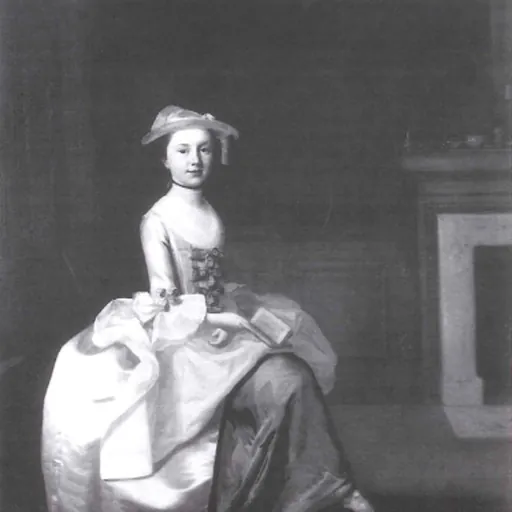
About Sarah Scott
Lived 1720 – 1795 (aged 75). Sarah Scott was a British novelist, historian, translator and writer.
Sarah Scott (née Robinson; 21 September 1720 – 3 November 1795) was an English novelist, translator, social reformer, and member of the Bluestockings. Her most famous work was her utopian novel A Description of Millenium Hall and the Country Adjacent, followed closely by the sequel The History of Sir George Ellison.
Early life Sarah's father, Matthew Robinson, and her mother, Elizabeth Drake, were both from distinguished families, and Sarah was the youngest of nine children. Although born in Yorkshire, she spent much time with her siblings in Cambridge, England, where her grandmother, Sarah Morris Drake, lived with her stepgrandfather, Dr. Conyers Middleton, a famous scholar at Cambridge University. All but one of her brothers would go on to a highly accomplished career, yet her elder sister, who would later become the writer and social activist Elizabeth Montagu, became the most accomplished, earning fame in literary circles as a critic of Shakespeare and founder of the Bluestockings, of which Sarah also became a member. The sisters were emotionally close in their early years. Although Elizabeth was much more acclaimed as an author, Elizabeth often considered Sarah to be "superior in certain respects, particularly intellectual and literary interests, in which she encouraged her." The two regularly corresponded with each other in letters which have been preserved, along with other letters Sarah wrote throughout her life, discussing such matters as "French and English literature and histories, writing, translation, and politics." Sarah's letters also revealed an early love of literature, especially the works of Spenser, Sidney, Milton, Swift, and Voltaire.
Sarah contracted smallpox in 1741, a disease that would often leave its victims scarred and disfigured, "lowering [their] value in the marriage market." Sarah would later create a fictional character in Millenium Hall who had the telltale marks of smallpox that diminished her complexion but not her character.
A year after Sarah's illness, her sister Elizabeth, after being befriended by Lady Margaret Harley and introduced to the highest circles of London life, married the wealthy 50-year-old Edward Montagu, grandson of the Earl of Sandwich. Sarah stayed home to tend to her mother, who was dying of cancer. After her mother died in 1746, Sarah visited Elizabeth and Edward in Bath. She chose to stay and care for the invalid Lady Barbara Montagu, or Lady Bab, with whom she developed a very close friendship. In 1748, the two women combined their finances and set up house together. Millenium Hall went through four editions by 1778. Interest in its feminist aspects and implications brought it back into public attention in the late 20th century.
Later life
In 1763, Lady Barbara gained a pension of £300, which floated the household finances sufficiently, and Sarah did not write for a couple of years. But with Lady Barbara's death in 1765 and with the encouragement and insistence of her sister, Sarah again began writing. The History of Sir George Ellison was published in 1766. This sequel to Millenium Hall portrays the eponymous narrator's "charitable deeds" inspired by his visit to Millennium Hall. His actions include "institut[ing] reforms on his plantations in Jamaica and devis[ing] schemes to relieve the poor in England, employing aged laborers on the grounds of his house, initiating a fund for the release of prisoners, and paying for the educations of females of different ranks." Again, the novel was utopian, but it also contained elements of the "patriot kings" that Sarah wrote about in her political writings.
The next year, Sarah attempted to create a real Millennium Hall in Buckinghamshire, a "communal household" that would include "a school and other charitable institutions for the impoverished community." Sarah invited fellow writer Sarah Fielding, among others, to come live with her. Each member invested £50 into the project. Sarah's sister Elizabeth Montagu donated livestock, land, and staff. Even though the project began with success, "financial difficulties, ill health, and quarrels between the members of the community led to the eventual dissolution of this real-life Millenium Hall."
After some work in translation and educational writing that was never published, Sarah published in 1772 The Life of Theodore Aggrippa d'Aubigne. As a response to emerging populism this work was about the life of a Protestant who fought against both mob rule and the absolute monarchy of the king. Sarah published in that same year her final novel, The Test of Filial Duty, which was an epistolary novel addressing the rights of a daughter to choose her husband.
In 1775, Edward Montagu, Elizabeth's husband, died, and Elizabeth gave Sarah £200 a year. In 1778, Sarah's father died, which gave her more money. She produced no more published works in her lifetime. After a lengthy illness, Sarah died on 11 November 1795 in Catton, Norwich. Per instructions Sarah left, most of her letters were destroyed by executor of her estate. By the 19th century, her name was largely forgotten, and her works were attributed to other writers, including novelist and playwright Oliver Goldsmith. Renewed interest in Sarah Scott and her work has emerged in recent literary criticism.
Major works All works below were published anonymously or under a male pseudonym.
1750 The History of Cornelia 1754 Agreeable Ugliness, or, The Triumph of the Graces; Exemplified in the Real Life and Fortunes of a Young Lady of Some Distinction, trans. of Le Laideur aimable by Pierre Antoine, Marquis de La Place 1754 A Journey through every Stage of Life, Described in a Variety of Interesting Scenes, Drawn from Real Characters. By a Person of Quality 1761 The History of Gustavus Ericson, King of Sweden; With an Introductory History of Sweden, from the Middle of the Twelfth Century (pseudonym: Henry Augustus Raymond, Esq.) 1762 The History of Mecklenburgh, from the First Settlement of the Vandals in that Country, to the Present Time; including a Period of about Three Thousand Years 1762 A Description of Millenium Hall and the Country Adjacent, Together with the Characters of the Inhabitants and such Historical Anecdotes and Reflections as May Excite in the Reader Proper Sentiments of Humanity, and Lead the Mind to the Love of Virtue 1766 The History of Sir George Ellison 1772 The Life of Theodore Agrippa d'Aubigné, Containing a Succinct Account of the Most Remarkable Occurrences during the Civil Wars of France in the Reigns of Charles IX, Henry III, Henry IV, and in the Minority of Lewis XIII 1772 The Test of Filial Duty; In a Series of Letters between Miss Emilia Leonard, and Miss Charlotte Arlington: A Novel
Don’t just read it —
keep it.
Full-length biographies made to live with: read them, listen on the way to work, watch them tonight.
- E-book
- Audio
- Video
Instant download · yours to keep · every purchase keeps this site free
Important facts
People in Sarah Scott's life
Named in this biography and alive at the same time





Related people
Same field, nearest in time

Contemporaries
People whose lives overlapped Sarah Scott's




Frequently asked questions
Who was Sarah Scott?
British writer
When was Sarah Scott born?
Sarah Scott was born on 21 September 1720 in Yorkshire.
When did Sarah Scott die?
Sarah Scott died on 3 November 1795 in Norwich.
What was Sarah Scott's occupation?
Sarah Scott was a novelist, historian, translator and writer.
What nationality was Sarah Scott?
Sarah Scott was British.
Sources & further reading
Cite this page
APA: Biography.guide. (2026). Sarah Scott. https://biography.guide/sarah-scott/
MLA: "Sarah Scott." Biography.guide, https://biography.guide/sarah-scott/.
Chicago: "Sarah Scott." Biography.guide. https://biography.guide/sarah-scott/.
Data last updated: 2026-09-21 · Spot an error? Report a correction.
Portrait: Wikimedia Commons · author & licence
Page generated 2026-09-27 05:01 UTC