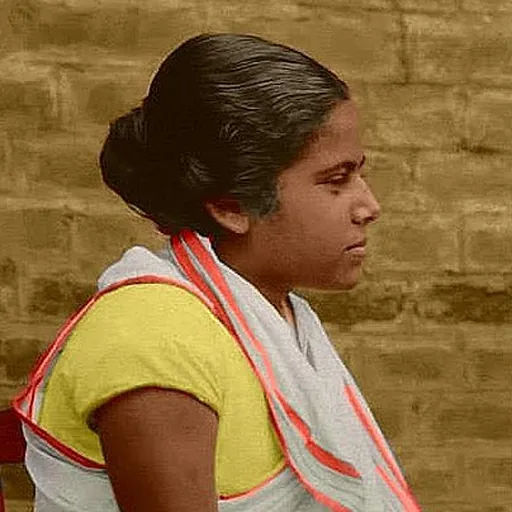
About Santi Ghose
Lived 1916 – 1989 (aged 72–73). Santi Ghose was an Indian politician and revolutionary.
Santi Ghose (also known as Santi Ghosh; 22 November 1916 – 1989) was an Indian nationalist who, along with Suniti Choudhury, assassinated a British district magistrate when she was 16 years old and is known for her participation in an armed revolutionary struggle. She trained in self-defense with swords, clubs, and firearms. In an interview, they stated, "It is better to die than live in a horse's stable." Ghose said that she was disappointed that she had not been sentenced to hanging and would thus not be able to achieve martyrdom.
Ghose was subjected to humiliation and physical abuse in prison and was treated as a "second-class prisoner." In 1939, after having served seven years of her sentence, she was released because of the amnesty negotiations between Gandhi and the British colonial authorities.
Public and media response Contemporary Western periodicals portrayed the assassination as a sign of "Indians' outrage against an ordinance by the Earl of Willingdon that suppressed the civil rights of Indians, including that of free speech." Indian sources characterized the assassination as Ghose and Chowdbury's response to the "misbehaviors of the British district magistrates" who, secure in their positions of power, had sometimes molested Indian women.
After the verdict was announced, a flyer was found by the intelligence branch of police in the Rajshahi district praising Ghose and Chowdbury as nationalist heroines. The poster read, "THOU ART FREEDOM'S NOW, AND FAME'S" and displayed photographs of the two girls alongside lines from Robert Burns' poem Scots Wha Hae:
"Tyrants fall in every foe! Liberty's in every blow!"
Later life and death After her release, Ghose attended the Bengali Women's College and participated in India's Communist movement. She later joined the Indian National Congress. In 1942, Ghose married Professor Chittaranjan Das. She served on the West Bengal Legislative Council from 1952–62 and 1967–68. She also served on the West Bengal Legislative Assembly from 1962–64. Ghose wrote and published a book entitled Arun Bahni.
Ghose died in 1989.
Don’t just read it —
keep it.
Full-length biographies made to live with: read them, listen on the way to work, watch them tonight.
- E-book
- Audio
- Video
Instant download · yours to keep · every purchase keeps this site free
Important facts
People in Santi Ghose's life
Named in this biography and alive at the same time


Related people
Same field, nearest in time





Contemporaries
People whose lives overlapped Santi Ghose's



Frequently asked questions
Who was Santi Ghose?
Anti-British Bengali revolutionary
When was Santi Ghose born?
Santi Ghose was born on 22 November 1916 in Kolkata.
When did Santi Ghose die?
Santi Ghose died in 1989.
What was Santi Ghose's occupation?
Santi Ghose was a politician and revolutionary.
What nationality was Santi Ghose?
Santi Ghose was Indian.
Sources & further reading
Cite this page
APA: Biography.guide. (2026). Santi Ghose. https://biography.guide/santi-ghose/
MLA: "Santi Ghose." Biography.guide, https://biography.guide/santi-ghose/.
Chicago: "Santi Ghose." Biography.guide. https://biography.guide/santi-ghose/.
Data last updated: 2026-09-23 · Spot an error? Report a correction.
Portrait: Wikimedia Commons · author & licence
Page generated 2026-09-27 05:07 UTC