
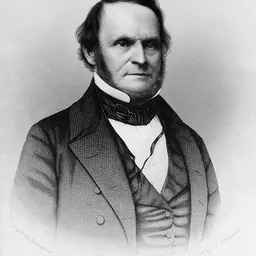
Samuel Wells Williams
U.S. linguist, missionary, diplomat, naturalist and Sinologist
About Samuel Wells Williams
Lived 1812 – 1884 (aged 71). Samuel Wells Williams was an American lexicographer, linguist, sinologist, missionary, historian and naturalist.
Samuel Wells Williams (September 22, 1812 – February 16, 1884) was a linguist, official, missionary and sinologist from the United States in the early 19th century.
Early life Williams was born in Utica, New York, son of William Williams (1787–1850) and the former Sophia Wells, an elder of the First Presbyterian Church. Among his siblings were brothers William Frederick Williams (who worked with Dr. H. A. DeForest in Beirut, Lebanon) Williams' cousin, Cornelia Williams Martin, was a prominent philanthropist and social activist in Auburn, New York, and helped support his missionary work in China.
At age 8 he was impressed by the departure to Ceylon as a printing missionary of a James Garrett who was associated with his father's printing business. He studied at Rensselaer Polytechnic Institute in Troy, New York. There he assisted in the writing of a botanical manual by Senior Professor and co-founder Amos Eaton, published 1833. On graduation he was elected as a professor of the institute.
China
After a year's preparation, on June 15, 1833, just 21, he sailed for China to take charge of the printing press of the American Board of Commissioners for Foreign Missions at Guangdong, China. He arrived at Whampoa, Canton, aboard the Morrison on October 25, 1833. and Walter Medhurst in completing his English-Chinese Dictionary of 1848, two early works of Chinese lexicography.
In 1855, Williams was appointed Secretary of the United States Legation to China. During his stay in China, he wrote A Tonic Dictionary Of The Chinese Language In The Canton Dialect in 1856. After years of opposition from the Chinese government, Williams was instrumental in the negotiation of the Treaty of Tientsin, which provided for the toleration of both Chinese and foreign Christians.
In 1860, he was appointed chargé d'affaires for the United States in Beijing. He resigned his position on October 25, 1876, 43 years to the day that he first landed at Guangzhou in 1833. Around 1875, he completed a translation of the Book of Genesis and the Gospel of Matthew into Japanese, but the manuscripts were lost in a fire before they could be published.
Later life Williams returned to the United States in 1877 where he spent the last eight years of his life. Williams became the first Professor of Chinese language and literature in the United States at Yale University as well as the president of the American Bible Society on February 3, 1881. "He also revised his book, The Middle Kingdom. In his later years, he heavily corresponded with missionaries remaining in China, the American Bible Society and with Scribners concerning the publishing of The Middle Kingdom."
Personal life On November 20, 1845, Williams married Sarah Simonds Walworth (1815–1881), a daughter of Maj. John Walworth. Together, they were the parents of several children, including:
Sophia Gardner Williams (1855–1938), who married Thomas George Grosvenor, C.B., second son of Robert Grosvenor, 1st Baron Ebury, in 1877. Grosvenor was appointed secretary to the British legation at Peking in 1879 and died in 1886. Sophia married secondly to Sir Albert Gray, Counsel of the Chairman of Committees at the House of Lords from 1896 to 1922. Frederick Wells Williams (1857–1928), editor of The National Baptist, a professor at Yale; he married Frances "Fanny" Hapgood Wayland (1864–1948), a granddaughter of Francis Wayland, President of Brown University.
He died at his residence, 39 College Street in New Haven, Connecticut, on February 16, 1884.
Works
Account of a Japanese romance (1849) Retrieved 1 August 2017.
The Chinese commercial guide (1856)
Chinese Immigration (1879)
Publications Reports of missionary society hospitals at Amoy, Canton, Chinkiang, Foochow, Hankow, Shanghai, Swatow, Tientsin. 1848-49 (1850)
Don’t just read it —
keep it.
Full-length biographies made to live with: read them, listen on the way to work, watch them tonight.
- E-book
- Audio
- Video
Instant download · yours to keep · every purchase keeps this site free
Important facts
People in Samuel Wells Williams's life
Named in this biography and alive at the same time





Related people
Same field, nearest in time


Contemporaries
People whose lives overlapped Samuel Wells Williams's





Frequently asked questions
Who was Samuel Wells Williams?
U.S. linguist, missionary, diplomat, naturalist and Sinologist (1812–1884)
When was Samuel Wells Williams born?
Samuel Wells Williams was born on 22 September 1812 in Utica.
When did Samuel Wells Williams die?
Samuel Wells Williams died on 16 February 1884 in New Haven.
What was Samuel Wells Williams's occupation?
Samuel Wells Williams was a lexicographer, linguist, sinologist, missionary, historian and naturalist.
What nationality was Samuel Wells Williams?
Samuel Wells Williams was American.
Sources & further reading
· Wikipedia: Samuel Wells Williams
· DBpedia: Samuel Wells Williams
Cite this page
APA: Biography.guide. (2026). Samuel Wells Williams. https://biography.guide/samuel-wells-williams/
MLA: "Samuel Wells Williams." Biography.guide, https://biography.guide/samuel-wells-williams/.
Chicago: "Samuel Wells Williams." Biography.guide. https://biography.guide/samuel-wells-williams/.
Data last updated: 2026-09-20 · Spot an error? Report a correction.
Page generated 2026-09-27 05:25 UTC