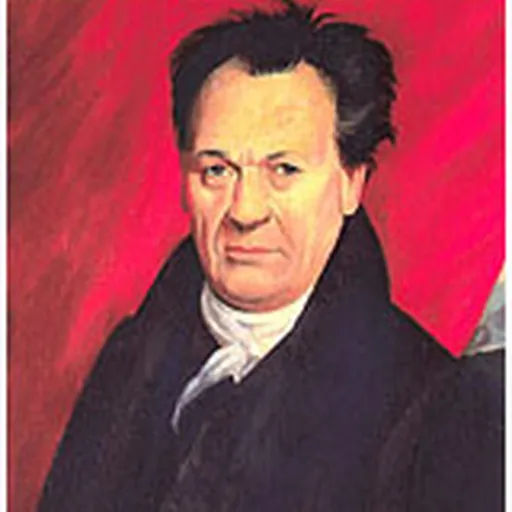
About Amos Eaton
Lived 1776 – 1842 (aged 65). Amos Eaton was an American botanist, lawyer, geologist, mineralogist and botanical collector, known for Botany and Surveying.
Life alt=Eaton's Herbarium, published in 1830, including one hundred and eleven specimens labeled in his handwriting. Eaton's Herbarium, published in 1830, includes one hundred eleven specimens labeled in his handwriting. Amos Eaton was born at Chatham, New York on May 17, 1776. His father, Captain Abel Eaton was a farmer of comfortable means. He belonged to a family that traced its lineage to John Eaton, who arrived from Dover, England in 1635, settling two years later in Dedham, Massachusetts Bay Colony. Amos Eaton showed early preference for nature, by the age of sixteen constructing his own compass and chain to survey land as a chain bearer.
Eaton was sent to Williamstown with the Rev. Dr. David Potter, of Spencertown, to study at Williams College. After graduating in 1799 with high marks in natural philosophy, he married the Polly Thomas in October the same year. She died in 1802, leaving him a son. In 1805 he married Sally Cady who bore him five sons. In New York, Eaton formed an association with naturalists David Hosack and Samuel L. Mitchill and under their influence, he became committed to the natural sciences, and in particular botany.
Nevertheless, Eaton pursued a legal career and arranged to study law with Elisha Williams, of Spencertown, and Josiah Ogden, of New York. In 1802 he was admitted to the bar and in 1804 received permission to practice before the Supreme Court of New York. Eaton worked as a lawyer and as a land agent in Catskill, New York. He became deeply involved in land-speculation and was charged with forgery in 1810, possibly as a result of securing a loan using property that was already mortgaged. He was found guilty and spent nearly five years in Newgate Prison, the state penitentiary at Greenwich Village. While in prison he formed a friendship with a young John Torrey, whose father was a city alderman and fiscal agent for the prison. Torrey would bring Eaton books while Eaton in turn would tutor his protege in the basics of botany. In 1815 he was released with a pardon from Daniel D. Tompkins, the governor of New York.
On his release in 1815, Eaton moved to New Haven at Yale College to take up the study of botany, chemistry and mineralogy under the tuition of Benjamin Silliman and Eli Ives. He then returned to Williams College to offer a course of lectures and volunteer classes of the students on botany, mineralogy zoology, and geology and published a botanical dictionary. In 1817, he published his Manual of Botany for the Northern States, the first comprehensive flora of the area; it ultimately went through eight editions. From Williams College the lectures were extended, in the shape of courses, with practical instructions to classes, to the larger towns of New England and New York.
He returned to New York in 1818 following Governor DeWitt Clinton's invitation for him to deliver a series of lectures on the state's geology to the New York State Legislature in connection with the building of the Erie Canal. Among the legislators who heard these lectures was Stephen Van Rensselaer III, who hired him to produce A Geological Survey of the County of Albany, which was followed by geological surveys of much of the area through which the canal was built. Ultimately, Eaton completed a survey fifty miles wide from Buffalo to Boston.
Eaton delivered talks at the Lenox Academy and the Medical College at Castleton, Vermont, where he was appointed professor of natural history in 1820. He gave lectures and practical instructions in Troy, laying the foundation of the Lyceum of Natural History. In 1820 and 1821, Eaton initiated geological and agricultural surveys of Albany and Rensselaer counties, which were financed by Van Rensselaer.
Rensselaer School After co-founding the Rensselaer School in 1824, Van Rensselaer appointed Eaton to teach chemistry, experimental philosophy, geology, surveying, and the "laws regulating town officers and jurors." Eaton's principal focus was the training of students to teach science and its applications to the New York farming community via experimental demonstrations, a goal in keeping with Britain's mechanics' institutes and lyceum movements on diffusing useful knowledge. As a result, Eaton's system of instruction posed a challenge, if not a threat, to the traditional liberal-arts colleges, causing them to expand their own curricula and set up departments or schools of engineering and science. The eight young ladies who participated in Eaton's experiment continued their education at the Troy Female Seminary. Eaton trained a bevy of future, notable, scientists and lectured to countless later educationists.
Today Amos Eaton Hall houses the mathematics department, and the Amos Eaton Professorship is a faculty endowment named at the institute. The Amos Eaton Chair was originally given by students to Amos Eaton in 1839, but was later returned to the institute by the Eaton family.
Personal life Amos Eaton Grave at Oakwood Cemetery Troy, NY
Following the death of his first wife, Polly Thomas, Eaton was remarried to Sally Cady in 1803, who bore him five sons. Through her, Eaton was the uncle of social reformer Elizabeth Cady Stanton (1815-1902). After her death in 1816 he remarried the same year to Anna Bradley, by whom he had three sons and two daughters. She having died, Eaton married Alice Johnson in 1827, who bore him one son, and survived him about four years. Three of his children showed a preference for natural philosophy. Hezekiah Hulbert Eaton (1809–1832) became a chemist at Transylvania University but died at the age of twenty-three. Major General Amos Beebe Eaton (1806–1877) was a U.S. Army officer interested in natural philosophy. Sara Cady Eaton (1818–1881) taught natural sciences and modern languages in a young woman's seminary at Monticello, Illinois. Eaton's grandson, Daniel Cady Eaton (1834–1895), professed botany at Yale College in the 1860s.
Works Amos Eaton published on agriculture, botany, engineering, geology, surveying, and zoology. Art without Science (1800) Elementary Treatise on Botany (1810) Botanical Dictionary (1817) (2nd 1819, 4th ed. 1836) Manual of Botany (1817) Index to the Geology of the Northern States (1818) Geological and Agricultural Survey of the County of Albany, New York (1820) Chemical Notebook (1821) Chemical Instructor (1822) Cuvier's Grand Division (1822) Geological Nomenclature of North America (1822) Zoological Syllabus and Notebook (1822) Geological and Agricultural Survey of the District adjoining the Erie Canal (1824) Philosophical Instructor (1824) Botanical Exercises (1825) Botanical Grammar and Dictionary (1828) Geological Text-Books Prepared for Popular Lectures on North American Geology (1830) Directions for Surveying and Engineering (1838) Geological Text-Book for the Troy Class (1841)
Eaton's students James Curtis Booth — chemist, melter and refiner at the U.S. Mint Ezra S. Carr — medical doctor, natural scientist George Hammell Cook — state geologist of New Jersey and vice-president of Rutgers College James Dwight Dana — Geologist, zoologist James Eights — Antarctic explorer Ebenezer Emmons — geologist; named the Adirondack Mountains Asa Fitch — natural historian and entomologist Asa Gray — botanist James Hall — First New York State Geologist Joseph Henry — Developed electromagnetism Eben Norton Horsford — scientist Douglass Houghton — doctor, chemist, geologist Mary Mason Lyon — founder of Mount Holyoke Female Seminary Almira Hart Lincoln Phelps — natural scientist and educator John Leonard Riddell — botanist, geologist and author Abram Sager — professor of zoology, botany, obstetrics, and physiology John Torrey — botanist Emma Willard — founder of Troy Female Seminary
Don’t just read it —
keep it.
Full-length biographies made to live with: read them, listen on the way to work, watch them tonight.
- E-book
- Audio
- Video
Instant download · yours to keep · every purchase keeps this site free
Important facts
People in Amos Eaton's life
Named in this biography and alive at the same time


Related people
Same field, nearest in time




Contemporaries
People whose lives overlapped Amos Eaton's



Frequently asked questions
Who was Amos Eaton?
American botanist (1776-1842)
When was Amos Eaton born?
Amos Eaton was born on 17 May 1776 in Chatham.
When did Amos Eaton die?
Amos Eaton died on 10 May 1842 in Troy.
What was Amos Eaton's occupation?
Amos Eaton was a botanist, lawyer, geologist, mineralogist and botanical collector.
What was Amos Eaton known for?
Amos Eaton was known for Botany and Surveying.
What nationality was Amos Eaton?
Amos Eaton was American.
Sources & further reading
Cite this page
APA: Biography.guide. (2026). Amos Eaton. https://biography.guide/amos-eaton/
MLA: "Amos Eaton." Biography.guide, https://biography.guide/amos-eaton/.
Chicago: "Amos Eaton." Biography.guide. https://biography.guide/amos-eaton/.
Data last updated: 2026-09-22 · Spot an error? Report a correction.
Portrait: Wikimedia Commons · author & licence
Page generated 2026-09-27 05:02 UTC