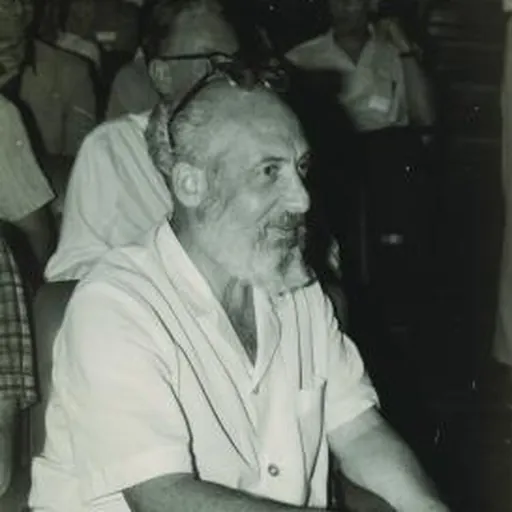
About Samuel Eilenberg
Lived 1913 – 1998 (aged 84). Samuel Eilenberg was a Polish and American mathematician, topologist, university teacher and art collector, known for Acyclic model, Cartan–Eilenberg resolution and Category theory.
Samuel Eilenberg (September 30, 1913 – January 30, 1998) was a Polish-American mathematician who co-founded category theory (with Saunders Mac Lane) and homological algebra.
Early life and education He was born in Warsaw, Kingdom of Poland to a Jewish family. He spent much of his career as a professor at Columbia University.
He earned his Ph.D. from University of Warsaw in 1936, with thesis On the Topological Applications of Maps onto a Circle; his thesis advisors were Kazimierz Kuratowski and Karol Borsuk. He died in New York City in January 1998.
Career Eilenberg's main body of work was in algebraic topology. He worked on the axiomatic treatment of homology theory with Norman Earl Steenrod (and the Eilenberg–Steenrod axioms are named for the pair), and on homological algebra with Saunders Mac Lane. As a result of this work, Eilenberg and Mac Lane developed the field of category theory, for which they are now best known.
Eilenberg was a member of Bourbaki and, with Henri Cartan, wrote the 1956 book Homological Algebra.
Later in life he worked mainly in pure category theory, being one of the founders of the field. The Eilenberg swindle (or telescope) is a construction applying the telescoping cancellation idea to projective modules.
Eilenberg contributed to automata theory and algebraic automata theory. In particular, he introduced a model of computation called X-machine and a new prime decomposition algorithm for finite state machines in the vein of Krohn–Rhodes theory. He also identified a natural correspondence between certain classes of regular languages called varieties and pseudovarieties of finite monoids, a result which is now known as Eilenberg's theorem.
Art collection Eilenberg was also a prominent collector of Asian art. His collection mainly consisted of small sculptures and other artifacts from India, Indonesia, Nepal, Thailand, Cambodia, Sri Lanka and Central Asia. In 1991–1992, the Metropolitan Museum of Art in New York staged an exhibition from more than 400 items that Eilenberg had donated to the museum, entitled The Lotus Transcendent: Indian and Southeast Asian Art From the Samuel Eilenberg Collection. In reciprocity, the Metropolitan Museum of Art donated substantially to the endowment of the Samuel Eilenberg Visiting Professorship in Mathematics at Columbia University.
Selected publications
Don’t just read it —
keep it.
Full-length biographies made to live with: read them, listen on the way to work, watch them tonight.
- E-book
- Audio
- Video
Instant download · yours to keep · every purchase keeps this site free
Important facts
more
Eilenberg–MacLane space, Eilenberg–Moore spectral sequence, Eilenberg–Niven theorem, Eilenberg–Steenrod axioms, Eilenberg–Zilber theorem, Lie algebra cohomology, Obstruction theory, Projective module, Shuffle algebra, Simplicial set, Standard complex, Weak dimension, X-machinePeople in Samuel Eilenberg's life
Named in this biography and alive at the same time



Related people
Same field, nearest in time



Contemporaries
People whose lives overlapped Samuel Eilenberg's



Frequently asked questions
Who was Samuel Eilenberg?
Polish mathematician (1913-1998)
When was Samuel Eilenberg born?
Samuel Eilenberg was born on 30 September 1913 in Warsaw.
When did Samuel Eilenberg die?
Samuel Eilenberg died on 30 January 1998 in New York City.
What was Samuel Eilenberg's occupation?
Samuel Eilenberg was a mathematician, topologist, university teacher and art collector.
What was Samuel Eilenberg known for?
Samuel Eilenberg was known for Acyclic model, Cartan–Eilenberg resolution, Category theory, Eilenberg swindle, Eilenberg–Ganea conjecture and Eilenberg–Ganea theorem.
What nationality was Samuel Eilenberg?
Samuel Eilenberg was Polish and American.
Sources & further reading
Cite this page
APA: Biography.guide. (2026). Samuel Eilenberg. https://biography.guide/samuel-eilenberg/
MLA: "Samuel Eilenberg." Biography.guide, https://biography.guide/samuel-eilenberg/.
Chicago: "Samuel Eilenberg." Biography.guide. https://biography.guide/samuel-eilenberg/.
Data last updated: 2026-09-20 · Spot an error? Report a correction.
Portrait: Wikimedia Commons · author & licence
Page generated 2026-09-27 04:58 UTC