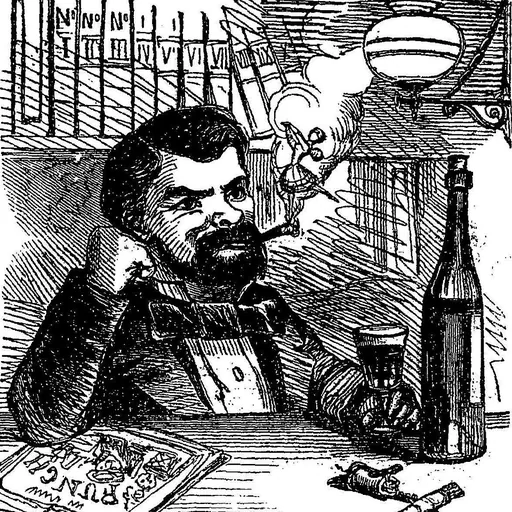
About Samuel Calvert
Lived 1828 – 1913 (aged 84). Samuel Calvert was a British painter and carver.
Samuel Calvert (21 November 1828 – 1 January 1913) was a British draughtsman, printer and artist active in Australia, noted for his wood-engravings, published in contemporary periodicals. He was the third son of the renowned engraver and painter, Edward Calvert. During his period in Australia, Samuel Calvert produced hundreds of engraved illustrations for a variety of publications on a wide range of subjects. Calvert also designed postage stamps for the Victorian government. He was one of the founding members of the Victorian Academy of Art, formed in 1870, and showed watercolours and oil paintings at their subsequent exhibitions. Calvert left a legacy of finely-produced wood engravings depicting landscape, contemporary events and portraits.
Biography
Early life
Samuel Calvert was born on 21 November 1828 the fourth child of Edward Calvert and Mary (née Bennell). His father was a renowned artist and engraver.
Calvert was raised in a family environment dedicated to art and was taught drawing, painting, and print-making skills by his father. Advertisements for the April 1850 edition of the Monthly Almanac offered a tinted lithograph print by Calvert, 'City of Adelaide S.A. looking south-east', "gratis to all persons paying five months' subscription in advance". The print featured a view of the River Torrens in the foreground, depicting a group of Aborigines fishing in the river, and a view of the early settlement of Adelaide and the Mount Lofty Ranges in the background. The Monthly Almanac was short-lived, its last edition being published in July 1850. By September 1850 Calvert had entered into partnership with Alfred Waddy; they conducted the Artists' Repository in King William Street, producing prints and maps and selling artists' supplies. By October they had enlarged their premises to incorporate a bookbinding service. As well as illustrative work for publications and art reproductions, Calvert produced wood engravings for billheads and advertisements.
Samuel Calvert and Emma Lake were married in about 1851 in Adelaide.
Melbourne
'Diggers' by Samuel Calvert, the frontispiece of James Bonwick's Notes of a Gold Digger and Gold Diggers' Guide, published in 1852.
Soon after his arrival in Melbourne Calvert produced two illustrations for James Bonwick's Notes of a Gold Digger and Gold Diggers' Guide, published in Melbourne in 1852. His contributions were a map, 'Routes to the Victoria Diggings', and a frontispiece depicting a group of diggers around a camp-fire, surrounded by mining equipment. In Melbourne Calvert resumed work as an artist and wood-engraver, providing illustrations for books and advertisements and for the illustrated monthly magazine The Arm-Chair. The Arm-Chair was first published in about September 1853 by Hough & Co. It was described as "an amusing little publication... the Punch of Melbourne", containing "sparkling and witty" writing and "clever wood engravings". In March 1853 Calvert's portrait of the racehorse Balaarat, "winner of the Town Plate", was published.
In 1854 Calvert commenced a printing business with his older brother William. The firm of Calvert Brothers were initially located in Lonsdale Street. By mid-1855 they had moved to premises in Brunswick Street in Collingwood, but by the following November the business had relocated nearer to the centre of Melbourne at 24 Collins Street West. As engravers, lithographers and draughtsmen, they produced and contributed to various illustrated periodicals and specialty publications such as Melbourne Punch, first published in August 1855, and Australian Home Companion and Illustrated Weekly Magazine, first published in October 1856. Calvert provided illustrations for Victoria Illustrated, published by Messrs. Sands and Kenny in December 1856, described as "a handsomely bound volume of engravings illustrative of the scenery of Victoria". The Calvert Brothers partnership also published the illustrated periodicals Australian Builder and Weekly Remembrancer as well as local almanacs.
Postage stamps
In 1854 Samuel Calvert successfully tendered for the engraving and printing of Victorian postage stamps. In June 1854 a contract was signed with the Victorian Post Office specifying the production of one million stamps, in sheets of fifty, for which Calvert would be paid £275. He continued to engrave and print postage stamps from 1854 to 1857 under a number of contractual arrangements with the Post Office.
After the trial bankruptcy proceedings were begun against Calvert and on 29 May 1858 his assets was placed under sequestration. In August 1858 he appeared in the Insolvent Court where it was revealed that the three-month sentence passed on him had "not been carried into effect, in consequence of a reserved point" and in all probability "it will be quashed". At the third meeting before the Insolvent Court on 13 September 1858 Calvert disclosed that, although he had a claim against the Post Office for £180, the debt "is so mixed up with contingencies as to the payment, that the assignee has serious doubts of its being paid". Calvert was granted a certificate of discharge from insolvency in July 1859.
Revived career
After being discharged from bankruptcy Samuel Calvert began to rebuild his career as an artist and wood-engraver, working either from home or as an employee of an established printing business. The couple had five children, four daughters and a son, born between 1852 and 1861.
Samuel Calvert was one of the founding members of the Victorian Academy of Art, formed in 1870 (later renamed the Victorian Artists' Society). He was elected to the council of the academy in April 1872. Calvert regularly exhibited watercolours and oil paintings at the academy's exhibitions during the mid-1870s and early 1880s.
In about 1886 Calvert's son, William Samuel Calvert, joined his father's business at 85 Little Collins Street East. In general, William took responsibility for the engraving work while Samuel Calvert worked as the artist of the business.
Samuel Calvert returned to England in 1888, remaining there for about six years. During this period W. S. Calvert took over his father's printing business in Melbourne. In England Calvert wrote A Memoir of Edward Calvert, Artist, by his Third Son, a volume commemorating his late father, which was published in London in 1893 in an edition of 250 copies. In 1894 Calvert returned to Melbourne and leased a building at 92-94 Collins Street (a location associated with artists since the mid-1860s), where he opened the Burlington Studios in November 1894. Calvert put together an initial exhibition and sale of watercolour drawings and sketches he had collected in England. In the early morning of 9 May 1895 a fire broke out in the building where the Burlington Studios was located, completely gutting the structure. Paintings destroyed in the fire were by French and English artists, as well as some by "old Italian masters". A painting "of a Greek Pastoral" by Calvert's father Edward, which had been exhibited at the Royal Academy, was also destroyed. Calvert estimated his losses at about £1,500, which were partly covered by insurance.
Gallery
Don’t just read it —
keep it.
Full-length biographies made to live with: read them, listen on the way to work, watch them tonight.
- E-book
- Audio
- Video
Instant download · yours to keep · every purchase keeps this site free
Important facts
People in Samuel Calvert's life
Named in this biography and alive at the same time



Related people
Same field, nearest in time


Contemporaries
People whose lives overlapped Samuel Calvert's




Frequently asked questions
Who was Samuel Calvert?
British painter (1828–1913)
When was Samuel Calvert born?
Samuel Calvert was born on 21 November 1828 in Brixton.
When did Samuel Calvert die?
Samuel Calvert died on 1 January 1913 in Crowthorne.
What was Samuel Calvert's occupation?
Samuel Calvert was a painter and carver.
What nationality was Samuel Calvert?
Samuel Calvert was British.
Sources & further reading
· DBpedia: Samuel Calvert (painter)
Cite this page
APA: Biography.guide. (2026). Samuel Calvert. https://biography.guide/samuel-calvert-painter/
MLA: "Samuel Calvert." Biography.guide, https://biography.guide/samuel-calvert-painter/.
Chicago: "Samuel Calvert." Biography.guide. https://biography.guide/samuel-calvert-painter/.
Data last updated: 2026-09-22 · Spot an error? Report a correction.
Portrait: Wikimedia Commons · author & licence
Page generated 2026-09-27 05:02 UTC