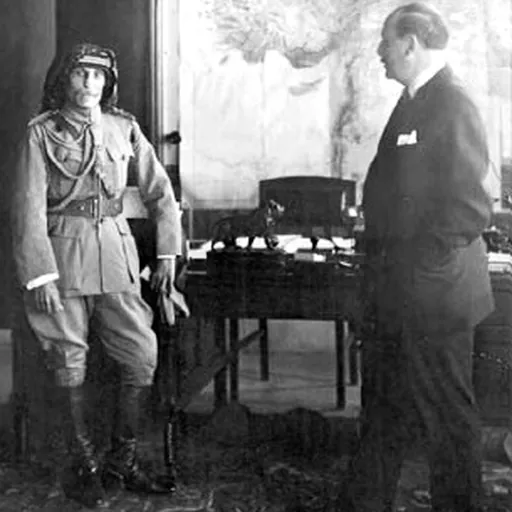
About Ramadan al-Shallash
Lived 1879 – 1961 (aged 81–82). Ramadan al-Shallash was a Turkish military personnel.
Ramaḍān Pāshā al-Shallāsh (; 1879– 1962) was a prominent rebel commander of the 1925 Great Syrian Revolt and, prior to that, a military officer in the Ottoman and Sharifian armies.
Shallash became a captain in the Ottoman army, serving on the Libyan and Balkan fronts in 1911 and 1912, respectively. In 1916, he joined the Arab independence movement of Sharif Hussein. Three years later, he led efforts to ensure Deir ez-Zor and its environs become part of Syria; to that end, he and his Bedouin fighters expelled the British from the city without apparent sanction from Hussein's son, Emir Faisal. He was consequently dismissed from Deir ez-Zor but continued his efforts nonetheless.
After France toppled Faisal's government and took over Syria in 1920, Shallash moved to Transjordan. He served as the intermediary between that country's emir and Faisal's brother, Abdullah, and the northern Syrian revolt leader Ibrahim Hananu. With the launch of the Great Syrian Revolt, Shallash returned to command his own rebel band. He participated in the rebels' brief capture of Damascus and later led operations in the Anti-Lebanon Mountains.
Early life and education Shallash was born in al-Shumaytiyah, Deir ez-Zor Governorate, likely in 1879. His autobiography states that he was born in 1869, but this was probably printing error. His father was the sheikh (chieftain) of the Al Bu Saraya (also spelled "Albu Saray"), a Bedouin tribe that inhabited the area around Deir ez-Zor. Shallash graduated from Istanbul's Military School for Bedouin Chiefs in 1898. Historian Michael Provence holds that due to his older age and other factors, Shallash would have needed the specialized remedial curriculum of the Tribal School". Sharif Husayn's son, Emir Faisal set up a rudimentary government in Damascus in October–November 1918 with the support of the allied and clandestine Arab nationalist societies, al-Fatat and al-Ahd. Al-Shallash had been a member of the latter group, which mostly consisted of ex-Ottoman officers from the empire's Arab territories. Faisal and the Arab nationalists were incensed at the division of Arab territories among the colonial powers, having been promised by the British independence in return for revolting against the Ottomans.
On 11 December, at 3:00 am, between 500 and 2,000 Bedouin tribesmen raided Deir ez-Zor, entering from its southern entrance, i.e. from the desert instead of the population centers to the east, west and north. The tribesmen were joined by townspeople and together they burned down the local British headquarters, and entered the town's hospital, two mosques and a church. Cash stored in the government house was seized, but the town bazaar was not looted. The tribesmen raided the local prison and freed its inmates. In the fighting, thirty rebels were killed and sixty wounded when a fuel tank was ignited and exploded near them at 5:00 am. Shallash did not command the tribesmen, but was on standby outside of Deir ez-Zor. Chamier and his relatively small group of officers and troops, along with sixty local gendarmes, barricaded themselves in their barracks. They had two armored cars and two machine guns. The armored car that was sent by Chamier to impose order inside Deir ez-Zor was neutralized. Meanwhile, about forty of the gendarmes defected and fled the barracks. At 10:00 am, the barracks came under rebel fire and Chamier's last machine gun was heavily damaged. On 13 December, they captured Mayadin, before proceeding to Albu Kamal the next day. By then, its forty-man British garrison withdrew. However, most of the sheikhs retreated to their encampments within a few days, leaving Shallash only with the soldiers he arrived with and Al Bu Saray tribesmen. He sent men to collect taxes, raid British-held parts of the Jazira and destroy British transport lines. Shallash then left for Aleppo. He used an incident where Mukhlis confiscated smuggled gold from a group of Syrian merchants to raise opposition against him. However, Shallash and his supporters were expelled and headed northward to their tribal encampment at al-Tibni. During the meeting, Shallash agreed to head a tribal delegation to Ibn Saud, thus removing Shallash far from Deir ez-Zor. From early 1921, he acted as an intermediary between Ibrahim Hananu and Emir Abdullah of Transjordan. to join the Great Syrian Revolt. According to Provence, He [Shallash] fought in the revolt and mobilized peasants, nomads, and villagers throughout Syria with a complicated and apparently potent mix of nationalism, popular religious fervor, evocations of Arab honor, Kemalist enthusiasm, and class warfare against big landlords aligned with the French Mandatory government. He joined with Fawzi al-Qawuqji's band following the latter's defeat in Hama in early October. Qawuqji and Shallash headed toward Damascus from Hama's eastern countryside, but Bakri and Kharrat launched their assault before they arrived. After the French aerial bombardment of Damascus, Shallash condemned the action, stating:
With cannons and aeroplanes you bombed a large city like Damascus without any warning: this has turned all of Syria against you, and irritated the whole Muslim world and made you a laughing stock of Nations, because you forgot the simplest of international laws. ... If General Sarrail is a stupid idiot, is it not your duty to warn him of the damage you would suffer and the ill reputation which would result for France in the Orient? You have lost the confidence of the Muslims and the Christians in all of Syria. By your act of barbarism, you have given a powerful weapon to the Muslim world and to the Power which works against you.
Activities in the Anti-Lebanon Mountains By November, Shallash and his tribal fighters joined forces with Jum'a Sawsaq; the latter was the former mukhtar (headman) of Rankus and led a rebel band whose area of operations extended from an-Nabk southward to Zabadani. Their combined forces numbered between 600 and 1,000 Bedouin and peasant fighters, and both Shallash and Sawsaq declared themselves, with al-Atrash's sanction, joint commanders of a "National Army" brigade.
Intra-rebel disputes and surrender Shallash surrendered to the French Mandatory authorities in 1926. A biography of Shallash, Ramadan al-Shallash: Ahad Abtal al-Tarikh al-Arabi [Ramadan Shallash: A Hero of Arab History], written by Fa'iz al-Shallash was published in Cairo in 2001.
Don’t just read it —
keep it.
Full-length biographies made to live with: read them, listen on the way to work, watch them tonight.
- E-book
- Audio
- Video
Instant download · yours to keep · every purchase keeps this site free
Important facts
People in Ramadan al-Shallash's life
Named in this biography and alive at the same time

Related people
Same field, nearest in time





Contemporaries
People whose lives overlapped Ramadan al-Shallash's




Frequently asked questions
Who was Ramadan al-Shallash?
ottoman rebel commander
When was Ramadan al-Shallash born?
Ramadan al-Shallash was born in 1879.
When did Ramadan al-Shallash die?
Ramadan al-Shallash died in 1961.
What was Ramadan al-Shallash's occupation?
Ramadan al-Shallash was a military personnel.
What nationality was Ramadan al-Shallash?
Ramadan al-Shallash was Turkish.
Sources & further reading
· Wikipedia: Ramadan al-Shallash
· DBpedia: Ramadan al-Shallash
Cite this page
APA: Biography.guide. (2026). Ramadan al-Shallash. https://biography.guide/ramadan-al-shallash/
MLA: "Ramadan al-Shallash." Biography.guide, https://biography.guide/ramadan-al-shallash/.
Chicago: "Ramadan al-Shallash." Biography.guide. https://biography.guide/ramadan-al-shallash/.
Data last updated: 2026-09-23 · Spot an error? Report a correction.
Portrait: Wikimedia Commons · author & licence
Page generated 2026-09-27 05:06 UTC