
About R. Leonard Brooks
Lived 1916 – 1993 (aged 77). R. Leonard Brooks was a British mathematician.
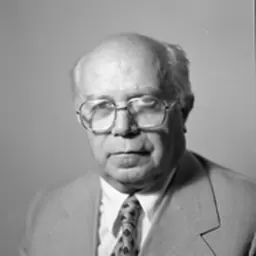
Rowland Leonard Brooks (February 6, 1916 – June 18, 1993) was an English mathematician, known for proving Brooks's theorem on the relation between the chromatic number and the degree of graphs. He was born in Lincolnshire, England, studied at Trinity College, Cambridge University, and also worked with fellow Trinity students W. T. Tutte, Cedric Smith, and Arthur Harold Stone on the problem of "Squaring the square" (partitioning rectangles and squares into unequal squares), both under their own names and under the pseudonym Blanche Descartes.
After leaving Cambridge, he worked as a full-time tax inspector.
Don’t just read it —
keep it.
Full-length biographies made to live with: read them, listen on the way to work, watch them tonight.
- E-book
- Audio
- Video
Instant download · yours to keep · every purchase keeps this site free
Important facts
People in R. Leonard Brooks's life
Named in this biography and alive at the same time


Related people
Same field, nearest in time

Contemporaries
People whose lives overlapped R. Leonard Brooks's





Frequently asked questions
Who was R. Leonard Brooks?
English mathematician (1916–1993)
When was R. Leonard Brooks born?
R. Leonard Brooks was born on 6 February 1916 in Lincolnshire.
When did R. Leonard Brooks die?
R. Leonard Brooks died on 18 June 1993.
What was R. Leonard Brooks's occupation?
R. Leonard Brooks was a mathematician.
What nationality was R. Leonard Brooks?
R. Leonard Brooks was British.
Sources & further reading
· Wikipedia: R. Leonard Brooks
Cite this page
APA: Biography.guide. (2026). R. Leonard Brooks. https://biography.guide/r-leonard-brooks/
MLA: "R. Leonard Brooks." Biography.guide, https://biography.guide/r-leonard-brooks/.
Chicago: "R. Leonard Brooks." Biography.guide. https://biography.guide/r-leonard-brooks/.
Data last updated: 2026-09-20 · Spot an error? Report a correction.
Page generated 2026-09-27 05:27 UTC