
About Peretz Hirschbein
Lived 1880 – 1948 (aged 67). Peretz Hirschbein was a Polish writer, journalist, playwright and director.
Peretz Hirshbein ; November 7, 1880 – August 16, 1948) was a Yiddish-language playwright, novelist, journalist, travel writer, and theater director and producer. Because his work focused more on mood than plot, he became known as "the Yiddish Maeterlinck". His work as a playwright and through his own short-lived but influential troupe, laid much of the groundwork for the second golden age of Yiddish theater that began shortly after the end of World War I. The dialogue of his plays is consistently vivid, terse, and naturalistic. Unusually for a Yiddish playwright, most of his works have pastoral settings: he had grown up the son of a miller, and made several attempts at farming.
Biography Hirschbein was born November 7, 1880 in the village of Mielnik, Grodno Governorate (present-day Poland) to Sheyne Hirschbein (Also cited as Sheyne Hollander.) on the encouragement of Bialik and by students from an acting conservatory in Odessa. It was the first Yiddish company to devote itself exclusively to "better" Yiddish theater. The troupe toured through Imperial Russia for two years, staging his own plays, as well as works by Sholem Asch, David Pinski, Sholem Aleichem, and Jacob Gordin, as well as translations of plays by Semen Iushkevich and Herman Heijermans. The troupe's high literary standards and high standards of ensemble acting strongly influenced the later Vilna Troupe and Maurice Schwartz's New York-based Yiddish Art Theater.
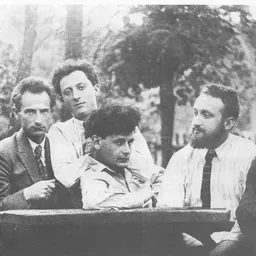
Peretz Hirschbein (second from left), with Mendl Elkin, Uri Zvi Greenberg, Peretz Markish, Melech Ravitch and I. J. Singer in 1922. The troupe disbanded in 1910 for financial reasons, at which point Hirschbein published what Jacob Glatshteyn (In tokh genumen [Sum and Substance], 1976, p. 77) has called "the four greatest plays in the Yiddish repertoire": A farvorfn vinkl (A Forsaken Corner; 1912), Di puste kretshme (The Empty [Deserted] Inn; 1913, written in America), Dem shmids tekhter (The Blacksmith's Daughters; 1918) and Grine felder (Green Fields; 1916). In these and other dramas, Hirshbein abandoned symbolism and returned to his rural roots, dramatizing the lives and loves of rural Jews. The understated quality of these works appealed to directors including Maurice Schwartz and Jacob Ben-Ami, and they became regular productions in the repertoire of artistically ambitious Yiddish theaters. His popularity extended to other cultures and genres, and his plays were performed in Russian, Hebrew, English, German, Spanish, and French. Indeed, the 1937 American film Grine felder (Green Fields), based on Hirshbein's play, is among the most beloved of all Yiddish films, and the play continues to be often anthologized and staged.
Hirshbein traveled extensively; in 1911 alone, he visited Vienna, Paris, London, and New York City. For a while in 1912, he tried farming in New York's Catskills (later, home to the Borscht Belt); he then returned briefly to Russia, and went from there to Argentina for another attempt at farming, this time in a Jewish agricultural colony. At the start of World War I he was en route to New York on a British ship, which was sunk by a German cruiser. He was briefly taken captive, then let off in Brazil, from where he eventually reached New York. He spent the succeeding decades traveling, accompanied by his wife,
Personal life In 1918, Hirschbein met his future wife Esther Shumiatcher-Hirschbein, a Yiddish-language poet and playwright, whilst on tour in Calgary. On 11 December 1918, Hirschbein married Shumiatcher-Hirschbein (Shumiatcher-Hirschbein's name is listed as "Ethel Smith" on the marriage index.) The Shumiatche family emigrated from Homyel, Gomel Governorate (present-day Belarus) to Calgary, Alberta in 1911 and adopted the surname "Smith", with Shumiatcher-Hirschbein anglicizing her first name to "Ethel".
Hirschbein died August 16, 1948, in Los Angeles Die Puste Kretshme (The Haunted Inn, 1912) A farvorfen Vinkel (A Neglected Nook or A Hidden Corner, 1912) Griene Felder (Green Fields, 1916) Dem Schmids Tekhter (The Smith's Daughters, 1918 or earlier) Where Life Ends Joel The Last One The Infamous A Lima Bean Roite Felder (Red Fields, 1935, novel) Hitler's Madman (screenplay for 1943 English-language film, the American debut of director Douglas Sirk)
Don’t just read it —
keep it.
Full-length biographies made to live with: read them, listen on the way to work, watch them tonight.
- E-book
- Audio
- Video
Instant download · yours to keep · every purchase keeps this site free
Important facts
Family & relationships
People in Peretz Hirschbein's life
Named in this biography and alive at the same time





Related people
Same field, nearest in time






Contemporaries
People whose lives overlapped Peretz Hirschbein's




Frequently asked questions
Who was Peretz Hirschbein?
Yiddish writer (1880–1948)
When was Peretz Hirschbein born?
Peretz Hirschbein was born on 7 November 1880 in Gmina Kleszczele, Belsk County.
When did Peretz Hirschbein die?
Peretz Hirschbein died on 16 August 1948 in Los Angeles.
What was Peretz Hirschbein's occupation?
Peretz Hirschbein was a writer, journalist, playwright and director.
What nationality was Peretz Hirschbein?
Peretz Hirschbein was Polish.
Sources & further reading
· Wikipedia: Peretz Hirschbein
Cite this page
APA: Biography.guide. (2026). Peretz Hirschbein. https://biography.guide/peretz-hirschbein/
MLA: "Peretz Hirschbein." Biography.guide, https://biography.guide/peretz-hirschbein/.
Chicago: "Peretz Hirschbein." Biography.guide. https://biography.guide/peretz-hirschbein/.
Data last updated: 2026-09-25 · Spot an error? Report a correction.
Page generated 2026-09-27 05:11 UTC