
About Paul Schuster Taylor
Lived 1895 – 1984 (aged 88). Paul Schuster Taylor was an American economist.
Paul Schuster Taylor (June 9, 1895 – March 13, 1984) was an American progressive agricultural economist. He was an undergraduate at the University of Wisconsin and earned his PhD at the University of California, Berkeley, where he joined the faculty as a professor of economics from 1922 until his retirement in 1962.
Early life Paul Schuster Taylor was born on June 9, 1895, in Sioux City, Iowa, to Henry Taylor and Rose Eugenia Schuster. He attended the University of Wisconsin, Madison. Taylor majored in economics and la, where "the caption under his photograph in his junior yearbook was 'I can and I will." He obtained his master's degree from University of California, Berkeley in 1920 and his Ph.D. in 1922.
Military service When the United States entered into World War I, Taylor sought and received a commission as a 2nd lieutenant in the United States Marine Corps. He took command of the 4th Platoon, 78th Company, 2nd Battalion 6th Marines in August 1917 in Quantico, Virginia. He deployed to France in January, 1918, and participated in the Battle of Chateau-Thierry and the Battle of Belleau Wood. He was severely gassed at Belleau Wood on June 14, 1918. After recuperating he served as an instructor at the First Corps Schools in Gondrecourt until returning home and mustering out in 1919.
Early career Taylor's research career was launched by the progressive sociologist Edith Abbott. As head of a Social Science Research Council project, she asked Taylor to undertake a study of the increasing Mexican migration into the United States. From 1927 to 1930, he spent a great deal of time on the road, driving through California, Colorado and Texas, and as far east as Pennsylvania. He sought quantitative data on Mexican employment patterns, interviewed workers and employers, and documented what he encountered with photographs. He went on to spend six months in Mexico during 1931. The Berkeley economics department responded to his unconventional work by denying him promotions and salary increases.
Work and marriage Taylor married Katharine Page Whiteside on May 15, 1920, in Alameda, California. They had three children, Katharine, Ross, and Margaret.
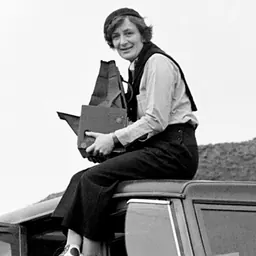
In 1934, Taylor saw the work of the documentary photographer Dorothea Lange, and recruited her to his project. They both divorced their first spouses, and on December 6, 1935, married one another,
Migrant farmers In the course of their research, Taylor and Lange encountered the "Dust Bowl" westward migration of ruined tenant farmers across the United States. Lange was hired as a photographer by the federal Farm Security Administration, and throughout the 1930s the two often traveled together; Taylor collected quantitative and qualitative information as Lange made photographs.
Together, Lange and Taylor brought the poverty and exploitation of sharecroppers, tenant farmers and migrant farmworkers to the attention of the American public in their hope that the New Deal would be extended to benefit those who worked on farms. Taylor risked his colleagues' further disapproval by publishing, with Lange, a popular book of text and photographs on the Dust Bowl, American Exodus, in 1939.
La Follette Committee Taylor's research formed a basis for the 1939 hearings conducted by the La Follette Committee of the U.S. Senate on civil liberties violations against farmworkers. This work antagonized powerful people at the University of California, Berkeley, where agribusiness was well represented among the university's regents and where university agricultural research provided direct support to the big growers (for example, creating hybrids, designing farm machinery, training in agricultural management).
Taylor's research, combined with the values of his Iowa upbringing, brought him to the conclusion that the power of the big growers in California agriculture was incompatible with democracy. Despite Robert La Follette's exposé of violence against farmworkers by sheriffs and deputies recruited by the Associated Farmers (the organization of big industrial farm owners), farmworker unionization struggles were not successful until the 1960s, when Taylor, then retired, supported the United Farm Workers.
Later career During World War II, Taylor was one of a small number of prominent whites to protest the mass incarceration of Japanese-Americans.
In 1943, he became involved with protests against federal provision of vast quantities of water to agribusiness at the taxpayers' expense. After 1950, this became the major focus of his work. The federal Newlands Reclamation Act of 1902, which provided funding for dams and canals to bring water to parched southwestern farms, had limited the amount of subsidized water for irrigation to per person. But this restriction was systematically violated, so the reclamation programs constituted huge subsidies to the biggest growers and enabled them to squeeze out small farmers. In 1944, Taylor led opposition to the insertion of an exemption from the limitation into the U.S. Senate bill authorizing the Central Valley Project to bring water into the San Joaquin Valley. For the rest of his life Taylor fought a losing battle against this policy.
From 1952 to 1956, Taylor served as chair of his department; he then headed the university's Institute of International Studies until his retirement in 1964. Beginning in the late 1950s, he served as a consultant for the U.S. State Department and the Ford Foundation, investigating land tenure and advocating land reform in Vietnam, Egypt, Colombia, Korea, and Ecuador. He applied to the Third World the principles and knowledge he had developed from decades of work on U.S. agriculture and rural poverty. Always strongly anticommunist, Taylor argued for land reform and community development, in the conviction that the concentration of vast landholdings in a few hands and the severe exploitation of farm labor made the development of democracy impossible and made communist popularity grow.
Selected writings
California Farm Labor, 1937
Don’t just read it —
keep it.
Full-length biographies made to live with: read them, listen on the way to work, watch them tonight.
- E-book
- Audio
- Video
Instant download · yours to keep · every purchase keeps this site free
Important facts
People in Paul Schuster Taylor's life
Named in this biography and alive at the same time


Related people
Same field, nearest in time



Contemporaries
People whose lives overlapped Paul Schuster Taylor's

Frequently asked questions
Who was Paul Schuster Taylor?
American economist (1895-1984)
When was Paul Schuster Taylor born?
Paul Schuster Taylor was born on 9 June 1895 in Sioux City.
When did Paul Schuster Taylor die?
Paul Schuster Taylor died on 13 March 1984 in San Francisco.
What was Paul Schuster Taylor's occupation?
Paul Schuster Taylor was an economist.
What nationality was Paul Schuster Taylor?
Paul Schuster Taylor was American.
Sources & further reading
· Wikipedia: Paul Schuster Taylor
· DBpedia: Paul Schuster Taylor
Cite this page
APA: Biography.guide. (2026). Paul Schuster Taylor. https://biography.guide/paul-schuster-taylor/
MLA: "Paul Schuster Taylor." Biography.guide, https://biography.guide/paul-schuster-taylor/.
Chicago: "Paul Schuster Taylor." Biography.guide. https://biography.guide/paul-schuster-taylor/.
Data last updated: 2026-09-20 · Spot an error? Report a correction.
Page generated 2026-09-27 05:28 UTC