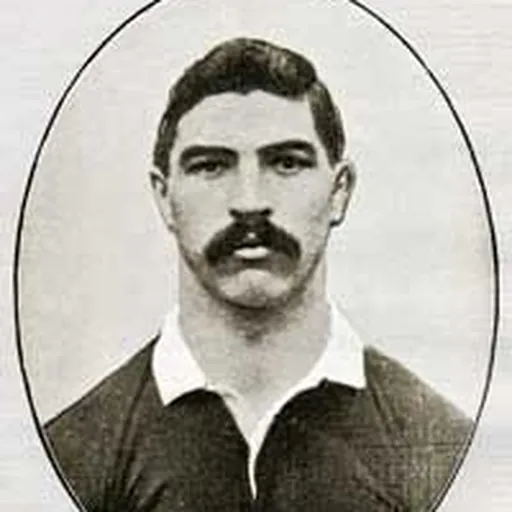
About Paul Roos
Lived 1880 – 1948 (aged 67). Paul Roos was a South African politician and rugby union player.
Paul Johannes Roos (30 October 1880 – 22 September 1948) (also known as Oom Polla – Afrikaans for "Uncle Polla", "Polla" being a pet name for "Paul") was one of the first South African Springbok rugby union captains and led the first South African rugby team to tour overseas – to Britain in 1906. Roos was born near the South African town of Stellenbosch on 30 October 1880 and completed his education there.
A devout Christian, Roos was a popular rugby player and was chosen by his own teammates to captain the 1906 tour. Throughout the tour he saw the campaign as an attempt to improve the relationship between his fellow countrymen and the British after the events of the Second Boer War.
Rugby career Roos earliest recorded games of rugby were for Victoria College, for whom he played in the third team in 1897, progressing through the squads until by 1899 he was a prominent member of the first team. With no first class team in the area, he joined the Villagers in 1900, before returning to the Stellenbosch University side in 1901. This led to Roos refusing to play for the Western Province team in the Currie Cup of 1904 as it would mean he would need to travel on a Sunday. The Western Province captain wrote to a professor at Stellenbosch University, where Roos lectured, to convince Roos to play.
Before his first international match Roos faced the 1903 touring British Isles while representing Western Province; the game ending in a 3–3 draw at Newlands. After his performance for Western Province, Roos was selected to represent the South African national team in 1903 in the final Test against the British Isles. The first two Test matches had both ended in draws, and when the South Africans won, they took their first series against a British team.
In 1906 Roos was part of the first overseas touring South African team. The bulk of the team was made up of Western Province players, who had recently won the Currie Cup. Roos, who was the only player not to have undertaken a trial for the match as he was seen as a certainty for the team, was elected by the rest of the players to be the team captain. The first international encounter for the team was against Scotland, played in front of a record crowd of 30,000. Roos was forced to miss the game after he injured his collarbone in the encounter with Oxford University, and the captaincy was handed over to Paddy Carolin; the match ended in the first defeat for the South African's with Scotland scoring two tries in the second half. The Springboks were back on winning form the very next game against the North of Scotland, then travelled to Belfast to face Ireland. Roos lead his team out at the Balmoral Showgrounds. After the first half, Roos men were leading 3–12, but Ireland levelled the scores to 12–12 before a try from the wing settled the game in the South Africans' favour.
The game against Wales was the most anticipated of the tour. Wales had been unofficially crowned the World's best team after a Triple Crown winning season in 1905 and a win over the All Blacks in the 'Game of the Century'. The Glamorgan team that had run the South Africans close earlier in the tour had contained twelve internationals, and the Welsh were keen for revenge. Despite this, Roos was a popular figure in Wales, and with his deep impressive voice and "pronounced Dutch accent", he had spoken at church meetings throughout the tour; Roos asked Charlie Pritchard, the Newport skipper, how the Newport forwards, who were lighter than the South Africans, had stolen the ball away so many times in the scrums. The tactic, which the Welsh team had used to counter the famous New Zealand scrum, was discussed with great openness between Pritchard and Roos, and when the South Africans left the next day Roos shook Pritchard's hand at the train station and thanked him. This revelation became a controversial talking point when the Welsh press heard of it.
The match against Wales was set for 1 December 1906, and was played at St. Helen's Ground in Swansea. Wales selected a strong team, with Teddy Morgan and Johnnie Williams on the wings, and captained by talismanic three-quarter Gwyn Nicholls, who had come out of retirement to lead the Welsh. Roos started the match with heavy strapping to protect an injured shoulder, and several of his team were suffering from coughs and sore throats brought on by the British winter weather. South Africa scored three tries without reply, dominating the game 11–0. At the final whistle the South African supporters, assisted by Welsh fans, rushed onto the pitch and carried Roos from the field. Roos later stated that 'he considered it to be the greatest honour of his life to be borne triumphant from the ground by supporters of his beaten opponents'.
A week later the South Africans faced England at Crystal Palace and Roos was fit enough to lead his team out against international opposition for the third time. Conditions for the match were poor; the pitch resembled a morass and a drizzle that began half an hour before the kick off continued throughout the game. After 20 minutes the ball was extremely difficult to handle and the backs from both teams found themselves unable to interact in the game with any real purpose. Although a match against France was planned at the end of the tour, the game was not officially recognised, and the England encounter was Roos' final international game, ending with a record of played four, won three, drawn one.
Joint photo of Oxford University and the Springboks, the game in which Roos was injured. As the tour headed towards its end, the South African's took control of the matches once again, beating Lancashire narrowly, but with decisive wins over Cumberland, Surrey and Cornwall. The team then returned to Wales for the last three games of the British leg of their tour. Continuing their impressive form, South Africa beat a Monmouthshire team and then Roos lead his team in a victory over Llanelli. The final game, before leaving for France, was against Cardiff, captained by Percy Bush. Several of the Cardiff players had represented Wales when the teams had met earlier in the tour, and amongst the Cardiff squad was Gwyn Nicholls, who had received much of the blame for the Welsh defeat. The conditions at the Cardiff Arms Park were worse than the England game, and after Roos lost the toss, the Welsh took advantage of the weather, using the wind to keep the ball behind the South Africans and choosing to dribble rather than handle the ball.
The final match of the series was against a France XV, and was played at the Parc des Princes in Paris on 3 January 1907, just two days after the Cardiff defeat. Despite coming from a bad defeat played in sapping conditions, Paul Roos' team beat the French side 55–6.
The Springboks
It was during the tour that the South African national rugby union team's nickname, Springboks, was first used. At an impromptu meeting, the tour manager Cecil Carden, vice-captain Carolin and Paul Roos invented the nickname 'Springbok' to prevent the British press from inventing their own nickname. He died on 22 September 1948.
Don’t just read it —
keep it.
Full-length biographies made to live with: read them, listen on the way to work, watch them tonight.
- E-book
- Audio
- Video
Instant download · yours to keep · every purchase keeps this site free
Important facts
Family & relationships
People in Paul Roos's life
Named in this biography and alive at the same time




Related people
Same field, nearest in time




Contemporaries
People whose lives overlapped Paul Roos's




Frequently asked questions
Who was Paul Roos?
South African rugby union footballer (1880-1948)
When was Paul Roos born?
Paul Roos was born on 30 October 1880 in Stellenbosch.
When did Paul Roos die?
Paul Roos died on 22 September 1948 in Stellenbosch.
What was Paul Roos's occupation?
Paul Roos was a politician and rugby union player.
What nationality was Paul Roos?
Paul Roos was South African.
Sources & further reading
· DBpedia: Paul Roos (rugby union)
Cite this page
APA: Biography.guide. (2026). Paul Roos. https://biography.guide/paul-roos-politician/
MLA: "Paul Roos." Biography.guide, https://biography.guide/paul-roos-politician/.
Chicago: "Paul Roos." Biography.guide. https://biography.guide/paul-roos-politician/.
Data last updated: 2026-09-22 · Spot an error? Report a correction.
Portrait: Wikimedia Commons · author & licence
Page generated 2026-09-27 05:03 UTC