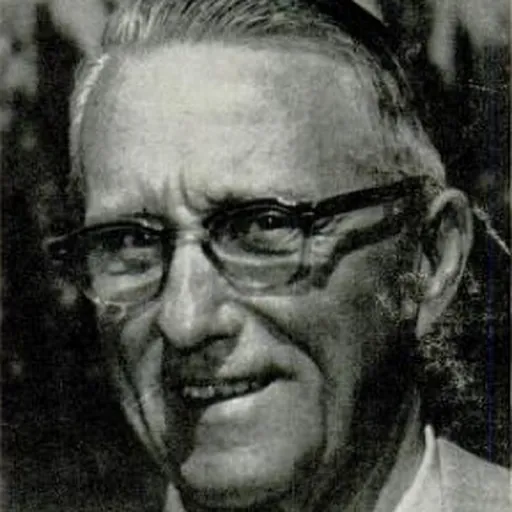
Paul Krichell
American baseball player and head scout for the New York Yankees for 37 years.
About Paul Krichell
Lived 1882 – 1957 (aged 74). Paul Krichell was an American baseball player.
Paul Bernard Krichell (December 19, 1882 – June 4, 1957) was a French Major League Baseball catcher, best known for being the head scout for the New York Yankees for 37 years until his death. Krichell's talent evaluations and signings played a key role in building up the Yankees' run of success from the Murderers' Row teams of the 1920s to the 1950s teams led by Casey Stengel.
Krichell began his professional career in the minor leagues, playing as the reserve catcher for the St. Louis Browns before a serious injury threatened his career. He continued to play in the minor leagues and began to move into coaching before Yankees manager Ed Barrow signed him as a scout in 1920. Considered one of the greatest scouts in baseball history, Krichell signed over 200 players who later played professional baseball, including future Baseball Hall of Famers Lou Gehrig, Hank Greenberg, Phil Rizzuto, Whitey Ford, and Tony Lazzeri. His recommendation of Stengel as the Yankees manager was instrumental in Stengel's appointment in 1948. Barrow called Krichell "the best judge of baseball players he ever saw".
Early life Krichell was born in Paris, France, the son of a German cabinetmaker and youngest of nine children. He grew up in The Bronx, near the site of the future Yankee Stadium. Krichell began his long association with manager Ed Barrow that year when the latter took charge of the Royals. The following year, he managed 59 games while sharing catching duties with Jim Stephens. In 161 at bats, Krichell achieved 35 hits and a .217 batting average. In a later game, a famous photograph captures Cobb appearing to intentionally be flying foot-first into Krichell's crotch while the catcher squints in pained anticipation. There is a 1950s interview with Krichell, and by his own testimony, Cobb was aiming his foot at the ball in Krichell's glove, and succeeded in knocking it to the backstop. "The ball hit the grandstand on the fly. I was mad and stunned. Cobb was mad and shaken. In a way it was really my fault. I was standing in front of the plate, instead of on the side, where I could tag Ty as he slid in. But out of that mix-up I learned one thing: never stand directly in front of the plate when Cobb was roaring for home."
After the 1912 season, the Browns released Krichell, but after recovering from his injury, he played six seasons in the minor leagues. He was the starting catcher for the Buffalo Bisons in 1914 when Babe Ruth made his professional debut with the Baltimore Orioles, hitting a double and a single against his pitching. From 1917 to 1918, Krichell served as manager for Bridgeport of the Eastern League, making several playing appearances over the two seasons. He resigned on June 27, 1918, after two wins were forfeited when he used a player not under contract. He worked in the shipyards during the First World War. before Prohibition forced Krichell to close and return to baseball.
Scouting career Krichell's most significant signing for the Yankees was Lou Gehrig, when he was a player at Columbia University. Prior to the 1921 season, Barrow was appointed general manager of the New York Yankees and requested that Krichell join him as a full-time scout. At the time, the Yankees had a two-man scouting rotation, and Barrow believed the appointment of Krichell would improve the scouting staff. allowing Lou Gehrig to assume Pipp's place in the starting lineup.
Discovery of Gehrig Early in the 1923 season, while traveling to New Brunswick, New Jersey, for a baseball game between Columbia University and Rutgers University, Krichell shared a train with the manager of the Columbia squad, Andy Coakley. They discussed Lou Gehrig, a left-handed pitcher on his squad who could also hit, Skeptical, Barrow sent Krichell to watch Columbia's next game against New York University, After the game, Krichell persuaded Gehrig to sign for the Yankees for $2,000 ($ in 2010) for the remainder of 1923, with a $1,500 bonus ($ in 2010).
After joining up with the team for batting practice in June 1923, Gehrig was sent by Yankees manager Miller Huggins to the Hartford Senators. After a good start, Gehrig went through a long slump and suffered depression which led him to consider quitting baseball. Upon hearing this, Krichell was sent to Hartford to speak with the star player. He discovered that Gehrig was drinking, boosted his confidence and gave him batting advice, including one of Ty Cobb's batting tricks. Gehrig started hitting again, and eventually joined the Yankees.
Later signings
1920s
Krichell was with Babe Ruth, when Ruth had the "bellyache heard around the world". Krichell's fast timing to take him to the hospital potentially saved Ruth's life. alt=A black-and-white photo of a man posting in front of the camera. He is wearing his uniform, holding a baseball bat. He is posing for the camera but looking away slightly from it. An autograph of the subject is also seen in the middle of the picture. Before the 1925 New York Yankees season, Babe Ruth collapsed at a train station in Asheville, North Carolina. Krichell's actions may have saved Ruth's life. On the instructions of Huggins, Krichell drove Ruth to hospital, before traveling with Ruth by train to New York, where Ruth had emergency surgery for an "intestinal abscess" that left him hospitalized for six weeks.
The same year, Krichell went to Hartford, Connecticut, to sign shortstop Leo Durocher for a $7,500 bonus ($ in 2010). When the deal was concluded, Barrow sent Krichell to Salt Lake City to watch young second baseman Tony Lazzeri, who played for the Salt Lake Bees of the Pacific Coast League and hit 60 home runs and achieved over 200 RBIs the previous season. The Bees were asking for $50,000 ($ in 2010), but several scouts placed his value ten times lower. Krichell saw promise in the player and convinced Barrow to buy him. These Krichell signings formed part of the 1927 New York Yankees team, considered by many to be the greatest team ever assembled. Four of the starters in this squad were signed by Krichell, including three-quarters of its infield and Mike Gazella, its main backup, who signed for $500 in 1923 ($ in 2010). The Yankees took just four games to defeat the Pittsburgh Pirates and win the 1927 World Series.
To assist at practice for the 1927 season, Krichell signed Billy Werber from Duke University. He left the team after a month, but re-signed after graduating in 1930. During that time, Krichell was involved in what is considered one of the worst deals from the era. Barrow asked him to travel to Durham, North Carolina, to negotiate with the Durham Bulls for an outfielder named Dusty Cooke. Krichell offered Greenberg a $10,000 contract ($ in 2010) on the spot based on his potential and knowing the Yankees were looking for Jewish players to increase their Jewish fanbase. Subsequently, he signed with the Detroit Tigers.
1930s In the early 1930s, Krichell focused on Ivy League pitchers, saying he preferred signing pitchers who could think. In 1935, a local scout who worked with Krichell placed Long Island University pitcher Marius Russo in a semi-professional team. When Krichell deemed Russo ready, he signed with the Yankees for $750, Krichell signed Borowy from Fordham University for $8,500 and the player later became the ace for the Yankees during the wartime era. However, in an interview with J. G. Taylor Spink of The Sporting News, Krichell said while he signed Allen, he did not discover him. Even so, Krichell decided to look at the infielder and was impressed by the way Rizzuto accomplished double plays; his technique reminded Krichell of Leo Durocher, one of his favorite players.
1940s–1950s Krichell's next target was second baseman Snuffy Stirnweiss from the University of North Carolina. He initially tried to convince him to bypass football for baseball, but the player refused until his father's death soon after his college graduation altered his priorities, leaving him as the sole supporter of his mother and younger brother. Krichell signed him to a contract soon afterwards. In a mass tryout for the Yankees team, Krichell scouted first baseman Whitey Ford. Krichell realised Ford had a strong arm, and recommended he tried pitching. Developing an effective fast curveball, Ford helped his team win the New York City sandlot ball championship, and was signed by Krichell for $7,000 in 1947 ($ in 2010). Ford later became a Hall of Famer and an ace of the Yankees for most of the 1950s and 1960s.
Krichell played a factor in signing future All-Star Tommy Byrne. He was referred by one of his scouts, Gene McCann, to see Byrne pitch for Wake Forest University. He also signed Red Rolfe and Vic Raschi. As he hired more scouts, Krichell reduced his own role, becoming the chief scout and regional scout for the New England area. Nicolas never reached the Majors. However, Krichell's recommendation of Casey Stengel for manager of the Yankees in 1948 was instrumental in their front office hiring him. By the time he retired, he was the most experienced employee still working for the Yankees. When he got word of a promising player, he went to see him play. If Krichell liked what he saw, he discussed the player's goals and motivation with him and his family. He discounted some of a player's weaknesses if their remaining skills were up to par, for example with Tony Lazzeri, who was a poor fielder.
At other times, Krichell collected some of the best prospects in an area, normally 300 or more, and put them through a four-day workout. It normally consisted of practice in the morning and a full game in the afternoon. There, Krichell and his staff sorted through players they believed could become useful in the organization, and dropped those they thought lacked motivation. The few players who survived the workout were assigned by Krichell to the Yankees minor league hierarchy. Birdie Tebbetts, a member of the Veterans Committee in the 1980s, led a campaign to have Krichell, along with fellow scouts Charlie Barrett and Hugh Alexander, inducted to the Baseball Hall of Fame. Under Hall of Fame rules, scouts are not eligible for induction. Tibbets appealed to the Hall of Fame Board of Directors every year from 1981 to 1986 to make the three scouts members of the Hall of Fame, but with no success.
Don’t just read it —
keep it.
Full-length biographies made to live with: read them, listen on the way to work, watch them tonight.
- E-book
- Audio
- Video
Instant download · yours to keep · every purchase keeps this site free
Important facts
People in Paul Krichell's life
Named in this biography and alive at the same time




Related people
Same field, nearest in time


Contemporaries
People whose lives overlapped Paul Krichell's




Frequently asked questions
Who was Paul Krichell?
American baseball player and head scout for the New York Yankees for 37 years. (1882–1957)
When was Paul Krichell born?
Paul Krichell was born on 19 December 1882 in Paris.
When did Paul Krichell die?
Paul Krichell died on 4 June 1957.
What was Paul Krichell's occupation?
Paul Krichell was a baseball player.
What nationality was Paul Krichell?
Paul Krichell was American.
Sources & further reading
Cite this page
APA: Biography.guide. (2026). Paul Krichell. https://biography.guide/paul-krichell/
MLA: "Paul Krichell." Biography.guide, https://biography.guide/paul-krichell/.
Chicago: "Paul Krichell." Biography.guide. https://biography.guide/paul-krichell/.
Data last updated: 2026-09-23 · Spot an error? Report a correction.
Portrait: Wikimedia Commons · author & licence
Page generated 2026-09-27 05:08 UTC