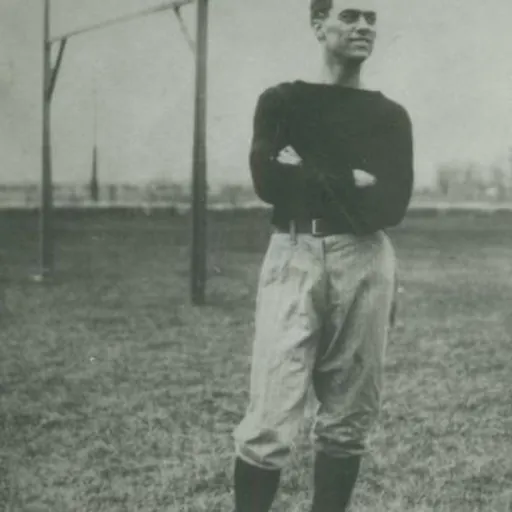
Curley Byrd
American football player and coach, baseball player and coach, college athletics administrator, university president
About Curley Byrd
Lived 1889 – 1970 (aged 81). Curley Byrd was an American baseball player, civil engineer, engineer, athletics competitor, american football player and reporter.
Harry Clifton "Curley" Byrd (February 12, 1889 – October 2, 1970) was an American university administrator, educator, athlete, coach, and politician. Byrd began a long association with the University of Maryland as an undergraduate in 1905, and eventually rose to the position of university president from 1936 to 1954.
In the interim, he had also served as the university's athletic director and head coach for the football and baseball teams. Byrd amassed a 119–82–15 record in football from 1911 to 1934 and 88–73–4 record in baseball from 1913 to 1923. In graduate school at Georgetown University, he became one of football's early users of the newly legalized forward pass, and he had a brief baseball career including one season as pitcher for the San Francisco Seals.
Byrd resigned as university president in order to enter Democratic Party politics in the 1954 gubernatorial election. He ran an unsuccessful campaign as the Democratic candidate for Maryland governor against Theodore McKeldin. Byrd later received appointments to state offices with responsibilities in the Potomac River and Chesapeake Bay. In the 1960s, he made unsuccessful bids for seats in each chamber of the United States Congress. Byrd was a proponent of a "separate but equal" status of racial segregation in his roles as both university administrator and political candidate.
In 2015, the Student Government Association agreed to a resolution in support of changing the name of Byrd Stadium (now SECU Stadium) because they noted that Byrd was "a racist and a segregationist" who "barred blacks from participating in sports and enrolling into the University until 1951". On September 28, 2015, University of Maryland President Wallace Loh appointed a task force to develop viewpoints and options. The University President then made a recommendation to the University System of Maryland Board of Regents — the governing body of Maryland state universities — to change the name to "Maryland Stadium". The ultimate decision on any name change rests with the Board of Regents. On December 11, 2015, the Board of Regents voted 12–5 to remove the "Byrd" from the stadium's name, renaming it Maryland Stadium temporarily before its naming rights were sold.
Early life Harry Clifton Byrd was born on February 12, 1889, in Crisfield, Maryland. He was one of six children of oysterman and county commissioner William Franklin Byrd and his wife Sallie May Byrd. He attended Crisfield High School, where he excelled on the baseball diamond, and was also known as his hometown's first recreational jogger.
College career
In 1905, Byrd graduated from Crisfield High School and enrolled at the Maryland Agricultural College, which is now known as the University of Maryland. He ignored the advice and reported for football practice where head coach Fred K. Nielsen told the undersized Byrd to "play with the kids" and that "football's a man's game." He was allowed, however, to fill in as an end on the scout team due to a shortage of players. During the summers and on weekends, Byrd supplemented his income by continuing work as a fisherman.
After graduation from Maryland, Byrd spent the next three years doing graduate work in law and journalism at George Washington University, Georgetown University, and Western Maryland College (now known as McDaniel College). In a time before eligibility limitations, he played football at George Washington and Georgetown and ran track at Western Maryland. According to The Georgetown Hoyas: A Story of A Rambunctious Football Team, Dorais's "end-over-end 'discus' throw was an exact copy" of Byrd's passing technique, and the Irish "got the headlines because they had a press agent and Georgetown didn't."
Byrd also played for Maryland-based semi-professional baseball teams while pursuing his graduate studies. Byrd led the Aggies to wins in both of their final games of the season, against Western Maryland, 6–0, and Gallaudet, 6–2.
In 1913, the Maryland Agricultural College hired Byrd as an instructor in English and history, According to author David Ungrady in Tales from the Maryland Terrapins, the university initially offered Byrd $300 to coach football, but he demanded $1,200. One of Byrd's track and football players, Geary Eppley, said, "He never yelled in practice or at a game ... He pointed out mistakes and explained what you did wrong. He took a calm approach. The strongest thing he'd say was 'for cripes sake.'" During his tenure as head football coach from 1911 to 1934, he compiled a 119–82–15 record.
Administrative career
Byrd was appointed to the post of assistant university president in 1918. From 1945 to 1948, the university budget increased from $4.8 million to $9.8 million. For years, Byrd refused to release the university's financial records to state legislators, and how exactly he secured funding for many of his projects was largely a mystery. According to booster Jack Heise, Byrd financed a new basketball arena through the out-of-state tuition, paid by the federal government, for Maryland high school graduates who attended the university on the G.I. Bill. The General Accounting Office calculated that the extra fees totaled more than $2 million, but determined that they were within the bounds of legality.
Byrd was a staunch supporter of a "separate but equal" state university system. The Princess Anne campus provided agricultural education and Morgan State College provided liberal arts education for the state's black students, while the University of Maryland remained open only to white students.
In 1945, Byrd hired 32-year-old Paul "Bear" Bryant to his first head coaching post. Bryant led the Terrapins to a 6–2–1 record, but the two personalities clashed. The tensions came to a head when Byrd reinstated a player Bryant had suspended for violating team rules. Bryant resigned as head coach an hour later, which caused an uproar among students until he interceded to restore order.
Two years later, Byrd hired Jim Tatum as football coach. The year prior at Oklahoma, Tatum fielded a winning team, but the athletic department ran up a huge deficit and some players were paid in violation of conference rules, which resulted in university president George Cross firing athletic director Jap Haskell. Tatum told Cross to refute Tatum's role in the matter, and threatened to reveal the Oklahoma team had been paid $6,000 after the 1947 Gator Bowl. Schools found to be in violation could be expelled from the NCAA. University of Virginia president Colgate Darden called the code hypocritical, and The Citadel's leadership refused to "lie to stay in the association" and requested termination of its NCAA membership. The ensuing vote fell 25 short of the needed two-thirds majority to expel the Sinful Seven. In 1952, Maryland and Clemson, which had also violated the bowl game ban, were sanctioned, and the incident hastened the break-up of the Southern Conference and formation of the Atlantic Coast Conference, of which both schools were founding members.
Opponents in The Baltimore Sun alleged that Byrd emphasized athletics over academics and belittled him as the only college football coach to rise to the position of university president. Among the campus expansions, Byrd was responsible for the construction of Byrd Stadium in 1950 and Cole Field House in 1955, which at the time was the largest basketball arena in the Southern Conference. Byrd also built the University of Maryland Golf Course in 1959.
Political career Byrd resigned from the presidency in January 1954 to embark upon an unsuccessful campaign for Governor of Maryland. He narrowly beat perennial candidate George P. Mahoney in the Democratic primary by 50.64% to 49.37% and faced Republican incumbent McKeldin in the general election. Elsewhere in the state, however, middle-class white voters did not support Byrd. Following the example of other oyster-producing states, Byrd authorized fossil shell mining to produce culch, crushed shells used to form oyster beds. He later served as the company's vice president.
Death Byrd died of a heart condition on October 2, 1970, at the University of Maryland Hospital in Baltimore, Maryland. He is interred at Asbury United Methodist Church Cemetery in Crisfield, Maryland, and his epitaph reads: "Harry Clifton 'Curley' Byrd, Educator–Statesman–Conservationist, President Emeritus, Father and Builder of the Greater Consolidated University of Maryland, Founded 1920."
Head coaching record Football
Baseball
Don’t just read it —
keep it.
Full-length biographies made to live with: read them, listen on the way to work, watch them tonight.
- E-book
- Audio
- Video
Instant download · yours to keep · every purchase keeps this site free
Important facts
People in Curley Byrd's life
Named in this biography and alive at the same time




Related people
Same field, nearest in time



Contemporaries
People whose lives overlapped Curley Byrd's


Frequently asked questions
Who was Curley Byrd?
American football player and coach, baseball player and coach, college athletics administrator, university president (1889-1970)
When was Curley Byrd born?
Curley Byrd was born on 12 February 1889 in Crisfield.
When did Curley Byrd die?
Curley Byrd died on 2 October 1970 in Baltimore.
What was Curley Byrd's occupation?
Curley Byrd was a baseball player, civil engineer, engineer, athletics competitor, american football player and reporter.
What nationality was Curley Byrd?
Curley Byrd was American.
Sources & further reading
Cite this page
APA: Biography.guide. (2026). Curley Byrd. https://biography.guide/curley-byrd/
MLA: "Curley Byrd." Biography.guide, https://biography.guide/curley-byrd/.
Chicago: "Curley Byrd." Biography.guide. https://biography.guide/curley-byrd/.
Data last updated: 2026-09-20 · Spot an error? Report a correction.
Portrait: Wikimedia Commons · author & licence
Page generated 2026-09-27 04:57 UTC