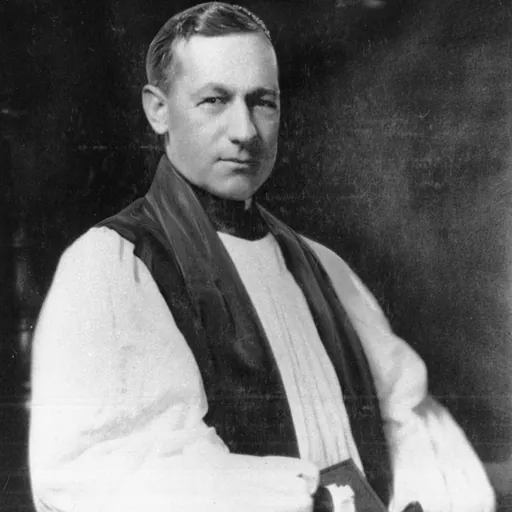
About Paul Jones
Lived 1880 – 1941 (aged 60). Paul Jones was an American cleric and peace activist.
Paul Jones (25 November 1880 – 4 September 1941) was the Episcopal Bishop of Utah (1916–1918), a socialist, and a prominent pacifist. He is included in the book of Lesser Feasts and Fasts of the Episcopal Church. His feast day is September 4.
Early life and education
Jones was born in Wilkes-Barre, Pennsylvania, to Sarah Eastman Coffin Jones and Henry Lawrence Jones, rector of St. Stephen's parish. Paul Jones attended the local grammar school, then Yale University. During summers he worked near home, once as a strikebreaker, and once learning accounting in a mine company's front office.
After graduating in 1902, Jones traveled to Cambridge, Massachusetts and attended the Episcopal Divinity School. He learned about social action theology, including works of Frederick D. Maurice. Before Jones graduated in 1906, Utah's rugged Missionary Bishop Franklin Spencer Spalding (like himself a clergyman's son) addressed the students. This prompted Jones to volunteer to serve in that diocese.
After receiving a pay raise, Jones married Mary Balch in Coronado, California in June 1913. They had a daughter and son, Barbara Spalding Jones (b. 1915) and David Balch Jones (b. 1923), both of whom survived him. He would later receive honorary degrees from Wilberforce University (L.L.D in 1934), and Meadville Theological School (D.D. in 1937).
Ministry Jones accepted a position at the mission church of St. John in Logan, Utah and also ministered to students at the nearby Utah Agricultural College. He also cleared a farm in the mountains (that was later donated to St. John's Church), as well as traveled to remote parishes in the large missionary district. Bishop Ethelbert Talbot of the Episcopal Diocese of Central Pennsylvania had ordained him a deacon after his graduation, and by year's end, Bishop Spalding had ordained him a priest. His rank increased from associate of the St. John's mission to priest-in-charge in 1911. Jones also served as secretary of the diocesan convocations from 1907 until 1914. Like Bishop Spalding, Jones was a social activist and pacifist, especially after witnessing ill-treatment of miners and railroad workers, as well as discrimination against German immigrants in Salt Lake City.
When Bishop Spalding died unexpectedly after being hit by a car, the diocese chose Jones (whom Bishop Spalding had appointed as archdeacon in 1913) as his successor. On December 16, 1914, Presiding Bishop Daniel S. Tuttle (himself a former Missionary Bishop of Utah who had become bishop of the Episcopal Diocese of Missouri) led the consecration service, joined by California bishops William Ford Nichols, William Hall Moreland and Joseph Horsfall Johnson as well as mostly current or former western missionary bishops Talbot, James Bowen Funsten, Robert L. Paddock, Nathaniel S. Thomas, Benjamin Brewster and Louis Childs Sanford. Bishop Jones' ministry continued to take him to many reservations of Native Americans, as well as among miner and railroad workers. He traveled many miles around the diocese visiting parishes by railroad, stagecoach, motorcar, horse and foot.
In the years preceding World War I, Fort Douglas near Salt Lake City became a detention center for pacifists, a German naval crew, and later German-Americans. The lawyer son of the camp's commander was an active layman in the joint vestry of the two Salt Lake parishes, and also lost a son during military training in 1916. Because of Jones' outspoken opposition to World War I, particularly his declaration that "war is unchristian" in August 1917 which received wide press coverage after police raided pacifists meeting in Los Angeles, California (and a complaint filed from the Salt Lake City parishes), Jones was hauled before a special committee of the House of Bishops in St. Louis, Missouri by year's end. Although the committee initially recommended he remain in his post, Presiding Bishop Tuttle appointed a second committee that never received certain defense documents (including a survey demonstrating overwhelming support for him outside the two Salt Lake City parishes) and recommended Jones take a leave of absence based on his opposition to government policy. By year's end, Jones resigned his see effective April 11, 1918 (Easter Sunday that year being March 31). The United States formally joined World War I in February 1918. Jones helped the Fellowship of Reconciliation become international in 1919, and moved to New York and became its secretary for a decade.
Although in 1929 Jones was chosen as temporary bishop of Southern Ohio while the next incumbent was being selected, he never again held a permanent diocese. In 1933, presiding bishop James DeWolf Perry restored Jones's seat, but not his vote, in the House of Bishops.
In 1929, Jones accepted a position as chaplain and assistant professor of religion at Antioch College in Yellow Springs, Ohio and while there sometimes referred to himself as "Bishop to the Universe." Just before his death, Jones helped resettle Jews displaced by the Nazis and advocated a more understanding U.S. relationship with Japan.
In 1940, Jones was the socialist candidate for governor of Ohio (and lost by a significant margin to incumbent Republican John W. Bricker as well as Democrat Martin L. Davey).
Death and legacy Jones died of multiple myeloma in Yellow Springs, Ohio on September 4, 1941, survived by his wife, daughter and 18-year-old son. A scrapbook of his missionary journeys as well as issues of his Logan parish newsletter and about his trial is now made available online by Utah State University.
In 1957 the Lambeth Conference adopted a statement condemning war as a method of settling international disputes, finding it incompatible with Jesus' teaching and urging extension of the right of conscientious objection. In 1962, the Episcopal Church's House of Bishops passed a resolution recognizing "the validity of the calling of the conscientious objector and the pacifist and the duty of the Church fully to minister to him, and its obligation to see that we live in a society in which the dictates of his conscience are respected.”
Don’t just read it —
keep it.
Full-length biographies made to live with: read them, listen on the way to work, watch them tonight.
- E-book
- Audio
- Video
Instant download · yours to keep · every purchase keeps this site free
Important facts
People in Paul Jones's life
Named in this biography and alive at the same time





Related people
Same field, nearest in time

Contemporaries
People whose lives overlapped Paul Jones's





Frequently asked questions
Who was Paul Jones?
American bishop (1880–1941)
When was Paul Jones born?
Paul Jones was born on 25 November 1880 in Wilkes-Barre.
When did Paul Jones die?
Paul Jones died on 4 September 1941 in Yellow Springs.
What was Paul Jones's occupation?
Paul Jones was a cleric and peace activist.
What nationality was Paul Jones?
Paul Jones was American.
Sources & further reading
· DBpedia: Paul Jones (bishop)
Cite this page
APA: Biography.guide. (2026). Paul Jones. https://biography.guide/paul-jones-cleric/
MLA: "Paul Jones." Biography.guide, https://biography.guide/paul-jones-cleric/.
Chicago: "Paul Jones." Biography.guide. https://biography.guide/paul-jones-cleric/.
Data last updated: 2026-09-22 · Spot an error? Report a correction.
Portrait: Wikimedia Commons · author & licence
Page generated 2026-09-27 05:02 UTC