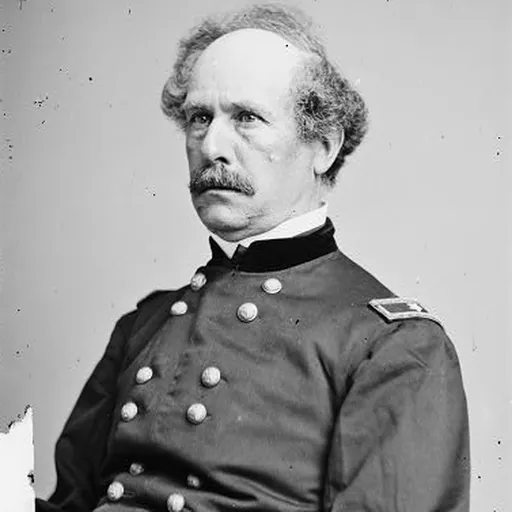
About James Bowen
Lived 1808 – 1886 (aged 78). James Bowen was an American businessperson.
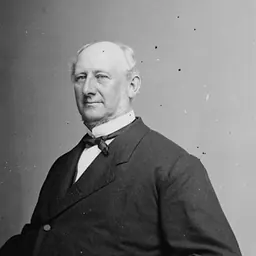
James Bowen (February 25, 1808 – September 29, 1886) was the president of Erie Railroad who served as a Union Army general during the American Civil War.
Biography James Bowen was born in New York City on February 25, 1808. His father was a merchant of ample means, and the son was liberally educated. He was not trained to any profession or business calling, but he cultivated habits of business voluntarily and intuitively. He was a close and persistent student of public affairs, and among his intimate associates were Daniel Webster, Gen. James Watson Webb, William H. Seward, Philip Hone, Moses H. Grinnell, Charles A. Peabody (subsequently of national fame as a jurist, who is the only survivor of that notable coterie), and men of similar cast and bent of mind. Most of them were members of a then famous society known as the Hone Club. Its membership was not only exclusive but limited. Healey's celebrated painting of Webster belonged to this club, and a resolution was passed by the club that the painting should pass to the heirs of the last surviving member. James Bowen was that one, and the painting is now in the possession of Gen. Alexander S. Webb, of New York, to whom it was willed by him.
Upon the passage of the act creating the Metropolitan Police of New York City in 1857, James Bowen was appointed by Governor King one of the first Board of Police Commissioners under that act, his associates in the Board being Simeon Draper, James W. Nye (afterward United States Senator), James S. T. Stranahan, and Jacob Chandler. Mr. Bowen was elected president of the Board, and had charge during the exciting and riotous days of Mayor Fernando Wood's organized but unsuccessful opposition to the replacing of his police force by the new one.
Mr. Bowen was a native of New York City, a man of wealth, a member of the Union Club, and of the Kent Club, famous in that day, in which James Watson Webb, Moses H. Grinnell, Richard M. Blatchford, and similar spirits, were conspicuous. President Bowen was a leader in that coterie, and was especially an intimate of General Webb. The latter had supported the New York and Erie project in his paper, New York Courier and Enquirer, from the beginning, and it was as a friend of his that James Bowen entered the Directory of the company, and through his influence that Bowen was advanced to the Presidency.
April 6, 1832, the charter was amended to authorize the company, with permission of the authorities of New York City, to extend its railroad "along the Fourth Avenue to Fourteenth Street." May 12, 1836, the company was authorized to unite with any railroad or canal company organized under the laws of New York State, for the purpose of constructing a railroad, at any point which the directors of the two companies might agree upon. Subsequent legislation empowered the company to extend its railroad to the City Hall. May 7, 1840, the company was authorized to extend its railroad from the Harlem River through the County of Westchester to a point of intersection with the proposed New York and Albany Railroad. The company was also authorized to build a drawbridge across the Harlem River. Map of New York & Erie Rail Road, 1844, showing the state of work. Under the concurrent influence, however, of the political faction who were opposed to State Loans and to all public works, and of a depressed state of commercial affairs, the sale of the State stock became increasingly difficult, and the price receded from ninety-two per cent, in June, to eighty-two, in December. To avoid so heavy a discount, and prevent a further decline by throwing it on the market, a large amount of it was hypothecated as security for temporary loans. At length, in the course of the winter, the price fell below the rates at which hypothecations had been made, and sales became necessary.
The result was a sacrifice of so large a sum (about $300,000) as suddenly to render the Company unable to pay the quarterly interest due on 1 April 1842. Their credit being thus destroyed, and their operations arrested, and there being a variety of claims which were liable to be prosecuted, the Company immediately placed its affairs in the hands of assignees, by whom its interests; were protected, and the Eastern division was kept in successful operation. An effort was made in the Legislature, at the session of 1842, to obtain a release of the State loan and authority to the company to issue bonds; but neither that nor any accommodation in respect to the accruing interest, was agreeable to the politicians at that time.
The liabilities of the company, to the extent of about $600,000, for work and materials West of Goshen, and chiefly on the Susquehanna and Western divisions, were unprovided for; and all operations were suspended, and continued so till 1845. Owing to the disappointment of the Central and Western counties, and the old leaven of outside political influence, a change of directors was desired, by which a large majority of the Board should be taken, not from the city as before, but from the interior counties. This was accordingly effected at the annual election in the autumn, 1843. The former directors, with one or two exceptions, declined a reelection. A new direction was chosen, and Mr. William Maxwell, of Chemung county, was appointed president.
Publications New York and Erie Railroad Company, James Bowen (1841) Office of the New-York and Erie Rail-Road Company. New York, 13 September 1841. New York and Erie Railroad Company, James Bowen (1842) To the Stockholders of the New York and Erie Railroad Company.
Don’t just read it —
keep it.
Full-length biographies made to live with: read them, listen on the way to work, watch them tonight.
- E-book
- Audio
- Video
Instant download · yours to keep · every purchase keeps this site free
Important facts
People in James Bowen's life
Named in this biography and alive at the same time



Related people
Same field, nearest in time


Contemporaries
People whose lives overlapped James Bowen's





Frequently asked questions
Who was James Bowen?
Railroad executive
When was James Bowen born?
James Bowen was born on 25 February 1808 in New York City.
When did James Bowen die?
James Bowen died on 29 September 1886 in Hastings-on-Hudson.
What was James Bowen's occupation?
James Bowen was a businessperson.
What nationality was James Bowen?
James Bowen was American.
Sources & further reading
· DBpedia: James Bowen (railroad executive)
Cite this page
APA: Biography.guide. (2026). James Bowen. https://biography.guide/james-bowen-businessperson/
MLA: "James Bowen." Biography.guide, https://biography.guide/james-bowen-businessperson/.
Chicago: "James Bowen." Biography.guide. https://biography.guide/james-bowen-businessperson/.
Data last updated: 2026-09-20 · Spot an error? Report a correction.
Portrait: Wikimedia Commons · author & licence
Page generated 2026-09-27 04:57 UTC