
About Paul Carrington
Lived 1733 – 1818 (aged 85). Paul Carrington was an American lawyer, politician and judge.
Paul Carrington (March 16, 1733 – June 23, 1818) was a Virginia planter, lawyer, judge and politician. He served in the Virginia House of Burgesses representing Charlotte County, and later in the Virginia Senate where his district also included neighboring Halifax and Prince Edward Counties. In 1788, legislators elected him as a justice of the Virginia Court of Appeals, now the Supreme Court of Virginia. He was a delegate to the Virginia Ratifying Convention in 1788 and cast his vote for ratification of the United States Constitution.
Early life and education Carrington was born on March 16, 1733, at "Boston Hill" in the former Goochland County of the Colony of Virginia. His parents were Anne Mayo (1712–1785) and Col. George Carrington (1711–1785), a surveyor and planter in southside Virginia, who held local offices and became one of the burgesses long representing Goochland County.
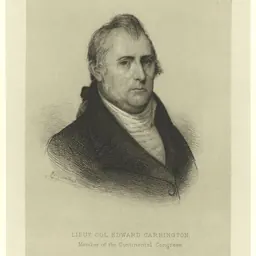
His paternal grandparents, Dr. Paul Carrington and Henningham Codrington, had migrated from England to the Island of Barbados, and his parents arrived in Virginia in 1723. Paul Carrington's maternal grandparents were Major William Mayo and Frances Gould. The family also included a much-younger brother, Edward Carrington who distinguished himself as a Continental Army officer and served in the Confederation Congress.
After receiving a private education, at about age 17 Carrington began reading law under the direction of Colonel Clement Read in Lunenburg County. Read was the county clerk and served as a burgess. In 1775, he became a member of the first board of trustees in the founding of Hampden-Sydney College.
Carrington was elected to the House of Burgesses for Charlotte County in 1765; he was regularly re-elected, serving until Governor Dunmore suspended the legislature in 1775. Charlotte County voters then elected Carrington to five Virginia Revolutionary conventions. The Third Revolutionary Convention appointed Carrington to the statewide Committee of Safety. In the Fifth Revolutionary Convention, he served on the committee that drafted the Virginia Declaration of Rights and the first Virginia Constitution. At the time his father represented Cumberland County in the Virginia House of Delegates. His parents died in 1785, separated by only eight days. His father had not made a will, so Carrington as the firstborn son inherited the entire estate, which included 32,000 acres of land and 18 slaves; he nevertheless chose to divide the estate equitably according to his father's plan.
Legislators elected Carrington as a Judge of the first Virginia General Court under the newly adopted Virginia state constitution on January 23, 1778. He was the second Justice appointed to the new Court of Appeals, which was then composed of judges from the General, the Admiralty and the Chancery Courts. In 1780 he became the Chief Justice of the Virginia General Court. In 1789, the Virginia General Assembly elected Carrington as a Justice of the reorganized Virginia Supreme Court of Appeals. His son, sometimes referred to as George Carrington Jr. to distinguish him from his grandfather, who had served in the patriot armies under his uncle Col. Edward Carrington, also was a delegate at the convention, but had opposed ratification without the amendments.
At age 75, concerned as to his ability to continue judicial duties, Carrington resigned from the bench in 1807.
Carrington farmed with enslaved labor his entire life, as did his sons. Complicating matters, one of his sons, who served as speaker of the Virginia Senate before also becoming a judge, was named Paul. In the last federal census of his lifetime, Carrington’s name appears on two entries on the same page for different plantations. One entry shows him with several other freeborn whites as well as 78 enslaved blacks. The other entry included only a white male older than 45 with 95 slaves.
Don’t just read it —
keep it.
Full-length biographies made to live with: read them, listen on the way to work, watch them tonight.
- E-book
- Audio
- Video
Instant download · yours to keep · every purchase keeps this site free
Important facts
People in Paul Carrington's life
Named in this biography and alive at the same time


Related people
Same field, nearest in time


Contemporaries
People whose lives overlapped Paul Carrington's






Frequently asked questions
Who was Paul Carrington?
American politician 1733-1818
When was Paul Carrington born?
Paul Carrington was born on 16 March 1733 in Charlotte County.
When did Paul Carrington die?
Paul Carrington died on 23 June 1818 in Halifax County.
What was Paul Carrington's occupation?
Paul Carrington was a lawyer, politician and judge.
What nationality was Paul Carrington?
Paul Carrington was American.
Sources & further reading
· DBpedia: Paul Carrington (judge)
Cite this page
APA: Biography.guide. (2026). Paul Carrington. https://biography.guide/paul-carrington/
MLA: "Paul Carrington." Biography.guide, https://biography.guide/paul-carrington/.
Chicago: "Paul Carrington." Biography.guide. https://biography.guide/paul-carrington/.
Data last updated: 2026-09-20 · Spot an error? Report a correction.
Page generated 2026-09-27 05:19 UTC