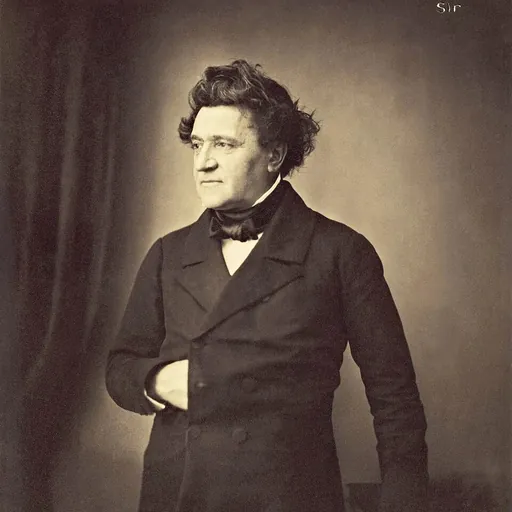
About Paul Abadie
Lived 1812 – 1884 (aged 71). Paul Abadie was a French architect, restorer and visual artist.
Paul Abadie (9 November 1812 – 2 August 1884) was a French architect and building restorer. He is considered a central representative of French historicism. He was the son of architect Paul Abadie Sr.
Abadie worked on the restoration of Notre-Dame de Paris, Église Sainte-Croix of Bordeaux, Saint-Pierre of Angoulême and Saint-Front of Périgueux. He won the competition in 1873 to design the Basilica of the Sacré Cœur on Montmartre in Paris, and saw construction commence on it, though he died long before its completion in 1914.
Biography Paul Abadie (Jr.) was born on 9 November 1812 in Paris, France. He was the son of Paul Abadie Sr., who was also an architect in France. He entered the School of Fine Arts (École des Beaux-Arts) in 1835; under the direction of the Monsieur Achille Leclère.
As attaché to the commission for historical monuments, he participated in the architectural rediscovery of the Middle Ages, touring and studying medieval sites intensively. Abadie was known to be interested in the restoration of medieval monuments and buildings; namely the Church of S. Front and the Cathedral of Angoulême. He also designed the Hôtel de Ville at Angoulême.
Abadie began the Basilica of Sacré Cœur, but he died during its construction, on 3 August 1884, in Chatou, (departement of Yvelines), France.
List of works
Constructions Basilica Sacré-Cœur, Paris, France Church of Chatou, France Neo-romanic Church of Saint-Georges of Mussidan, France Mailleberchie Castle, Villebois-Lavalette, France Maison Léon Croizet, Saint-Même-les-Carrières, France
Restorations Notre-Dame de Paris (initially under supervision of Viollet-le-Duc) Church Sainte-Croix Bordeaux Church Saint-Michel Tower, Bordeaux, France Saint-Ferdinand Church, Bordeaux, France Church of the Bastide (Église de la Bastide), Bordeaux, France Sacristy of the Saint-André Cathedral, Bordeaux, France Great Synagogue of Bordeaux, Bordeaux, France Saint Front Périgueux Cathedral, Périgueux, France Saint-Georges Church, Périgueux, France Saint-Pierre Abbey of Brantôme, France Angoulême Cathedral, Angoulême, France Saint-Étienne Cathedral, Cahors, France Saint-Léger Church, Cognac, France Château d'Angoulême, Angoulême, France Saint-Martial Church, Angoulême, France Sacré-Cœur, Paris, France
Other Grave monument for Jean-Louis Guez de Balzac, Hôtel Dieu (Chapel), Angoulême, France
Legacy and influence The work of Paul Abadie was not appreciated by some academics in the mid-twentieth century, as they felt he was fanciful, destroyed much Romanesque heritage, and had no compunction about adding whimsical sculptures of his own manufacture on capitals and corbels. An example of his willful implantations of false Romanesque sculpture is to be found in the clover-leaf church of St Michel d'Entraygues near Angoulême. Here, he has introduced a capital featuring a triple-headed Green Man with horns and a diabolical expression. Despite its intriguing shape, this small church has no connection with the Templars, but was built to receive pilgrims on the way to Compostela. Abadie's restoration works at Périgueux Cathedral Many communities in the present-day Charente and Dordogne departments are indebted to him for the restoration of a large number of ecclesiastical buildings, many that were in severe disrepair or simply neglected over centuries, for example in Angoulême, Périgueux, and Cahors, where from 1849 onwards he was the diocesan architect for those dioceses. His works, in particular Sacré Cœur, inspired many devotional and pilgrimage basilicas, for example the Basilica of the Sacred Heart, Brussels, (Koekelberg), 1919–1960, by Albert van Huffel, or the basilica Sainte-Thérèse de Lisieux, 1928–1954, by Louis-Marie Cordonnier. He also inspired a large number of churches, most notably in Paris (Saint-Esprit, 1928–1935, by Paul Tournon; Saint-Pierre-de-Chaillot, 1931–1938, by Émile Bois; and Sainte-Odile, 1934–1946, by Jacques Barge).
Don’t just read it —
keep it.
Full-length biographies made to live with: read them, listen on the way to work, watch them tonight.
- E-book
- Audio
- Video
Instant download · yours to keep · every purchase keeps this site free
Important facts
more
Paul II AbadiePeople in Paul Abadie's life
Named in this biography and alive at the same time

Related people
Same field, nearest in time




Contemporaries
People whose lives overlapped Paul Abadie's




Frequently asked questions
Who was Paul Abadie?
French architect and building restorer (1812–1884)
When was Paul Abadie born?
Paul Abadie was born on 9 November 1812 in Paris, former 4th arrondissement of Paris.
When did Paul Abadie die?
Paul Abadie died on 3 August 1884 in Chatou.
What was Paul Abadie's occupation?
Paul Abadie was an architect, restorer and visual artist.
What nationality was Paul Abadie?
Paul Abadie was French.
Sources & further reading
Cite this page
APA: Biography.guide. (2026). Paul Abadie. https://biography.guide/paul-abadie/
MLA: "Paul Abadie." Biography.guide, https://biography.guide/paul-abadie/.
Chicago: "Paul Abadie." Biography.guide. https://biography.guide/paul-abadie/.
Data last updated: 2026-09-20 · Spot an error? Report a correction.
Portrait: Wikimedia Commons · author & licence
Page generated 2026-09-27 04:58 UTC