
About Paolo Battino Vittorelli
Lived 1915 – 2003 (aged 87). Paolo Battino Vittorelli was an Italian politician and journalist.
Paolo Battino Vittorelli (9 July 1915 – 24 March 2003) was an Egyptian–Italian author, journalist, political commentator, and politician of the centre-left. He actively engaged in anti-fascist propaganda during the war years, most of which he spent exiled in Egypt as an anti-fascist publicist and professor at Cairo University.
Biography Family provenance and early years Paolo Battino Vittorelli was born as "Raffaello Battino" to an Italian–Jewish family in Alexandria, Sultanate of Egypt, at the time a protectorate of the British Empire. His ancestral roots tracked back to Corfu, which had been ruled by the Republic of Venice for half a millennium until the end of the 18th century, and which remained heavily influenced by Venetian and Italian culture through the 19th and early 20th centuries. Amedeo Battino, his father, had graduated from the University of Athens and then as a newly qualified lawyer moved to the Khedivate of Egypt in 1908, an autonomous tributary state of the Ottoman Empire, attracted by the commercial opportunities and the booming free-wheeling economy which had opened up to European businesses since the opening of the Suez Canal in 1864.
His mother, born Blanche Caroli, ended up in Alexandria after Giacomo Caroli, her own father (and thereby Raffaello's maternal grandfather) had moved to Egypt following the death of his wife (born Emilia Mattatia, Raffaello's maternal grandmother), and set himself up in business as the owner-manager of a small hotel in Alexandria. Giacomo Caroli was born in Trieste but moved to Corfu when he married, as his second wife, Emilia Mattatia, who had grown up on the island. The child grew up bilingual, fluent both in Italian and French; the latter was the language still favoured by the largely expatriate Western European community of bourgeois businessmen and bureaucrats in British-ruled Egypt. In 1937, Paolo Vittorelli became a contributor to the movement's weekly political magazine, which was also named Giustizia e Libertà.
World War II
In 1938, comrades sent him back to Fascist Italy with instructions to make contact with an underground network of Italian anti-fascists, but he was intercepted at the frontier by the Italian police and returned to France, where he was now based until 1940.
In addition, Vittorelli worked as a journalist and directed the Corriere degli Italiani, an Italian-language newspaper affiliated to Giustizia e Libertà (GL) and published in Cairo.
On 8 February 1948, Azione Socialista Giustizia e Libertà gave birth to the Unione dei Socialisti (UdS), a political party created by Ivan Matteo Lombardo. The new party then linked up with other left-leaning political parties to form Unità Socialista. The overriding objective was to preclude an East German-style Moscow-backed political alliance with the Italian Communist Party (PCI) ahead of the critically important 1948 general election. A year later, following an election outcome which had disappointed socialists and communists alike, a further political coming together on the political centre-left created the Partito Socialista Unitario (PSU). Vittorelli was appointed party deputy secretary and permanent delegate to the re-emerging Socialist International. Vittorelli was not entirely comfortable with this outcome.
The so-called Scam Law proposed by the government early in 1953 appalled Vittorelli, as did the attitude of the PSDI to the government proposal to distort general election results by awarding extra parliamentary seats to whichever party gained the most votes. Together with Tristano Codignola, Piero Calamandrei, and Aldo Garòsci, Vittorelli resigned from the PSDI and joined the Unità Popolare (UP), a newly formed coalition of democrats from the political centre and left which came together to oppose the Fraud Law. The law was passed by parliament, but would be repealed in 1954 without ever having been implemented, apparently because the government, still in power, but with a greatly reduced majority following the 1953 general election, concluded that it was becoming so unpopular with voters as to be electorally counter-productive. The UP failed to achieve significant traction with voters. It nevertheless limped on for several years. In 1963, Vittorelli was one of seven candidates elected to membership of the Senate (IV Legislature) by voters in the Basilicata electoral district, whom he represented on behalf of the Socialist Party. The others from Basilicata were Christian Democrats (4) and Communists (2). Across the country, the Socialists ranked third in the Senate, securing 44 of the 315 seats, against 85 for the Communists and 132 for the Christian Democrats. Vittorelli served as a senator for the full five-year term, until 1968. During his time in the Senate, he also found time to publish a translation into Italian of Isaiah Berlin's 1939 biography of Karl Marx. Vittorelli's translation, which appears to have been the first written in Italian, appeared in 1967; it was republished a number of times, most recently in 2021. The 2004 edition is enhanced by an introduction from Bruno Bongiovanni.
Paolo Vittorelli stood for election in the 1970 Piedmontese regional election as a PSI candidate and was elected. In terms of party votes the Socialists were comfortably outperformed in the election, but no party gained an overall majority and the regional government was therefore a PSI–DC coalition-led administration. Presidency of the regional council alternated between the two parties. Between 23 July 1970 and 3 March 1972, Paolo Vittorelli served as president of the Piedmont regional council.
Later during the decade Vittorelli was a founder, in 1979, of the Istituto Studi e Ricerche Difesa ("Institute of Defence Studies and Research"),
In 1972, Vittorelli stood successfully for election to the Chamber of Deputies as a Socialist Party member for the Torino-Novara-Vercelli electoral district. He served as a member of parliament throughout the 1972–1976 and 1976–1979 parliamentary sessions.
Authorship During his later decades, Vittorelli turned increasingly to writing books. At the 1981 Viareggio Prize ceremony, he was recipient of the President's Prize for his memoires of the defunct Action Party, "L'età della tempesta. Autobiografia romanzata di una generazione". He followed through in 1998 with a sequel, also based on his knowledge of the Action Party, titled "L'età della speranza. Testimonianze e ricordi del Partito d’Azione" and dealing with what one source identifies as the party's "militant years" ("... agli anni della militanza").
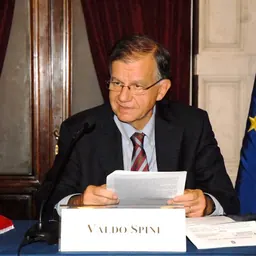
Final years Paolo Vittorelli's final years coincided with further ructions among the left-wing parties of Italy. During the 1990s, the PSI burst apart and collapsed, partly under the weight of its internal contradictions and partly due to the wave of corruption scandals which hit the Italian political class at that time. In 1998, taking his lead from Valdo Spini, who was also a former PSI member, Vittorelli joined the Democratici di Sinistra (DS), a coming together of formerly separate centre-left groupings hoping to construct a modern European Social Democratic party.
Don’t just read it —
keep it.
Full-length biographies made to live with: read them, listen on the way to work, watch them tonight.
- E-book
- Audio
- Video
Instant download · yours to keep · every purchase keeps this site free
Important facts
People in Paolo Battino Vittorelli's life
Named in this biography and alive at the same time




Related people
Same field, nearest in time




Contemporaries
People whose lives overlapped Paolo Battino Vittorelli's




Frequently asked questions
Who was Paolo Battino Vittorelli?
Italian politician, journalist and writer
When was Paolo Battino Vittorelli born?
Paolo Battino Vittorelli was born on 9 July 1915 in Alexandria.
When did Paolo Battino Vittorelli die?
Paolo Battino Vittorelli died on 24 March 2003 in Turin.
What was Paolo Battino Vittorelli's occupation?
Paolo Battino Vittorelli was a politician and journalist.
What nationality was Paolo Battino Vittorelli?
Paolo Battino Vittorelli was Italian.
Sources & further reading
· Wikipedia: Paolo Battino Vittorelli
· DBpedia: Paolo Battino Vittorelli
Cite this page
APA: Biography.guide. (2026). Paolo Battino Vittorelli. https://biography.guide/paolo-battino-vittorelli/
MLA: "Paolo Battino Vittorelli." Biography.guide, https://biography.guide/paolo-battino-vittorelli/.
Chicago: "Paolo Battino Vittorelli." Biography.guide. https://biography.guide/paolo-battino-vittorelli/.
Data last updated: 2026-09-25 · Spot an error? Report a correction.
Page generated 2026-09-27 05:13 UTC