
About Otto Gotsche
Lived 1904 – 1985 (aged 81). Otto Gotsche was a German politician, writer, resistance fighter and prose writer.
Otto Gotsche (3 July 1904 – 17 December 1985) was a German political activist (KPD) and writer. After 1945 he moved into mainstream politics.
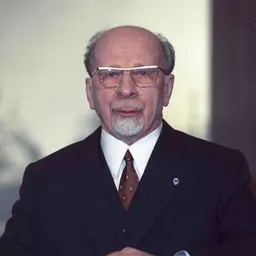
During the Nazi years he worked effectively in the country's resistance movement. Having survived, he became a leading member of the East German literary establishment. A committed adherent to the country's political path during the 1950s and 1960s, he enjoyed the confidence of Walter Ulbricht, at times employed as an official spokesman for the leader. In 1966 he became a member of the country's powerful Party Central Committee. After Ulbricht lost power in 1971, the public profile of Otto Gotsche quickly faded, and he found himself retiring, one by one, from the various party offices he had acquired. He continued to be officially honoured for his work as a writer till the end, however.
Life
Provenance and early years Otto Gotsche was born in Wolferode, a quarter on the western side of Eisleben, a small town to the west of Leipzig which then, as now, was chiefly venerated as the birthplace of Martin Luther. Gotsche's father was a miner, and between 1918 and 1921 the boy trained as a metal worker. The Nazis took power in January 1933 and lost little time in converting the German state into a one-party dictatorship. Political activity (unless in support of the Nazi party) became illegal. Gotsche was arrested in March 1933 and spent several months in Sonnenburg concentration camp. Following his release he was kept under close police surveillance.
After 1934 he continued to use his metal working skills on various building sites in the Halle-Merseburg area which enabled him unobtrusively to sustain connections with other communists. Between 1941 and 1945 he worked in the Lützkendorf fuel factory of Wintershall AG. together with Kläre and Adolf Jahns-Taskiwski. Along with its connections in the Mansfeld region, the AAM had individual contacts in Halle, Zeitz, Querfurt, Weißenfels, Erfurt, Gotha and several towns in the Rhine-Ruhr region. In the closing years of the war it was one of the largest and best regional opposition groups in the entire country. It avoided close relationships on a group level with other Communist opposition groups, as a result of which it also successfully avoided being penetrated by Gestapo spies.
In March 1945, with foreign armies fighting their way towards Berlin and the end of the war in sight the AAM organised armed resistance groups, and at the start of April set up an illegal "citizens' committee" incorporating former Red Front and Reichsbanner members to form the leadership of a citizen militia. On 13 April 1945, shortly before the arrival of the US army, they disarmed the local police and took over the Eisleben town hall.
Soviet occupation zone Although central southern Germany was liberated from the Nazis by the US army, many of the postwar national frontiers of Europe had by that time already been agreed, albeit with varying levels of enthusiasm, by the leaders of the victorious nations. Most of the eastern part of Germany was passed to Poland and the eastern part of Poland was passed to the Soviet Union. What was left of Germany was to be divided into four allied occupation zones, and what had been the central portion of Germany was to be administered as the Soviet occupation zone. Respecting the agreement between President Roosevelt and General Secretary Stalin, in July 1945 the US army removed itself from the region and the Soviets moved in. Otto Gotsche was promptly installed as vice president of the regional administration to be based in Merseburg, with special responsibility for implementing land reform. and Otto Gotsche was one of the hundreds of thousands of former Communist Party members (and others) who lost no time in doing so. Until 1952 the territory defined by the Soviet occupation zone was divided for administrative purposes into five federal states (" Länder"), following a pattern similar to that applied in the western occupation zones: in 1947 Otto Gotsche switched to a position as Ministerial Director with the Interior Ministry for the federal state of Saxony-Anhalt. was a loyal supporter of the leader, with whom he worked closely, and on whose behalf undertook a succession of increasingly important tasks and roles. #tag:ref|Staatsrat der DDR: kollektives Gremium, das 1960 als Nachfolgeorgan des Amtes des Präsidenten der DDR geschaffen wurde. Erster Staatsratsvorsitzender war Walter Ulbricht. Zum Sekretär des Staatsrates wurde Otto Gotsche bestimmt. Another edition of it followed in 1971.
Possibly his most significant contribution to the canon of socialist literature was Die Fahne von Kriwoi Rog ("The Flag from Kriwoi Rog"). A film of the book appeared under the same title in 1967. Another book that gave rise to a movie version was "Unser kleiner Trompeter" ("Our Little Trumpeter"): the film appeared in 1964 under the title "Das Lied vom Trompeter" ("The Trumpeter's Song").
Reflecting the close links between literature and politics in East Germany, Otto Gotsche was also prominent as a representative of the Working Writer's Movement (Zirkel Schreibender Arbeiter).
Awards and honours (not a complete list) 1958 National Prize of the German Democratic Republic 1959 Literature Prize of the German Democratic Republic 1964 Erich Weinert Medal 1965 Order of Karl Marx 1969 Patriotic Order of Merit 1979 Patriotic Order of Merit gold clasp 1984 Star of People's Friendship
Don’t just read it —
keep it.
Full-length biographies made to live with: read them, listen on the way to work, watch them tonight.
- E-book
- Audio
- Video
Instant download · yours to keep · every purchase keeps this site free
Important facts
People in Otto Gotsche's life
Named in this biography and alive at the same time


Related people
Same field, nearest in time





Contemporaries
People whose lives overlapped Otto Gotsche's



Frequently asked questions
Who was Otto Gotsche?
German politician and author (1904-1985)
When was Otto Gotsche born?
Otto Gotsche was born on 3 July 1904 in Wolferode.
When did Otto Gotsche die?
Otto Gotsche died on 17 December 1985 in Berlin.
What was Otto Gotsche's occupation?
Otto Gotsche was a politician, writer, resistance fighter and prose writer.
What nationality was Otto Gotsche?
Otto Gotsche was German.
Sources & further reading
Cite this page
APA: Biography.guide. (2026). Otto Gotsche. https://biography.guide/otto-gotsche/
MLA: "Otto Gotsche." Biography.guide, https://biography.guide/otto-gotsche/.
Chicago: "Otto Gotsche." Biography.guide. https://biography.guide/otto-gotsche/.
Data last updated: 2026-09-22 · Spot an error? Report a correction.
Page generated 2026-09-27 05:20 UTC