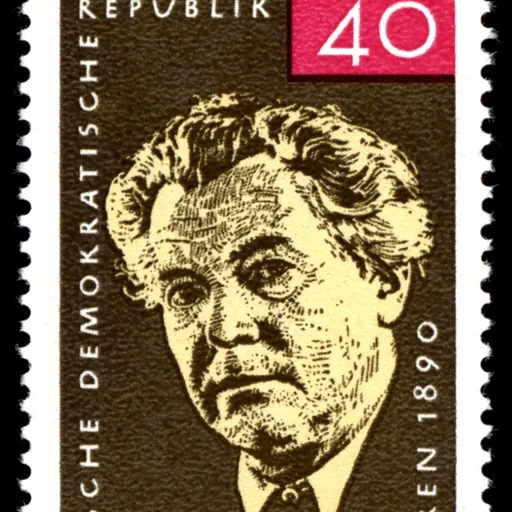
About Erich Weinert
Lived 1890 – 1953 (aged 62). Erich Weinert was a German translator, writer, resistance fighter, poet, songwriter and ukrainian–German translator.
Erich Bernhard Gustav Weinert (4 August 1890 – 20 April 1953) was a German Communist writer, poet and a member of the Communist Party of Germany (KPD).
Early life Weinert was born in 1890 in Magdeburg to a family supporting the Social Democratic Party of Germany. He attended a boys' school in Magdeburg and, from 1908 to 1910, he visited the arts, crafts and trade school in the city and went to an art school in Berlin in 1912. He later joined the military, where he participated as an officer during World War I. It was during his time as a soldier that he was attracted to the revolutionary ideology. After the war, he went to Leipzig and worked as an actor and lecture artist, joining the Communist Party of Germany in 1929. Meanwhile, he made various works.
Literary career
Weinert started writing in 1921. From the very beginning, his poems were thoroughly anti-imperialist. In the second half of the 1920s, Weinert's work leaned towards portraying the struggles of the German proletariat. In 1929, he joined the Communist Party of Germany. Weinert's works were always political, and the role of political poet, agitator, and satirist were gradually assumed, as best seen in his collections Theater of the Apes (1925) and Erich Weinert Speaks (1930). In July 1937 he attended the Second International Writers' Congress, the purpose of which was to discuss the attitude of intellectuals to the war, held in Valencia, Barcelona and Madrid and attended by many writers including André Malraux, Ernest Hemingway, Stephen Spender and Pablo Neruda. He turned his experience on the Spanish front into poems, which were published in the book Camaradas (1951). using methods such as poems printed on handbills that were thrown off behind the German lines as well as making pleas to them via the radio and shouting slogans from the rubble of Stalingrad. In 1943 he was selected as the president of the National Committee for a Free Germany. Once again the time spent on the front lines found literary expression. Weinert published his war diary under the title 'Remember Stalingrad' in 1943. Two short stories – 'Death for the Fatherland' and 'Expediency' – came out in 1942. A collection of leaflet poems written during the war came out in 1944 as 'Against the Real Enemy'. In 1947, he also published 'Chapter Two of World History: Poems About the Land of Socialism', an anthology of poems about the Soviet Union.
Return to Germany
In 1946 he returned to Germany in a sickly state. Regardless, he served actively as vice-president of the Central Administration for National Education in the Soviet Occupation Zone. In recognition of his work, he was awarded the National Prize in 1949 and 1952. He was also elected into the position of a member of the German Academy of Arts. He continued to publish works until his death at the age of 62 in 1953. He was cremated and honoured with burial at the Memorial to the Socialists in the Friedrichsfelde Central Cemetery, Berlin.
Selected writings
Affentheater. Gedichte. Leon Hirsch Verlag, Berlin 1925. Erich Weinert spricht. Gedichte. Internationaler Arbeiter-Verlag, Berlin, Wien, Zürich 1930. Rufe in die Nacht. Gedichte aus der Fremde 1933–1943. Volk und Welt, Berlin 1950. Memento Stalingrad. Ein Frontnotizbuch. Volk und Welt, Berlin 1951. Camaradas. Ein Spanienbuch. Volk und Welt, Berlin 1952 Gesammelte Werke. (9 Bände), herausgegeben 1955–1960. Gesammelte Gedichte. (7 Bände), herausgegeben 1970–1987. Der verbogene Zeitspiegel. Der Gottesgnadenhecht und andere Abfälle. Der heimliche Aufmarsch. Der unzüchtige Zille. Des reichen Mannes Frühlingstag. Das Nationalkomitee Freies Deutschland 1943–1945. Rütten & Loening, Berlin 1957. Poesiealbum 5. Verlag Neues Leben, Berlin 1968.
Don’t just read it —
keep it.
Full-length biographies made to live with: read them, listen on the way to work, watch them tonight.
- E-book
- Audio
- Video
Instant download · yours to keep · every purchase keeps this site free
Important facts
People in Erich Weinert's life
Named in this biography and alive at the same time


Related people
Same field, nearest in time



Contemporaries
People whose lives overlapped Erich Weinert's



Frequently asked questions
Who was Erich Weinert?
German communist writer (1890–1953)
When was Erich Weinert born?
Erich Weinert was born on 4 August 1890 in Magdeburg.
When did Erich Weinert die?
Erich Weinert died on 20 April 1953 in Berlin.
What was Erich Weinert's occupation?
Erich Weinert was a translator, writer, resistance fighter, poet, songwriter and ukrainian–German translator.
What nationality was Erich Weinert?
Erich Weinert was German.
Sources & further reading
Cite this page
APA: Biography.guide. (2026). Erich Weinert. https://biography.guide/erich-weinert/
MLA: "Erich Weinert." Biography.guide, https://biography.guide/erich-weinert/.
Chicago: "Erich Weinert." Biography.guide. https://biography.guide/erich-weinert/.
Data last updated: 2026-09-22 · Spot an error? Report a correction.
Portrait: Wikimedia Commons · author & licence
Page generated 2026-09-27 05:02 UTC