
About Ogata Kōrin
Lived 1658 – 1716 (aged 57–58). Ogata Kōrin was a Japanese painter and xylographer.
Ogata Kōrin (; 1658 – June 2, 1716) was a Japanese landscape illustrator, lacquerer, painter, and textile designer of the Rinpa School.
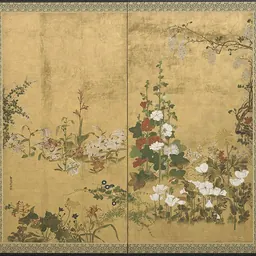
Kōrin is best known for his byōbu folding screens, such as Irises and Red and White Plum Blossoms (both registered National Treasures), and his paintings on ceramics and lacquerware produced by his brother Kenzan (1663–1743). Also a prolific designer, he worked with a variety of decorative and practical objects, such as round fans, writing boxes (suzuribako) executed in relief (makie) or inrō (medicine cases).
He is also credited with reviving and consolidating the Rinpa school of Japanese painting, fifty years after its foundation by Hon'ami Kōetsu (1558–1637) and Tawaraya Sōtatsu (c. 1570 – c. 1640). In fact the term "Rinpa", coined in the Meiji period, means "school of [Kō]rin". In particular he had a lasting influence on Sakai Hōitsu (1761–1828), who replicated many of his paintings and popularized his work, organizing the first exhibition of Kōrin's paintings at the hundredth anniversary of his death.
Biography Kōrin was born in Kyoto into a wealthy merchant family, dedicated to the design and sale of fine textiles. The family business, named Karigane-ya, catered to the aristocratic women of the city. His father, Ogata Sōken (1621–1687), who was a noted calligrapher in the style of Kōetsu and patron of Noh theater, Kōrin was the second son of Sōken. His younger brother Kenzan was a celebrated potter and painter in his own right, with whom he collaborated frequently. As the offspring of a wealthy urban family, Kōrin received an education typical of men of his social stature, which included instruction in painting and calligraphy. However, he was reportedly more interested in the theater than in painting during his youth. He most likely received painting lessons from a member of the Kanō school, though attempts to determine the specific teacher have been inconclusive. The most significant influences on his mature painting style were his great-granduncle Hon'ami Kōetsu and the painter Tawaraya Sōtatsu.
Sōken died in 1687, His masterpieces from that last period, such as the Red and White Plum Blossoms screens, are thought to have been painted there. His chief pupils were Tatebayashi Kagei, Watanabe Shikō The screens are among the first works of Kōrin as a hokkyō. It depicts abstracted blue Japanese irises in bloom, and their green foliage, creating a rhythmically repeating but varying pattern across the panels. The similarities of some blooms indicate that a stencil was used. ). They are listed as a National Treasure of Japan.
Kōrin made a similar work about five to twelve years later, another pair of six-panel screens, known as . It is a more explicit reference to the "Yatsuhashi (Eight Bridges)" episode from The Tales of Ise, including the depiction of an angular bridge that sweeps diagonally across both screens. made using ink and color on gold-foiled paper. It is a replica of an original work by Tawaraya which depicts Raijin, the god of lightning, thunder and storms in the Shinto religion and in Japanese mythology, and Fūjin, the god of wind. Later, Sakai Hōitsu, another prominent member of the Rinpa school, painted his own version of the work. All three versions of the work were displayed together for the first time in seventy-five years in 2015, at the Kyoto National Museum exhibition Rinpa: The Aesthetics of the Capital. The simple, stylized composition of the work depicts a patterned flowing river with a white plum tree on the left and a red plum tree on the right. The plum blossoms indicate the scene occurs in spring.
No documentation exists from before the 20th century on the commission or provenance of the screens. They receive mention in no Edo-period publications on Kōrin's works and were not copied by his followers, which suggests they were not well known. A journal article in 1907 is the first known publication about them, and their first public display came in a 200th-anniversary exhibition of Kōrin's work in 1915.
In addition to the use of tarashikomi, the work is notable for its plum flowers depicted using pigment only, without any outline, now a popular technique known as Kōrin Plum Flowers.
Gallery
Don’t just read it —
keep it.
Full-length biographies made to live with: read them, listen on the way to work, watch them tonight.
- E-book
- Audio
- Video
Instant download · yours to keep · every purchase keeps this site free
Important facts
more
Korin, Kōrin, Koretomi, Iryō, Seisei, Kōrin Ogata, Hōsei, Ichinojō Koretomi, Dōsū, Ogata Korin, Ogata KourinPeople in Ogata Kōrin's life
Named in this biography and alive at the same time
Related people
Same field, nearest in time


Contemporaries
People whose lives overlapped Ogata Kōrin's



Frequently asked questions
Who was Ogata Kōrin?
Japanese painter, craftsman (1658-1716)
When was Ogata Kōrin born?
Ogata Kōrin was born in 1658 in Heian-kyō.
When did Ogata Kōrin die?
Ogata Kōrin died on 2 June 1716 in Heian-kyō.
What was Ogata Kōrin's occupation?
Ogata Kōrin was a painter and xylographer.
What nationality was Ogata Kōrin?
Ogata Kōrin was Japanese.
Sources & further reading
Cite this page
APA: Biography.guide. (2026). Ogata Kōrin. https://biography.guide/ogata-korin/
MLA: "Ogata Kōrin." Biography.guide, https://biography.guide/ogata-korin/.
Chicago: "Ogata Kōrin." Biography.guide. https://biography.guide/ogata-korin/.
Data last updated: 2026-09-20 · Spot an error? Report a correction.
Page generated 2026-09-27 05:06 UTC