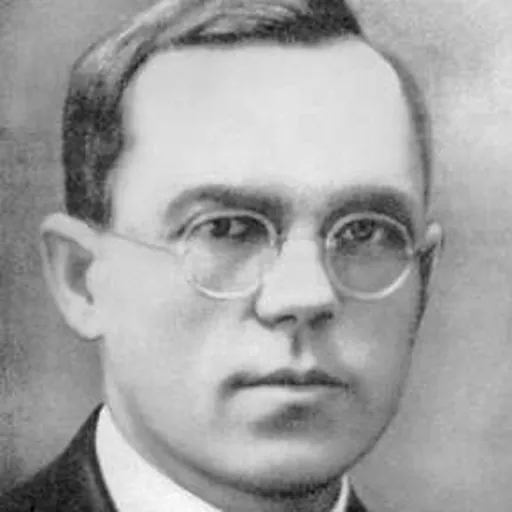
About Nikolai Kondratiev
Lived 1892 – 1938 (aged 46). Nikolai Kondratiev was a Russian economist and politician.
Nikolai Dmitriyevich Kondratiev (; also Kondratieff; Russian: Никола́й Дми́триевич Кондра́тьев; 4 March 1892 – 17 September 1938) was a Russian Soviet economist and proponent of the New Economic Policy (NEP) best known for the business cycle theory known as Kondratiev waves. Despite being a Soviet citizen, he was not a Marxian economist.
Kondratiev became an early leading figure of Soviet economics and promoted the NEP's system of small private free market enterprises in the Soviet Union. Kondratiev's theory that Western capitalist economies have long term (50-to-60-year) cycles of boom followed by depression gained recognition inside and outside the Soviet Union.
Kondratiev was condemned and imprisoned in 1930, but continued to work until his execution during the Great Purge in 1938. Some of his work was published, for the first time, posthumously.
Life Early life and education Nikolai Dimitrievich Kondratiev was born on 4 March 1892 in the Galuevskaya, a village near Vichuga, Kostroma Governorate, into a peasant family of Komi heritage. Kondratiev was tutored at the University of St. Petersburg before the 1917 Russian Revolution by Mikhail Tugan-Baranovsky and Alexander Sergeyevich Lappo-Danilevsky. A member of the Socialist-Revolutionary Party,
After the revolution, Kondratiev pursued academic research. In 1919, he was appointed to a teaching post at the Agricultural Academy of Peter the Great. In October 1920 he founded the Institute of Conjuncture, in Moscow. As its first director, he developed it into a large and respected institution with 51 researchers by 1923.
In 1922, he published his first writing on long cycles,
In 1923, Kondratiev intervened in the debate about the "Scissors Crisis", following the general opinion of his colleagues. In 1923–25, he worked on a five-year plan for the development of Soviet agriculture. In 1924, after publishing his first book, presenting the first tentative version of his theory of major cycles, Kondratiev traveled to England, Germany, Canada and the United States, and visited several universities before returning to Russia..
In his 1924 paper "On the Notion of Economic Statics, Dynamics and Fluctuations", Kondratiev formulated, for the first time, his theory of long business cycles. Specifically, he made the following conclusions: 1. Prosperity years were most common in the capitalist economies during upswing periods. 2. Agriculture suffered more and long depressions than did industry during price downswings 3. Major technological innovations were conceived in downswing periods but were developed in upswing periods 4. Gold supply increased, and new markets were opened at the beginning of an upswing 5. The most extensive and devastating wars occurred during periods of an upswing (Mager, 1987, p. 27)
In 1925 he published his book The Major Economic Cycles, which quickly was translated into German. A short form was published in 1935 in the Review of Economic Statistics and for a time his ideas became popular in the West, until eclipsed by those of John Maynard Keynes.
Major works 1922 – The Grain Market 1922 – The World Economy and its Conjunctures During and After the War 1923 – "Some Controversial Questions Concerning the World Economy and Crisis (Answer to Our Critiques)" 1924 – "On the Notion of Economic Statics, Dynamics and Fluctuations" 1925 – The Major Economic Cycles English version 1926a – "About the Question of the Major Cycles of the Conjuncture" 1926b – "Problems of Forecasting" 1926c – "Die langen Wellen der Konjunktur" (translated into English as "The Long Waves in Economic Life" in 1935/1979) 1928a – The Major Cycles of the Conjuncture 1928b – "Dynamics of Industrial and Agricultural Prices (Contribution to the Theory of Relative Dynamics and Conjuncture)" 1934 – "Main Problems of Economic Statics and Dynamics"
Don’t just read it —
keep it.
Full-length biographies made to live with: read them, listen on the way to work, watch them tonight.
- E-book
- Audio
- Video
Instant download · yours to keep · every purchase keeps this site free
Important facts
People in Nikolai Kondratiev's life
Named in this biography and alive at the same time



Related people
Same field, nearest in time



Contemporaries
People whose lives overlapped Nikolai Kondratiev's

Frequently asked questions
Who was Nikolai Kondratiev?
Soviet economist (1892-1938)
When was Nikolai Kondratiev born?
Nikolai Kondratiev was born on 4 March 1892 in Galuevskaya.
When did Nikolai Kondratiev die?
Nikolai Kondratiev died on 17 September 1938 in Kommunarka shooting ground.
What was Nikolai Kondratiev's occupation?
Nikolai Kondratiev was an economist and politician.
What nationality was Nikolai Kondratiev?
Nikolai Kondratiev was Russian.
Sources & further reading
· Wikipedia: Nikolai Kondratiev
Cite this page
APA: Biography.guide. (2026). Nikolai Kondratiev. https://biography.guide/nikolai-kondratiev/
MLA: "Nikolai Kondratiev." Biography.guide, https://biography.guide/nikolai-kondratiev/.
Chicago: "Nikolai Kondratiev." Biography.guide. https://biography.guide/nikolai-kondratiev/.
Data last updated: 2026-09-23 · Spot an error? Report a correction.
Portrait: Wikimedia Commons · author & licence
Page generated 2026-09-27 05:07 UTC