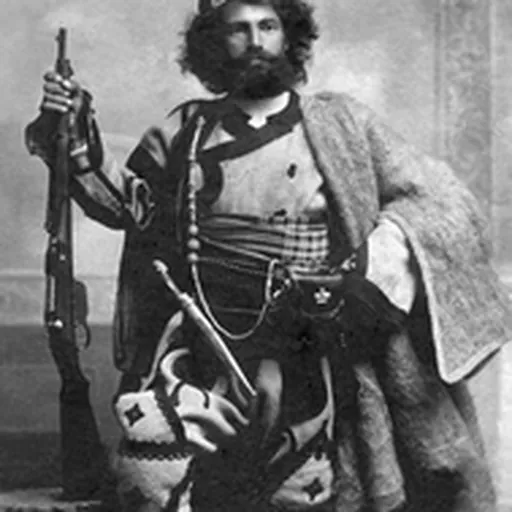
About Nikola Koev
Lived 1880 – 1961 (aged 81). Nikola Koev was a Bulgarian military personnel.
Mamin Kolyu was born on 20 March 1880 in Haskovo (then part of Eastern Rumelia) as revolutionary Tane Nikolov's older brother's son. After finishing primary school, he enlisted in the 10th Rhodopean Infantry Regiment of the Bulgarian Army and served from January 1901 to November 1902. He joined the ranks of IMARO as a soldier and after his discharge went for Sofia to become a member of a detachment (cheta) and fight in Macedonia. In 1903, he entered Macedonia under the command of Ivan Naumov Alyabaka.
During the Ilinden–Preobrazhenie Uprising of 1903, he set the Ottoman gendarmerie's barracks in Kruševo on fire together with Kosta Hristov Popeto. As the uprising was crushed, he returned to Bulgaria. In 1904, he assaulted the Turkish consul's carriage in Sofia together with Alyabaka, injuring the consul's bodyguard and forcing the Bulgarian government to sentence them. Six months later, they were quietly released without amnesty and told to stay out of the government's way. Upon his release he immediately headed to Macedonia and served as a revolutionary under Kosta Popeto, Ivan Naumov, Apostol Petkov and Ichko Gyupchev. During the unrest at the time he joined Hristo Chernopeev's band to dethrone and capture Sultan Abdul Hamid II from Istanbul and take him to Thessaloniki.
From 1912 on, Mamin Kolyu was an under-voivode and flag bearer in his uncle Tane Nikolov's band and took part in the Balkan Wars, becoming an independent voivode. In the winter of 1912 and the spring of 1913, he participated in the Bulgarian Exarchate's christianization mission in the Rhodopes. After the liberation of Western Thrace (which was ceded to Bulgaria per the Treaty of Bucharest), Mamin Kolyu married in a village near Gyumyurdzhina (today Komotini, Greece). From 1914 to 1919 he lived in Bulgarian Ksanti (today Xanthi, Greece) and Komotini and was a policeman for some time. In 1920–1924, when the region was already part of Greece, he collaborated with the Internal Thracian Revolutionary Organisation in Haskovo and Western Thrace.
In 1924, Mamin Kolyu withdrew from his revolutionary activities and worked as a miller in Asenovgrad with Tane Nikolov until 1945. From 1949 until his death on 30 July 1961, he lived in Haskovo. A vivid personality, Mamin Kolyu became a favourite of the population of Macedonia and Thrace: folk songs about him have been sung from Gora in Kosovo to the west (song from Gora) to Dobruja on the Black Sea to the east (song from Dobruja).
Don’t just read it —
keep it.
Full-length biographies made to live with: read them, listen on the way to work, watch them tonight.
- E-book
- Audio
- Video
Instant download · yours to keep · every purchase keeps this site free
Important facts
People in Nikola Koev's life
Named in this biography and alive at the same time



Related people
Same field, nearest in time





Contemporaries
People whose lives overlapped Nikola Koev's




Frequently asked questions
Who was Nikola Koev?
Bulgarian revolutionary
When was Nikola Koev born?
Nikola Koev was born on 20 March 1880 in Haskovo.
When did Nikola Koev die?
Nikola Koev died on 30 July 1961 in Haskovo.
What was Nikola Koev's occupation?
Nikola Koev was a military personnel.
What nationality was Nikola Koev?
Nikola Koev was Bulgarian.
Sources & further reading
Cite this page
APA: Biography.guide. (2026). Nikola Koev. https://biography.guide/nikola-koev/
MLA: "Nikola Koev." Biography.guide, https://biography.guide/nikola-koev/.
Chicago: "Nikola Koev." Biography.guide. https://biography.guide/nikola-koev/.
Data last updated: 2026-09-20 · Spot an error? Report a correction.
Portrait: Wikimedia Commons · author & licence
Page generated 2026-09-27 04:58 UTC