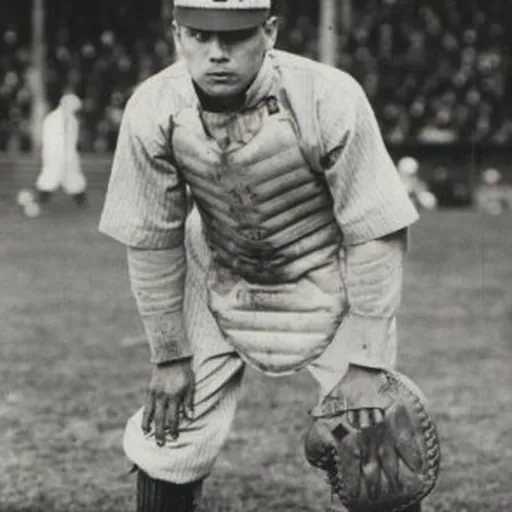
About Nig Clarke
Lived 1882 – 1949 (aged 66). Nig Clarke was an American baseball player.
Jay Justin "Nig" Clarke (December 15, 1882 – June 15, 1949) was a Canadian professional baseball player. A catcher, Clarke played in Major League Baseball (MLB) for nine seasons with the Detroit Tigers, Cleveland Naps, St. Louis Browns, Philadelphia Phillies, and Pittsburgh Pirates. In 506 career games, Clarke recorded a batting average of .254 and accumulated 20 triples, six home runs, and 127 runs batted in (RBI).
Born in Canada and raised in Michigan, Clarke began his baseball career in 1902, when he reportedly hit eight home runs in one game while playing for the Corsicana Oil Citys of the Texas League. From there, he spent two more seasons in the minor leagues before the Cleveland Naps signed him to a contract. Aside from a loan to the Detroit Tigers, he played for the Naps for six seasons. Clarke was then traded to the St. Louis Browns, where he played for one season. After several years in the minor leagues, Clarke joined the United States Marine Corps. He returned to the major leagues and played there until 1920, then continued playing for minor league teams until 1927. Clarke then retired from the game, rejoined the Marines, and moved to River Rouge, Michigan, where he lived until his death in 1949.
Early life Clarke was born in 1882 at Anderdon Township (now Amherstburg, Ontario), Canada. He was a member of the Wyandot of Anderdon First Nation. He moved to Detroit, Michigan as a child in April 1888. Early in his career, he was given the nickname of "Nig" by newspapers due to his dark complexion.
Professional baseball
Early career Clarke began his professional career in 1902 with the Corsicana Oil Citys in the Texas League. On June 15, he hit eight home runs in ten at bats in a 51–3 victory over the Texarkana Casketmakers. Because Corsicana's blue laws forbade Sunday baseball (or, according to The Sporting News, due to poor attendance in Corsicana), the game was played in Ennis, Texas, in a facility that has a right field fence estimated to be 210 feet from home plate along the foul line. While some cast doubt on Clarke's eight home run game, the feat was later attested to by the official scorer (under oath) and by others who observed the game.
In 1903, Clarke played for the Little Rock Travelers in the Southern Association, and had a batting average of .254 in 41 games. With Atlanta, Clarke started off the first half of the season with a .400 batting average before cooling down in the second half. The plan was for Clarke to be the third catcher on the roster behind Harry Bemis and Fritz Buelow, and as a result, he only played in a few games during the first half of the season. In August 1905, Clarke briefly joined the Detroit Tigers after the Cleveland team traveled to Boston without him. He was loaned to Detroit with the understanding that the Naps could reclaim him on one day's notice. Clarke appeared in only three games for Detroit, compiling a .429 batting average and a home run before being recalled by the Naps. In 45 games between both teams on the season, he had a .208 batting average. To end the year, Clarke compiled a career high batting average of .358, tying him with George Stone for the American League batting championship. However, Stone was recognized as the batting champion because Clarke had only appeared in only 57 games with 195 plate appearances.
After spending the offseason playing winter baseball in Florida with several other major leaguers, Clarke became the everyday catcher for the 1907 season. He started off hitting well, and had a batting average of .381 through the first month of the league, which was second in the American League. He started nearly every game for the Naps until his finger was hit by a foul ball in a game in June, causing him to miss two weeks. By the end of the season, he had stopped playing well, finishing the season with a .269 batting average and six triples in 120 games, as well as a league-leading 25 passed balls.
Clarke spent the 1908 season splitting time at the catcher position with Bemis, as both struggled in spring practice. In September, Clarke sustained an injury in a game against Detroit when the bone of a finger on his right hand was split and he was unable to grow a nail. He finished the year with a .241 batting average and six triples in 97 games. His wife did not like the "Nig" nickname that sports reporters used, and wanted them to simply call him Jay in newspapers.
The signing of Ted Easterly and Grover Land gave the Naps four catchers entering spring training. Easterly became the starting catcher and Bemis the backup due to Clarke's "lack of ambition", which led to speculation that he could be traded during the season. He finished the season with a .274 batting average in 55 games. Clarke saw little playing time in 1910 due to a bout of typhoid fever, which landed him in the hospital for most of the season. He played 21 games that season, batting .155. Clarke split time with Jim Stephens at catcher for the Browns, and appeared in 82 games for the team in 1911, compiling a .215 batting average. Shortly afterwards, he was sold to the Indianapolis Indians in the American Association, where he played from 1912 to 1913. In 1912, he hit .266 in 92 games, and the following year he hit .282 in 28 games.
Partway through the 1913 season, Clarke was sold to the San Francisco Seals of the Pacific Coast League, where he played from 1913 to 1915. With San Francisco, he hit .281 and .222 in 1913 and 1914, respectively. That season, he batted .149 in 20 games before being released. In 1918, while serving in the Marine Corps, Clarke filed a military naturalization petition and became a United States citizen; a year later he was discharged.
In 1919, he returned mid-season to the major leagues with the Philadelphia Phillies. He appeared in 26 games, compiling a .242 batting average. He led the National League with a 58.8% caught stealing percentage. In November 1919, Clarke was selected off waivers by the Pittsburgh Pirates from the Phillies. He appeared in three games for the Pirates and had no hits in seven at bats. He appeared in his final major league game on April 24, 1920. In 1925, he played for the Salisbury Indians in the Eastern Shore League. Clarke concluded his professional baseball career in 1927 with Tulsa. In June 1929, Clarke rejoined the Marine Corps, serving until August 1932 still in rank of Corporal.
After being discharged from the Marine Corps, Clarke built a house in River Rouge, a suburb of Detroit, where he lived with his wife and mother. In June 1949, Clarke was found dead at his home in River Rouge.
He was named to the Canadian Baseball Hall of Fame, in St. Marys, Ontario, in the Class of 1996.
Don’t just read it —
keep it.
Full-length biographies made to live with: read them, listen on the way to work, watch them tonight.
- E-book
- Audio
- Video
Instant download · yours to keep · every purchase keeps this site free
Important facts
People in Nig Clarke's life
Named in this biography and alive at the same time




Related people
Same field, nearest in time


Contemporaries
People whose lives overlapped Nig Clarke's



Frequently asked questions
Who was Nig Clarke?
Canadian baseball player (1882-1949)
When was Nig Clarke born?
Nig Clarke was born on 15 December 1882 in Amherstburg.
When did Nig Clarke die?
Nig Clarke died on 15 June 1949 in River Rouge.
What was Nig Clarke's occupation?
Nig Clarke was a baseball player.
What nationality was Nig Clarke?
Nig Clarke was American.
Sources & further reading
Cite this page
APA: Biography.guide. (2026). Nig Clarke. https://biography.guide/nig-clarke/
MLA: "Nig Clarke." Biography.guide, https://biography.guide/nig-clarke/.
Chicago: "Nig Clarke." Biography.guide. https://biography.guide/nig-clarke/.
Data last updated: 2026-09-21 · Spot an error? Report a correction.
Portrait: Wikimedia Commons · author & licence
Page generated 2026-09-27 05:00 UTC