
About Nicolaes van Verendael
Lived 1640 – 1691 (aged 51). Nicolaes van Verendael was a painter.
Nicolaes van Verendael or Nicolaes van Veerendael (1640 in Antwerp – 1691 in Antwerp) was a Flemish painter active in Antwerp who is mainly known for his flower paintings and vanitas still lifes. He was a frequent collaborator of other Antwerp artists to whose compositions he added the still life elements. He also painted a number of singeries, i.e., scenes with monkeys dressed and acting as humans.
Life Nicolaes van Verendael was baptized in the St. Andrew's Church in Antwerp on 19 February 1640. He trained with his father Willem van Veerendael. He was not formally registered as a pupil at the Antwerp Guild of Saint Luke but was admitted to the Guild as the son of a member in 1657. The couple has 11 children, one of whom was born after the death of the artist. Despite his high reputation among fellow artists, van Verendael was never out of financial trouble as he was a slow worker. As a result, he lived modestly. He was highly regarded from an early age. He was in demand as a collaborator working with some of the leading Antwerp painters such as David Teniers the Younger, Gonzales Coques, Erasmus Quellinus II, Jan Boeckhorst, Carstian Luyckx and Jan Davidsz. de Heem.
Flower paintings His early work shows the influence of the leading Antwerp flower still life painter Daniel Seghers but he used more and stronger and more contrasting colours. His early flower paintings depicted small, bright, graceful bouquets in tall, narrow vases or cartouches and garlands surrounding a religious figure or scene.
An example of a work by van Verendael in this genre is the Garland surrounding the Virgin Mary (Prado, Madrid) a collaboration with an unknown collaborator. The central motif is a sculpture rather than a painting of the Madonna as was more common. The garland of flowers is represented in groups, rather than in a circle, and is thus representative of the later evolution of this genre. The subject of the exaltation of the figure of Mary was a response to Protestant beliefs and is reinforced by the inscription 'ego flos campi' ('I am the flower of the field') at the foot of the bust.
Later he was influenced by Jan Davidsz. de Heem. Van Veerendael developed towards a brisker brushstroke in his later years and he found a personal style that was a forerunner of Flemish flower painting in the 18th century. Some of his still lifes include insects.
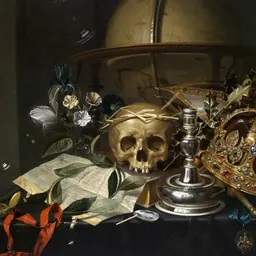
These vanitas paintings were informed by a Christian understanding of the world as a temporary place of ephemeral pleasures and torments from which humanity's only hope of escape had been offered by the sacrifice and resurrection of Christ. While most of these symbols reference earthly accomplishments (books, scientific instruments, etc.), pleasures (a pipe), sorrows (symbolised by a peeled lemon), the transience of life and death (skulls, soap bubbles, empty shells) and the role of chance in life (dice and playing cards), some symbols used in these paintings carry a dual meaning: a rose or an oar of grain refers as much to the brevity of life as it is a symbol of the resurrection of Christ and thus eternal life.
An example of a vanitas still life by Veerendael is the Vanitas with skulls (Musée des Beaux-Arts de Caen). The painting shows similarities with another vanitas work called Vanitas still life with a bunch of flowers, a candle, smoking implements and a skull in the Galleria Franchetti at the Ca' d'Oro, Venice dated 1679. The vanitas elements in the latter work have been attributed to the Antwerp painter Hendrick Andriessen. Both paintings contain the token vanitas symbols such as the candle stick, pipe and pipe cleaner, wilted flowers, crumpled up books. The skull too may be one and the same. In the Venice painting vanitas symbols such as the drop of water and the soap bubble are included.
Singeries
Nicolaes van Verendael contributed to the spread of the genre of the 'monkey scene', also called 'singerie' (a word, which in French means a 'comical grimace, behaviour or trick'). Comical scenes with monkeys appearing in human attire and a human environment are a pictorial genre that was initiated in Flemish painting in the 16th century and was subsequently further developed in the 17th century. The Flemish engraver Pieter van der Borcht introduced the singerie as an independent theme around 1575 in a series of prints, which are strongly embedded in the artistic tradition of Pieter Bruegel the Elder. These prints were widely disseminated and the theme was then picked up by other Flemish artists in particular by those in Antwerp such as Frans Francken the Younger, Jan Brueghel the Elder and the Younger, Sebastiaen Vrancx and Jan van Kessel the Elder. David Teniers the Younger became the principal practitioner of the genre and developed it further with his younger brother Abraham Teniers.
Later in the 17th century Nicolaes van Verendael started to paint these ‘monkey scenes’ as well. As he had collaborated with David Teniers the Younger in Antwerp, he was familiar with Teniers' work in this genre. An example is the Monkey feast which reprises the theme of 'The King drinks (the Bean King)' with the human roles played by monkeys. Another example is the Merry Company or Singerie (Royal Museums of Fine Arts of Belgium, which depicts monkeys reveling in an inn. A considerable number of paintings and additional drawings of singeries by Veerendael has been identified on the art market and in private collections.
Don’t just read it —
keep it.
Full-length biographies made to live with: read them, listen on the way to work, watch them tonight.
- E-book
- Audio
- Video
Instant download · yours to keep · every purchase keeps this site free
Important facts
more
Nicolas van Verandale, Nicolas van Virandel, Nicolas van Veerendal, Nicolaes Van Verendael, Nicolaas van Verendael, Nicolaas Verendael, Nicolas van Verandael, Nicolas van Varendael, Nicolas van Verendal, Nicolas van Verundael, Nicolas van Verendael, N. Veerendaal, Van Verendael, Veerendel, N. Veerendael, Verundal, VPeople in Nicolaes van Verendael's life
Named in this biography and alive at the same time


Related people
Same field, nearest in time


Contemporaries
People whose lives overlapped Nicolaes van Verendael's




Frequently asked questions
Who was Nicolaes van Verendael?
Flemish painter (1640-1691)
When was Nicolaes van Verendael born?
Nicolaes van Verendael was born on 19 February 1640 in Antwerp.
When did Nicolaes van Verendael die?
Nicolaes van Verendael died on 11 August 1691 in Antwerp.
What was Nicolaes van Verendael's occupation?
Nicolaes van Verendael was a painter.
What nationality was Nicolaes van Verendael?
Nicolaes van Verendael's recorded nationality: Habsburg Netherlands.
Sources & further reading
· Wikipedia: Nicolaes van Verendael
· DBpedia: Nicolaes van Verendael
Cite this page
APA: Biography.guide. (2026). Nicolaes van Verendael. https://biography.guide/nicolaes-van-verendael/
MLA: "Nicolaes van Verendael." Biography.guide, https://biography.guide/nicolaes-van-verendael/.
Chicago: "Nicolaes van Verendael." Biography.guide. https://biography.guide/nicolaes-van-verendael/.
Data last updated: 2026-09-20 · Spot an error? Report a correction.
Page generated 2026-09-27 05:16 UTC